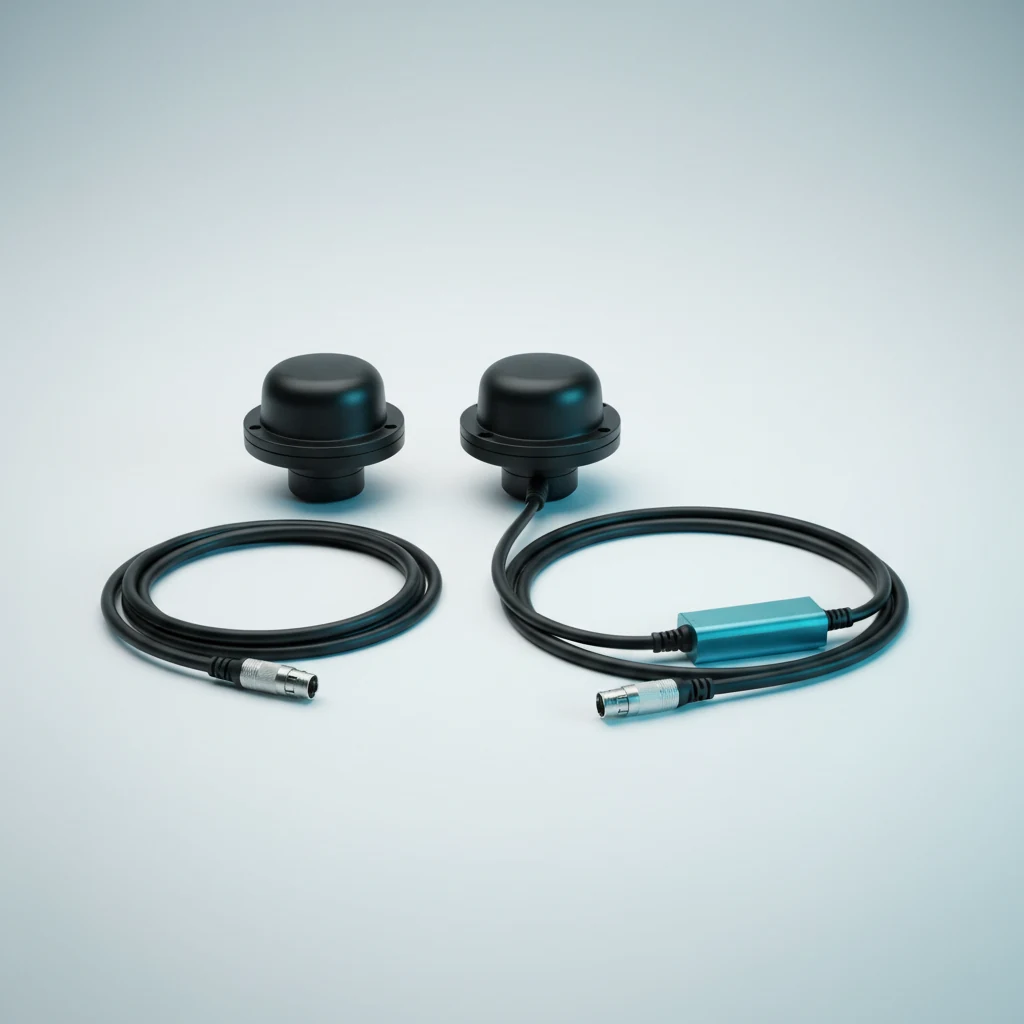
If you are deciding between an active and passive GPS antenna, the choice is not about quality — both can be excellent. It is about where the antenna sits relative to the receiver. An active GPS antenna has a built-in low-noise amplifier (LNA) and needs DC power up the coax; a passive antenna has no amplifier and relies on a short, low-loss path to the receiver. Pick wrong and you either lose signal in the cable or pay for an amplifier you didn’t need. Here is the rule engineers actually use.

The one rule
Choose by RF path length and where the antenna mounts:
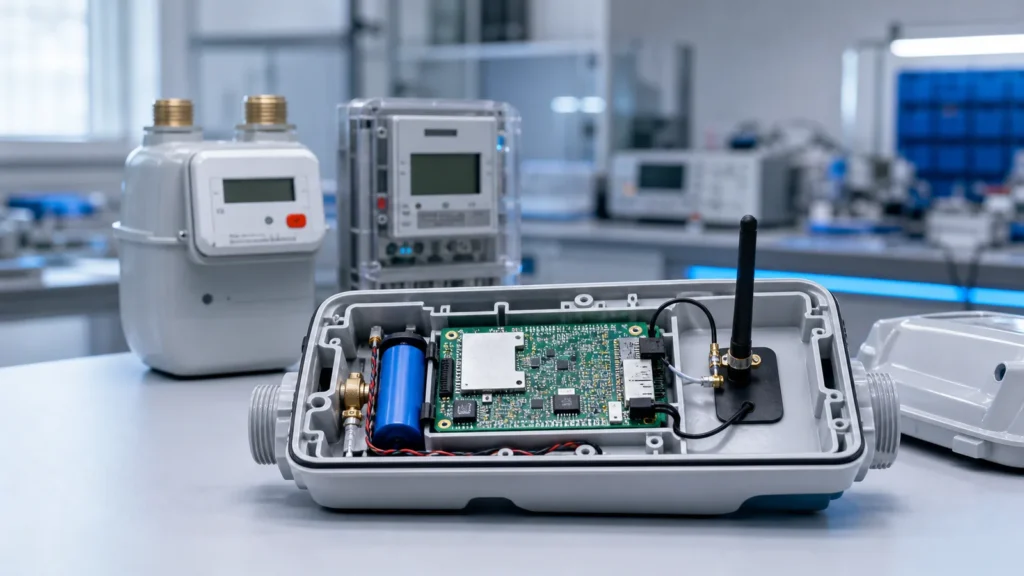
- Passive when the antenna is on or very near the receiver board — for example a ceramic patch on the same PCB as the GNSS module, with a few centimeters of trace.
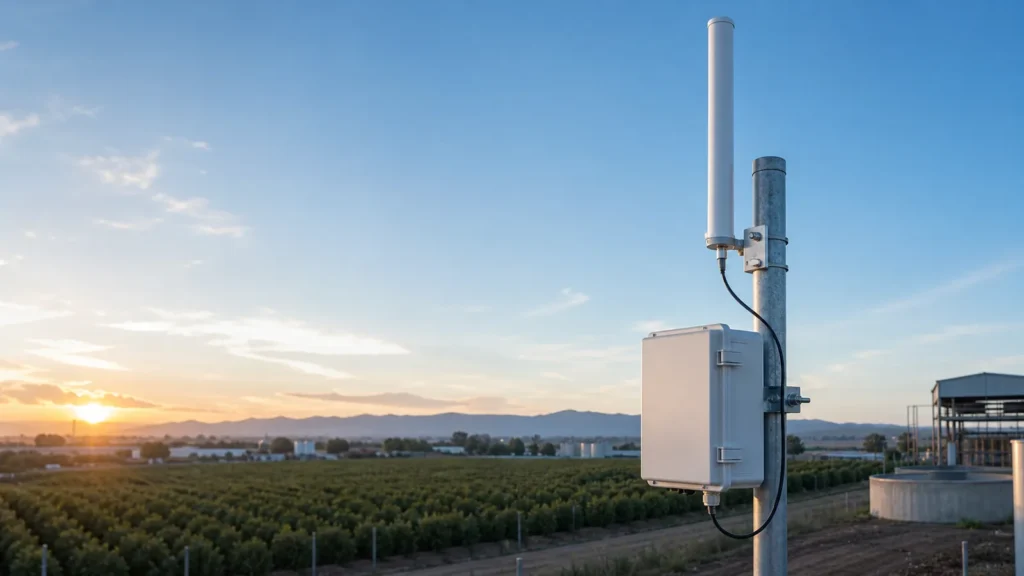
- Active when the antenna is external or the cable run is long enough that line loss eats the signal — roof mounts, vehicle magnetic mounts, enclosure-external antennas, or anything more than roughly 30 cm (about a foot) of coax.
Everything else — gain figures, brand, ceramic size — is secondary to this. If the signal is lost in the cable before it reaches the receiver, no amount of antenna gain fixes it.
What “active” actually adds
An active antenna puts an LNA right behind the radiating element. That matters because GNSS signals arrive extremely weak, below the noise floor. Amplifying at the antenna — before the cable — sets a good noise figure for the whole chain. Amplifying later, after a lossy cable, cannot recover what the cable already destroyed.
Two things come with that LNA:
- It needs DC bias. The receiver (or a bias-T) feeds typically 2.7–5 V up the same coax that carries the signal. If your receiver does not supply antenna bias, an active antenna will not work without an external injector.
- It has a gain budget. Typical LNA gain is in the 20–30 dB range. More is not always better — too much gain after a short cable can overload the receiver’s front end. Match the LNA gain to your cable loss, not to the biggest number on the page.
A passive antenna has none of this. It is simpler, draws no power, and cannot be overdriven — which is exactly why it is the right choice on-board.

Decision table
| Situation | Choose | Why |
|---|---|---|
| Patch on the same PCB as the GNSS module | Passive | Path loss is tiny; the module’s own front end handles it |
| Short pigtail (< ~30 cm) to a sensitive receiver | Passive (often) | Cable loss is small; check receiver sensitivity |
| External antenna, roof/vehicle mount | Active | Long coax + distance demand amplification at the antenna |
| Long cable run (1 m+) of thin coax | Active | Line loss at ~1.5 GHz is significant; LNA recovers it |
| Receiver provides no antenna bias | Passive, or add a bias-T | Active needs DC up the coax |
| Receiver already has a strong internal LNA, antenna close | Passive | Adding another LNA can saturate the front end |

The cable-loss reality that decides most cases
At the GPS L1 frequency (1575.42 MHz), thin coax loses signal fast. Common small cable like RG174 can lose on the order of ~1 dB per foot at this frequency; better cable loses less, but the trend holds: the longer and thinner the cable, the more a passive antenna’s signal degrades before it ever reaches the receiver.
That is the whole argument for active antennas in external installs. The LNA establishes a low noise figure at the antenna, so the cable that follows costs you less. Put the amplifier first, then run the cable — not the other way around.
A practical sanity check: estimate your cable loss (length × loss-per-foot at 1.5 GHz). If it is more than a couple of dB, plan for an active antenna and size the LNA gain to roughly offset the loss plus a margin.
GNSS integration
Need help choosing a GNSS or patch antenna?
Tell us your device size, ground plane, constellation, cable and mounting requirements. We can help match active, passive or embedded GNSS antenna options.
Common mistakes
- Passive antenna on a long external cable. The most frequent field failure — slow fixes or no lock. Switch to active.
- Active antenna with no bias supply. It looks dead because the LNA never powers up. Confirm the receiver feeds antenna voltage, or add a bias-T.
- Stacking gain. An external high-gain active antenna on a short cable into a receiver that already has a strong LNA can overload the front end. Match gain to loss.
- Choosing by gain number alone. “28 dB” is meaningless without knowing your cable loss and receiver. Size it to the path.
How our GPS/GNSS line splits
For board-level designs, our passive GPS/RHCP ceramic patch antennas (GL-DYS25 series) are made to sit on the PCB with an adequate ground plane, and several are also offered as active assemblies with an integrated LNA, cable, and connector when the antenna has to move off-board. For external and vehicle installs, the active GL-DY226 is built for longer runs. Each datasheet lists LNA gain and bias voltage — match those to your cable loss rather than to the highest figure. Browse the full GPS & GNSS range or send your cable length and receiver model to our engineering team for a quick call on active vs passive.
FAQ
When do I need an active GPS antenna?
When the antenna is external or the cable run is long enough that line loss degrades the signal — typically more than about 30 cm of coax, and especially for roof or vehicle mounts. The LNA amplifies before the cable, preserving the signal.
Does a passive GPS antenna need power?
No. A passive antenna has no amplifier and draws no DC. Only active antennas need bias voltage (usually 2.7–5 V) fed up the coax from the receiver or a bias-T.
Can I use an active antenna on a short cable?
You can, but watch the gain. Too much LNA gain into a receiver that already has a strong front end can cause overload. On a short path, a passive antenna or a modest-gain active part is usually cleaner.
What LNA gain should an active GPS antenna have?
Enough to offset your cable loss plus a small margin, not the maximum available. Estimate cable loss at 1.5 GHz, then choose LNA gain in that range. Oversized gain risks saturating the receiver.
Is active or passive better for accuracy?
Neither improves the fundamental fix accuracy by itself. The right choice keeps the signal strong enough for the receiver to track satellites reliably; the wrong choice (passive on a long cable) is what actually hurts performance.
Conclusion
Active vs passive GPS antenna selection is one decision: is the antenna close to the receiver, or far from it? Close and on-board → passive. External or long cable → active, with the LNA gain sized to your cable loss and a receiver that can bias it. Get that right and the rest of the spec sheet falls into place. For help matching a part to a specific cable run, contact our engineering team.
Ready to specify a product?
Get product suggestions and quotation details for your application.
Tell us your device size, ground plane, constellation, cable and mounting requirements. We can help match active, passive or embedded GNSS antenna options.
Ask our AI antenna assistant. Enter a keyword or question for a free answer based on this article, Global RF Tech content, and general antenna/RF knowledge.
Do not submit confidential or personal information. Privacy Policy