
A lot of buyers treat antenna gain as a quality score: the bigger the dBi number, the better the antenna. It is an easy assumption to make, and it is wrong often enough to be expensive. Gain does not describe how good an antenna is. It describes how narrowly it concentrates energy — and that concentration has to be paid for somewhere.
This guide walks through what you actually give up when you go higher, how to put numbers on it before you buy, and the two limits almost nobody mentions: the regulatory ceiling on gain, and the mechanical chain reaction it sets off. If you want the underlying definition first, see our primer on antenna gain.
Quick answer
- Gain is redistribution, not amplification. Total radiated power stays roughly the same; the antenna just decides where it goes.
- More gain always means a narrower beam. Estimate it: for a symmetrical main lobe,
θ_3dB ≈ √(41253 / G), so 15 dBi is about 36° wide and 30 dBi is about 6°. - Misalignment has a price you can calculate:
loss ≈ 12 × (θ_off / θ_3dB)²dB. On a 30 dBi antenna, being 5° off costs about 7 dB. - In several unlicensed bands, extra gain is legally offset by a power reduction. For non point-to-point use in 2.4 GHz, the net EIRP benefit is zero.
- Doubling antenna diameter adds roughly 6 dB, quadruples wind load and halves your alignment tolerance — all at once.
- Choose gain last: fix the frequency, the mounting stability and the coverage angle you need, then take the highest gain that still fits.
What antenna gain really measures
Antenna gain measures how well an antenna concentrates radio energy in a particular direction, expressed in dBi (decibels relative to a theoretical isotropic radiator that radiates equally in every direction).
The light analogy is the clearest one. A bare bulb behaves like a low-gain omnidirectional antenna: light goes everywhere, every direction is equally lit, and nothing is lit brightly.

A flashlight behaves like a high-gain antenna. Add a reflector and the same bulb, at the same wattage, throws a bright beam a long way in one direction — while everywhere else goes dark.

Nothing was amplified. The energy was moved. Wikipedia’s treatment of directional antennas states the accounting plainly: if an antenna makes a 1 W transmitter look like a 100 W transmitter, the beam can cover at most one hundredth of the sky, because the total radiated energy cannot exceed what the transmitter supplied (Wikipedia).
So “high gain” is not a performance grade. It is a statement about shape.
What you give up when gain goes up
Beamwidth — and you can estimate it from the datasheet
Beamwidth is the angular width of the useful beam, normally quoted at the half-power (−3 dB) points. Gain and beamwidth are two views of the same thing, and you can convert between them with the classic Kraus approximation:
Directivity ≈ 41253 / (θ_azimuth × θ_elevation), with both angles in degrees.
For a roughly symmetrical beam that simplifies to θ_3dB ≈ √(41253 / G), where G is gain expressed as a plain ratio rather than in dB. Kraus was explicit about the accuracy: results are good to “a decibel or two,” not to a tenth of a dB (University of Kiel).
| Gain | Approx. symmetrical beamwidth | What that feels like on site |
|---|---|---|
| 9 dBi | ≈ 72° | Forgiving; aim by hand |
| 15 dBi | ≈ 36° | Aim by eye, check signal once |
| 18 dBi | ≈ 26° | Needs a solid bracket |
| 24 dBi | ≈ 13° | Align against a live signal reading |
| 30 dBi | ≈ 6° | Precision mount, re-check seasonally |

Real antennas have sidelobes and asymmetric patterns, so treat these as design estimates rather than specifications.
Vertical coverage
The angle you lose is usually the vertical one, and that is the angle that matters when devices are above or below the antenna. A high-gain omnidirectional antenna flattens its pattern into a horizontal disc: farther in every compass direction, but noticeably worse at covering the floor above, the basement below, or a device on a hill. Teams often install a higher-gain omni to “improve coverage” and lose the very users they were trying to reach.
Physical size and weight
Higher gain requires a larger aperture, and there is no way around it: because of the diffraction limit, a narrower beam demands a physically larger antenna measured in wavelengths (Wikipedia). Larger means heavier, more wind-exposed, and harder to mount — quantified further below.
Bandwidth
Many high-gain designs get their performance from resonant structures whose dimensions are matched to a specific wavelength. Once the part is manufactured those dimensions are fixed, so performance falls away as you move off the design frequency. The practical consequence: a high-gain antenna tends to be a narrow-band antenna, and a wideband antenna quoting an impressive peak gain rarely delivers it across the whole range.
How much does a pointing error actually cost?
Every guide says a high-gain antenna “must be aimed precisely.” Here is how to turn that into a number before you commit to a product.
Within the main lobe, off-axis loss follows a Gaussian approximation closely enough for planning:
loss (dB) ≈ 12 × (θ_off / θ_3dB)²
The formula returns 3 dB at half the beamwidth, which is exactly what the half-power definition requires. Combine it with the beamwidth estimate above and the trade-off becomes concrete:
| Pointing error | 15 dBi (≈36° beam) | 24 dBi (≈13° beam) | 30 dBi (≈6.4° beam) |
|---|---|---|---|
| 1° | ≈ 0.01 dB | ≈ 0.07 dB | ≈ 0.3 dB |
| 3° | ≈ 0.08 dB | ≈ 0.7 dB | ≈ 2.6 dB |
| 5° | ≈ 0.2 dB | ≈ 1.8 dB | ≈ 7.3 dB |
| 10° | ≈ 0.9 dB | ≈ 7.3 dB | Outside the main lobe |
Read the last two columns together and the design question changes shape. Moving from 15 dBi to 30 dBi buys 15 dB on boresight — but a 5° installation error gives 7 dB of it straight back. If your mount, mast or vehicle cannot hold 5°, the higher-gain antenna is not delivering the specification you paid for.

The formula is only valid inside the main lobe. Beyond roughly one beamwidth off-axis, you are in sidelobe territory and need the actual radiation pattern.
The limit almost nobody mentions: gain can be legally cancelled
Gain is not free radiated power. In unlicensed bands, regulators frequently claw back part of it.
Under 47 CFR § 15.247, a system in the 2400–2483.5 MHz band used exclusively for fixed point-to-point operation may use directional gain above 6 dBi only if conducted output power is reduced by 1 dB for every 3 dB the gain exceeds 6 dBi (eCFR).
Work through it with a 1 W (30 dBm) radio:
| Configuration | Antenna gain | Allowed conducted power | Resulting EIRP |
|---|---|---|---|
| Baseline | 6 dBi | 30 dBm | 36 dBm |
| Fixed point-to-point | 24 dBi | 24 dBm | 48 dBm |
So +18 dB of antenna gain produced +12 dB of EIRP. Still worthwhile — but not what the datasheet arithmetic suggests.
Now the case that changes buying decisions. If the deployment is not fixed point-to-point — point-to-multipoint, omnidirectional coverage, or a sector serving many clients — the same rule requires a 1 dB power reduction for every 1 dB above 6 dBi. The transmit EIRP ceiling does not move at all. A 15 dBi sector antenna is legally no louder than a 6 dBi one.
The rules are deliberately uneven, which is why “is higher gain better” has no universal answer:
- 5725–5850 MHz, fixed point-to-point (§ 15.247): gain above 6 dBi is allowed with no power reduction.
- U-NII fixed point-to-point (§ 15.407): up to 23 dBi with no reduction; above that, 1 dB of power for every 1 dB of gain (eCFR Part 15).
- Europe, 2.4 GHz: ETSI EN 300 328 caps the band at 20 dBm EIRP, so every extra dB of gain must come off the radio (ETSI).
Two takeaways. First, confirm which rule your deployment falls under before you compare antennas — the same part can be a clear win or pure cost depending on the topology. Second, when transmit EIRP is capped, the value of gain shifts entirely to the receive side and to interference rejection, which is the subject of the next section.
Always verify the current text of the applicable regulation for your market and band; the figures above are the framework, not a compliance sign-off.
The part that gets undersold: what a narrow beam refuses to hear
Gain is usually discussed as a transmit story. On a congested site, the receive story matters more.
Link quality depends on signal-to-noise ratio, not raw signal strength. A directional antenna lifts the wanted signal by its boresight gain and simultaneously rejects what arrives from other directions. A well-designed panel or Yagi typically achieves a front-to-back ratio around 20 dB, so an interferer sitting directly behind the antenna arrives about a hundred times weaker in power. If your real problem is a co-channel neighbour rather than distance, swapping a 3 dBi omni for a 15 dBi panel can improve SNR by more than the 12 dB gain difference implies, because the noise floor falls at the same time.
This also explains a common purchasing mistake. An amplified antenna is not the same as a passive high-gain antenna. An in-line amplifier raises the signal and the noise already collected together, and contributes noise of its own. Passive directivity improves the ratio before anything is amplified. A passive high-gain antenna with a short cable will usually beat a low-gain antenna with a booster, and adding an amplifier to a badly aimed antenna achieves nothing.
Higher gain is a mechanical decision
For an aperture antenna at a fixed frequency, gain scales with aperture area while beamwidth scales inversely with size — roughly θ_3dB ≈ 70λ/D for a typical reflector (Via Satellite). Doubling the diameter therefore does three things simultaneously:
- Gain rises by about 6 dB (four times the area).
- Beamwidth halves, so your allowable pointing error halves.
- Projected area quadruples, and wind drag scales with projected area — so the force trying to push the antenna out of alignment rises by roughly the same factor.

Those last two move in opposite directions, and that is the whole problem. The structure takes four times more force at exactly the moment the antenna becomes twice as intolerant of movement. It is why long point-to-point links tend to fail intermittently in wind rather than failing outright, and why the fix is usually a stiffer mount rather than a bigger antenna.
It also reframes cost. At high gain the antenna is rarely the expensive line item; the bracket, the mast reinforcement, the alignment labour and the return site visits are.
Design order that works: establish the mounting envelope and the realistic pointing stability of the site, convert that into a minimum acceptable beamwidth using the table above, and only then select the highest gain that fits. Choosing gain first and hoping the mount copes is the sequence that produces field failures.
PRODUCT OPTIONS
Compare options for your installation
Check the operating band, connector and installation space before selecting a model.
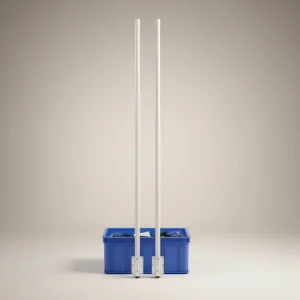
GLF868V10
868 MHz high-gain fiberglass omnidirectional antenna for pole installation.
- Band
- 868 ±10 MHz
- Gain
- 10 dBi
- Connector
- SMA male
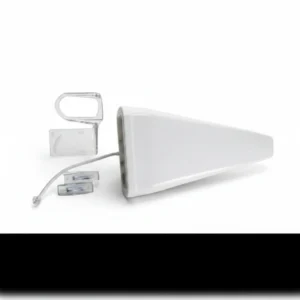
GL-DY7038V11
Directional LPDA antenna with three separate listed operating ranges.
- Bands
- 698–960 / 1710–2700 / 3300–3800 MHz
- Gain
- 11 dBi
- Connector
- N-K (datasheet marking)
When high gain is the right choice
High-gain omnidirectional antennas
A high-gain omni is best pictured as a very bright, very flat ring of light: it trades vertical coverage for reach across the horizontal plane, in all 360°.

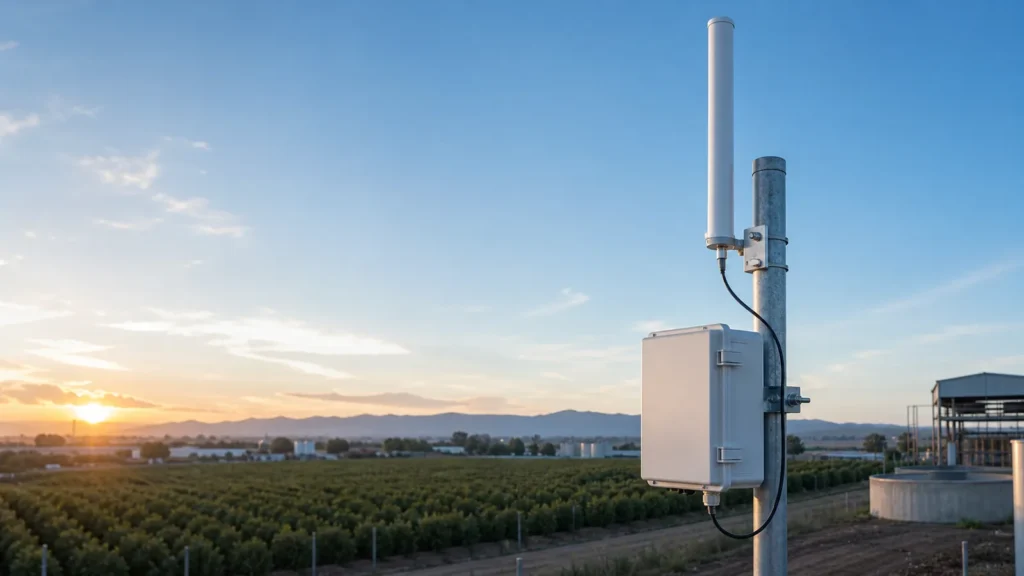
Use it when the antenna sits roughly in the middle of what it serves, when clients can be in any direction, or when the direction of the far end is unpredictable — vehicles, RVs, vessels, mobile machinery. It also suits large single-level spaces: open-plan warehouses, yards, farms, outdoor plazas. The appeal is that no aiming is required.
Avoid it when devices are spread across several floors or significant elevation differences. That is precisely the coverage a high-gain omni gives away. For the broader comparison, see omnidirectional vs directional antennas.
High-gain directional antennas
A high-gain directional antenna concentrates energy into a narrow beam pointed at one place, which buys both range and interference rejection.

It is the standard choice for building-to-building point-to-point bridges, for remote sites reaching a distant base station, and for long narrow spaces such as tunnels, mines, highways and rail corridors. It also performs well where interference is the limiting factor — stadiums, exhibition halls, production lines — because the pattern excludes most of what you do not want.
The conditions are strict: both ends must be fixed, line of sight must be reasonably clear, and the mount must hold the alignment tolerance implied by the beamwidth.
High-gain antenna types compared
| Type | Typical gain | Strengths | Trade-offs | Common applications |
|---|---|---|---|---|
| Yagi | 7–18 dBi | Long reach, good front-to-back ratio, light | Needs aiming; narrow usable band | TV reception, fixed long-range links |
| Parabolic dish | 20–40+ dBi | Highest practical gain for long hops | Very narrow beam; precise alignment; large wind load | Satellite links, wireless bridges |
| Panel | 8–18 dBi | Directional coverage in a flat, easy-to-mount housing | Limited coverage angle | 4G/5G, outdoor Wi-Fi, sectors |
| High-gain omni | 5–15 dBi | 360° horizontal reach, no aiming | Reduced vertical coverage | LoRa, Wi-Fi, IoT gateways |
| Directional Wi-Fi (grid, dish, panel) | 9–24 dBi | Extends fixed wireless links substantially | Fixed direction; unsuitable for mobile use | Wi-Fi bridges, outdoor links |
| Horn | 10–25 dBi | High efficiency with usable bandwidth | Bulky for the gain achieved | Radar, test and measurement |
| Helical | 8–20 dBi | Circular polarization, tolerant of orientation changes | Higher cost, more complex | GNSS, satellite communication |
How to read a gain specification critically
A lot of “antenna A beats antenna B” reasoning rests on a 1–2 dB datasheet difference. That difference is often inside the uncertainty of how gain is defined and measured.
Check the reference. Gain may be quoted against an isotropic radiator (dBi) or a half-wave dipole (dBd). A lossless half-wave dipole already has 2.15 dBi, so dBd ≈ dBi − 2.15 (Wikipedia). “5 dBd” and “7 dBi” describe the same antenna. A figure given only in “dB” is not usable.
Check where the peak is. Gain is a directional maximum at the frequency where it peaks. A wideband antenna covering several cellular bands will not deliver its headline number everywhere, and the low band is usually several dB behind. If your radio operates near a band edge, plan with the band-edge figure.
Allow for measurement uncertainty. Gain is a measurement, not a nameplate constant. NIST’s reference work on accurate gain measurement notes discrepancies on the order of 1 dB for low-loss antennas when gain is inferred indirectly rather than measured directly (NIST, NBS Circular 598), and beamwidth-derived estimates are good only to a decibel or two.
Practical rule: treat gain differences under about 2 dB between vendors as noise unless both figures come with comparable, stated test conditions. Compare beamwidth, pattern shape, front-to-back ratio, VSWR across your actual band and efficiency instead — those vary far more between products than peak dBi does.
A short selection checklist
- What frequency band, and does the antenna hold its performance at your band edges?
- Is the link fixed point-to-point, or point-to-multipoint? This determines both the coverage you need and which regulatory limit applies.
- What is the realistic pointing stability of the mount, including wind and thermal movement? Convert it to a minimum beamwidth.
- Are the devices spread vertically as well as horizontally? If yes, be careful with high-gain omnis.
- Is the problem distance or interference? Interference-limited sites benefit from directivity even when EIRP is capped.
- How long is the feed cable, and what does it cost you in dB? A long thin cable can consume the gain you just paid for.
If any of these is still unclear, resolve it before locking the antenna choice — changing an antenna after the mast is up is the expensive path.
The short version
Gain tells you the shape of an antenna’s coverage, not its quality. Higher gain buys reach and interference rejection, and charges you in beamwidth, size, bandwidth, alignment tolerance, mount cost and — in several bands — permitted transmit power. Fix your frequency, topology, mounting reality and coverage angle first; choose gain last.
For help matching gain and pattern to a specific deployment, start from the relevant application guidance or request a quote. To get a useful answer in one pass, include:
- frequency band(s) and the radio or module in use;
- link topology: point-to-point, point-to-multipoint, or mobile;
- distance, line-of-sight conditions and expected obstacles;
- mounting position, available space, and how much movement or sway is realistic;
- connector type, cable type and cable length;
- environment (indoor, outdoor, vehicle, marine, metal structure) and IP requirement;
- your market, so the applicable power and gain rules can be checked.
Frequently asked questions
Does a higher-gain antenna always give a stronger signal?
Only in the direction it is pointed, and only if it is pointed accurately. Gain redistributes energy rather than creating it, so what you gain on boresight you lose elsewhere. If the far end sits outside the narrow beam, a higher-gain antenna performs worse than a lower-gain one.
When should I choose a low-gain antenna instead?
When coverage matters more than distance, when devices are spread vertically, or when either end moves. Lifts and stairwells, multi-storey indoor coverage, port and yard equipment, and handheld or vehicle-mounted devices all favour wider patterns.
Will a high-gain antenna get through a concrete wall?
Not meaningfully. Concrete and metal reflect and absorb RF regardless of how much gain you apply; a focused beam does not drill through them. Moving the antenna — outdoors, to a window, or to the other side of the obstruction — is far more effective than adding gain.
Does antenna gain increase my transmit power?
It increases EIRP in the beam direction, but regulations may require you to reduce transmitter power in return. In the 2.4 GHz band under 47 CFR § 15.247, fixed point-to-point systems give back 1 dB of conducted power for every 3 dB above 6 dBi, and non point-to-point systems give back 1 dB per 1 dB — leaving no net EIRP benefit at all.
How precisely do I need to aim a high-gain antenna?
Estimate the beamwidth from the gain (θ_3dB ≈ √(41253/G)), then apply loss ≈ 12 × (θ_off/θ_3dB)². A 24 dBi antenna has roughly a 13° beam, so 5° off costs about 1.8 dB; a 30 dBi antenna has roughly a 6.4° beam, where the same 5° costs about 7 dB.
Is a 12 dBi antenna clearly better than a 10 dBi one?
Not necessarily. The two figures may use different references (dBi versus dBd differ by 2.15 dB), may peak at different frequencies, and carry measurement uncertainty of around 1 dB. Differences under about 2 dB are rarely decisive; beamwidth, pattern and in-band VSWR usually matter more.
Does cable length matter more with a high-gain antenna?
Yes. Feed-line loss subtracts directly from whatever the antenna delivers, and thin coax at higher frequencies loses a lot per metre. A long run can cancel the gain you paid for, so keep the cable short and use a lower-loss type for long runs.
Need help choosing a model?
Tell us your operating band, connector and installation constraints. Our team can review the options with you.
Discuss selection & pricingAsk our AI antenna assistant. Enter a keyword or question for a free answer based on this article, Global RF Tech content, and general antenna/RF knowledge.
Do not submit confidential or personal information. Privacy Policy