

Artificial intelligence is permeating every layer of radio design and operation. At MWC Barcelona 2026, Keysight and Qualcomm demonstrated a machine-learning-based channel state information (CSI) feedback scheme for downlink MIMO. By compressing CSI using neural networks, the system delivered more than 40 % higher downlink throughput than standard 3GPP eType II CSI reporting in a rank-4 MIMO scenario. Engineers emphasised that such AI-enhanced feedback will be essential as antenna arrays grow in size and channel matrices become high-dimensional. This demonstration, although initially framed for 5G-Advanced, signals the direction of AI-native 6G networks.
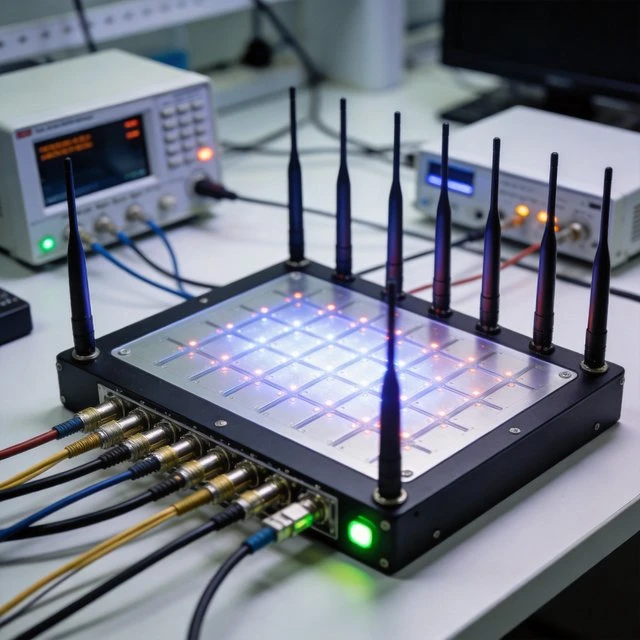
Machine learning is also being applied to uplink channel estimation and receiver design. Keysight’s product demonstrations at MWC 2026 included an ML-based channel estimator that increases throughput and system capacity while reducing radio-unit power consumption. These physical-layer innovations dovetail with higher-layer AI frameworks. For example, NVIDIA announced a 30-billion-parameter Large Telco Model (LTM) based on the Nemotron 3 foundation model. This open model is fine-tuned on telecom datasets and synthetic network logs and can perform tasks such as fault isolation, remediation planning and energy optimisation for radio access networks. The company also released agentic AI blueprints that orchestrate multi-agent energy efficiency and network configuration in real time.
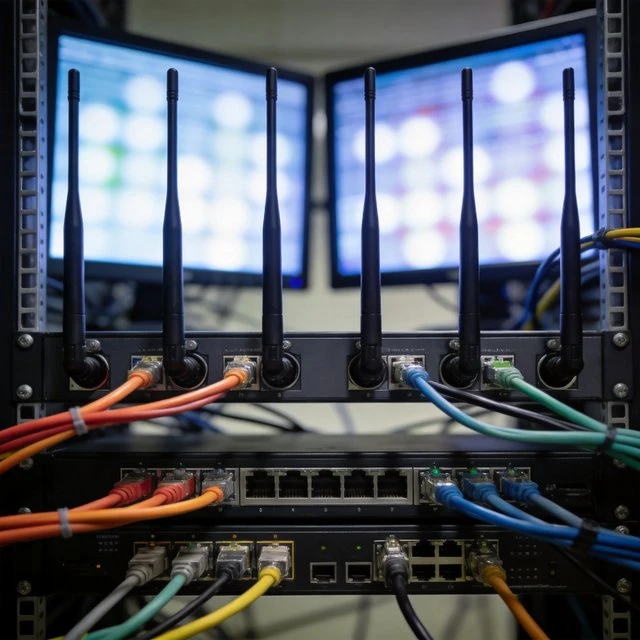
The combination of machine-learning inference and agentic frameworks will transform antenna systems. High-dimensional CSI, beamforming vectors and resource allocations will be computed by neural networks rather than rigid algorithms, enabling real-time adaptation to channel conditions. Generative AI models can synthesise network policies, predict equipment failures and design antennas with novel geometries. Meanwhile, reinforcement-learning controllers will allocate power and spectrum across thousands of antennas in massive MIMO arrays, balancing throughput and energy consumption. Such intelligence will require on-device acceleration and low-latency fronthaul to meet the strict timing requirements of 6G. The antenna industry must collaborate with AI hardware providers to ensure that smart beamforming and adaptive control are supported at the device level.
FAQ
How is machine learning improving MIMO antenna performance?
At MWC Barcelona 2026, Keysight and Qualcomm demonstrated a machine-learning-based CSI feedback scheme that delivered more than 40% higher downlink throughput than standard 3GPP eType II CSI reporting in a rank-4 MIMO scenario.
What role will AI play in operating antenna systems?
Neural networks will compute high-dimensional CSI, beamforming vectors, and resource allocations in real time, while reinforcement-learning controllers allocate power and spectrum across thousands of antennas in massive MIMO arrays.
What is a Large Telco Model?
It is NVIDIA's 30-billion-parameter model based on the Nemotron 3 foundation model, fine-tuned on telecom datasets and synthetic logs to perform tasks such as fault isolation, remediation planning, and energy optimisation for radio access networks.
What does AI-driven radio require from antenna hardware?
It requires on-device acceleration and low-latency fronthaul to meet the strict timing requirements of 6G, so the antenna industry must collaborate with AI hardware providers to support smart beamforming and adaptive control at the device level.
Cellular antenna fit
Need the right cellular antenna for your router, gateway or device?
Share the modem type, frequency bands, MIMO ports, mounting environment and cable length. We can recommend suitable 4G, 5G or MIMO antenna options.
References
- Keysight and Qualcomm demonstrate AI-powered CSI compression
- Keysight to showcase AI-driven wireless innovations and 6G readiness at MWC 2026
- NVIDIA: Agentic AI blueprints and telco reasoning models
- NVIDIA: Nemotron-3 Super for agentic AI
Ready to specify a product?
Get product suggestions and quotation details for your application.
Share the modem type, frequency bands, MIMO ports, mounting environment and cable length. We can recommend suitable 4G, 5G or MIMO antenna options.