

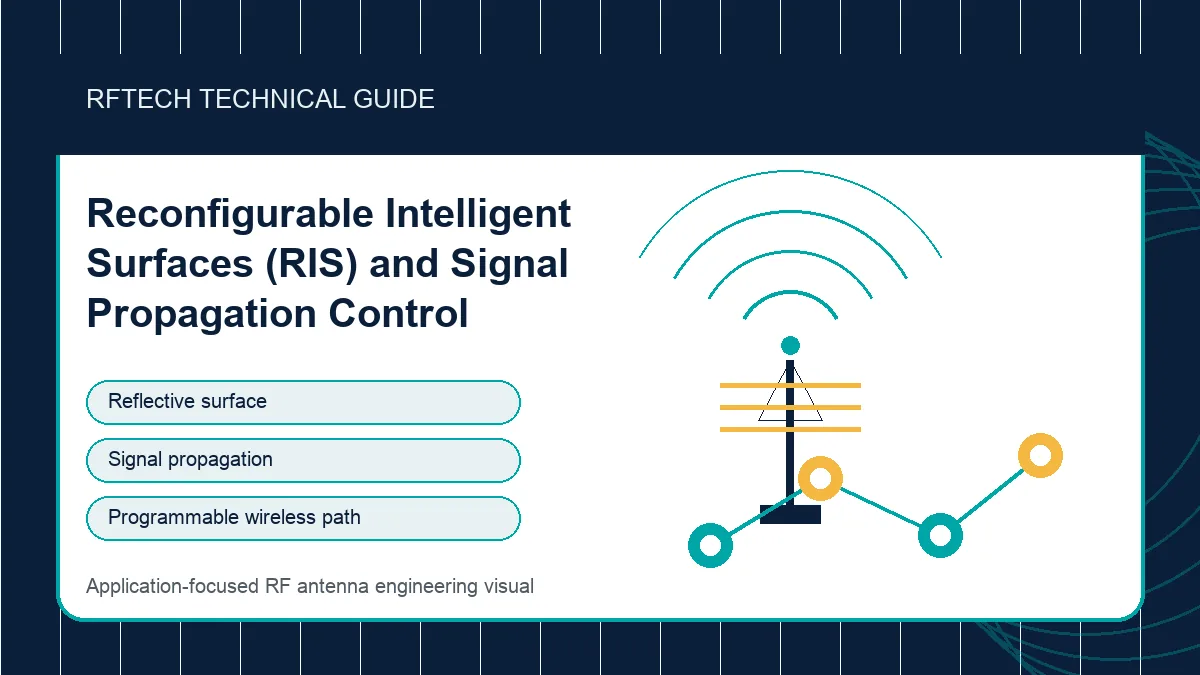
Reconfigurable intelligent surfaces (RIS) are a promising technology for shaping radio propagation environments in 6G. A RIS is a programmable surface composed of hundreds or thousands of meta-atoms whose reflection characteristics can be altered electronically. By adjusting the phase and amplitude of incident waves, RIS panels can create constructive interference at a receiver or redirect signals around obstacles. Modelling work by King Abdullah University of Science and Technology suggests that in urban areas with approximately 300 blockages per square kilometre, deploying six RIS units per square kilometre can eliminate blind spots; when blockage density rises to 700 per square kilometre, coverage enhancement may require up to 490 RIS panels. Such numbers highlight the importance of careful planning when integrating RIS with base stations and user equipment.

RIS technology is tightly coupled with artificial intelligence. A Help Net Security report on 6G research explains that machine learning and deep learning methods are being applied at multiple layers of future networks. At the physical layer, algorithms handle channel estimation and beam optimisation, including optimisation of reconfigurable surfaces. At higher layers, reinforcement learning will manage dynamic spectrum allocation and network slicing. These AI frameworks enable RIS panels to adapt to environmental changes in real time, making them essential components of smart radio environments.
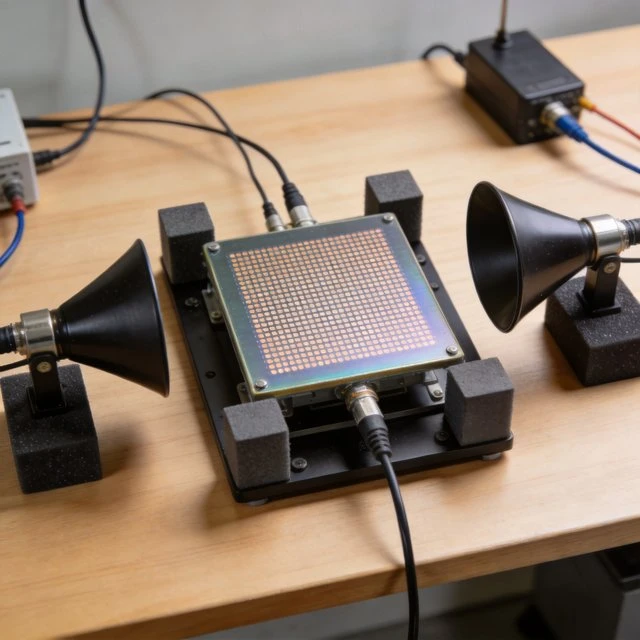
Deploying RIS poses new design requirements for antennas. Each meta-element must integrate an antenna and a programmable load, meaning packaging constraints are severe. Low-loss materials and energy-efficient control circuits are crucial because RIS units will be densely distributed throughout cities. Interoperability with existing MIMO arrays and integrated sensing is also key: RIS panels must not only reflect signals but also support localisation and sensing functions. As standards progress through Release 20 and Release 21, engineers can anticipate guidelines for RIS control protocols and energy-harvesting mechanisms to power massive deployments.
FAQ
What is a reconfigurable intelligent surface (RIS)?
A RIS is a programmable surface composed of hundreds or thousands of meta-atoms whose reflection characteristics can be altered electronically. By adjusting the phase and amplitude of incident waves, it can create constructive interference at a receiver or redirect signals around obstacles.
How many RIS units does a city area need?
In urban areas with about 300 blockages per square kilometre, roughly six RIS units per square kilometre can eliminate blind spots; at 700 blockages per square kilometre, coverage may require up to 490 RIS panels.
How is RIS connected to artificial intelligence?
Machine-learning methods handle channel estimation and beam optimisation, including optimisation of the reconfigurable surfaces, while reinforcement learning manages dynamic spectrum allocation. These frameworks let RIS panels adapt to environmental changes in real time.
What design challenges does RIS create for antennas?
Each meta-element must integrate an antenna and a programmable load, so packaging constraints are severe. Low-loss materials and energy-efficient control circuits are crucial because RIS units will be densely distributed throughout cities.
Interference environment
Need an antenna matched to a high-interference project?
Tell us the frequency range, installation space and interference scenario. We can suggest suitable anti-jamming or specialty antenna options.
References
- A Path to Smart Radio Environments: An Industrial Viewpoint on Reconfigurable Intelligent Surfaces
- Placement of Reconfigurable Intelligent Surfaces in Urban Cell for Improved Coverage
- Reconfigurable Intelligent Surfaces for 6G IoT Wireless Positioning: A Contemporary Survey
- Machine Learning for THz-RIS Enabled 6G: Survey and Key Challenges
Ready to specify a product?
Get product suggestions and quotation details for your application.
Tell us the frequency range, installation space and interference scenario. We can suggest suitable anti-jamming or specialty antenna options.