

Sixth-generation communication research pushes antenna work deep into the terahertz (THz) spectrum. The THz band is usually defined as 0.1-10 THz. However, early 6G deployments will use the so-called sub-THz region (90-300 GHz) because it offers a compromise between immense spectral bandwidth and manageable propagation loss. Atmospheric absorption features create quasi-transparent windows at roughly 140 GHz, 220 GHz and 340 GHz, guiding frequency planning. Researchers from UCLA highlight the 200-400 GHz range as particularly promising because it balances bandwidth and attenuation while being achievable with current semiconductor technologies. The very short wavelength at these frequencies supports dense antenna arrays and high-order beamforming.
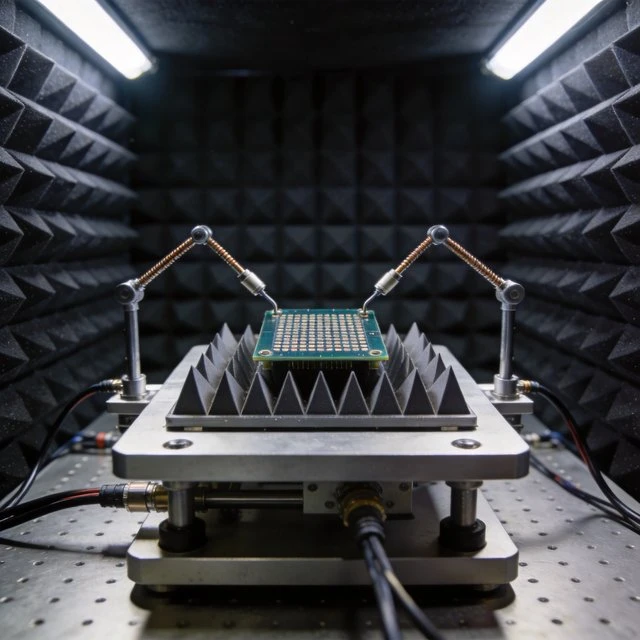
Operating at THz frequencies presents unique challenges. Free-space path loss scales with the square of frequency, so link budgets deteriorate rapidly. Massive multiple-input multiple-output (MIMO) arrays can compensate by focusing energy into narrow beams, but wideband phased arrays suffer from beam squint: when phase shifters steer beams over a broad bandwidth, the main lobe points in different directions at different frequencies. Qorvo notes that true-time-delay units are essential in wideband antenna systems to maintain a flat phase response and prevent beam squint, thus preserving signal quality across the band.
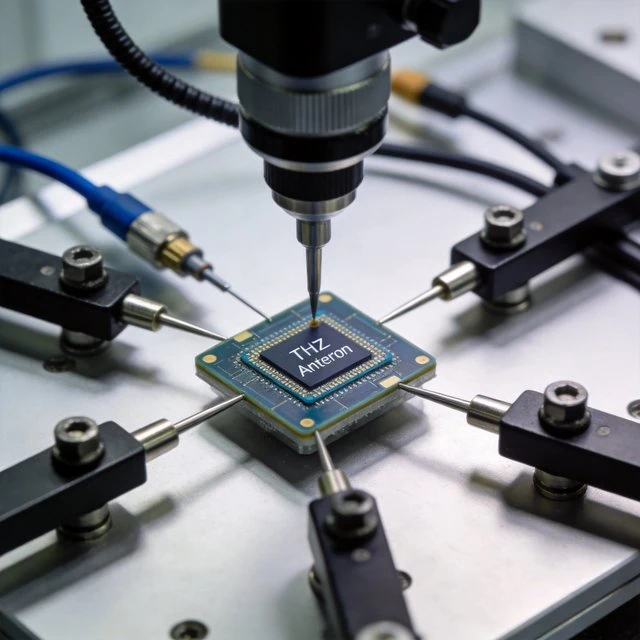
Transistor technology sets the ceiling for THz arrays. SiGe BiCMOS processes with transit frequencies (f_T) and maximum oscillation frequencies (f_max) of 450 GHz and 300 GHz have been demonstrated, with later generations reaching f_max/f_T values of 720/505 GHz. InP high-electron-mobility transistor (HEMT) amplifiers can deliver saturated output powers of 4.8 dBm at 643 GHz, while InP heterojunction bipolar transistor (HBT) amplifiers have achieved 13.5 dBm at 301 GHz. These figures indicate that power amplifiers for THz arrays remain power-limited and efficiency is critical. Advanced semiconductor materials such as GaN and InP, along with heterogeneous integration to combine power and control circuits, will underpin practical THz arrays.
Future THz arrays will also benefit from advanced packaging. Glass-core substrates used in 2.5D antenna-in-package modules enable fine-pitch interconnects and have a coefficient of thermal expansion closely matched to silicon, providing excellent electrical resistivity and low dielectric loss. Antenna-on-display concepts embed optically invisible antennas into smartphone screens to overcome losses introduced by metal frames. Coupled with true-time-delay beamformers and power-efficient amplifiers, these packaging strategies will make THz arrays more compact and energy-efficient.
FAQ
What frequencies will early 6G THz antennas use?
The THz band is usually defined as 0.1 to 10 THz, but early 6G will use the sub-THz region (90 to 300 GHz) because it balances bandwidth and propagation loss. Quasi-transparent atmospheric windows occur near 140, 220, and 340 GHz, and the 200 to 400 GHz range is considered particularly promising.
What is beam squint, and why does it matter at THz?
When wideband phased arrays use phase shifters to steer beams over a broad bandwidth, the main lobe points in different directions at different frequencies. True-time-delay units are essential to maintain a flat phase response and prevent beam squint, preserving signal quality across the band.
What limits the power of THz array antennas?
Power amplifiers remain power-limited: InP HEMT amplifiers deliver about 4.8 dBm at 643 GHz and InP HBT amplifiers about 13.5 dBm at 301 GHz, so efficiency is critical and advanced materials such as GaN and InP are needed.
How does advanced packaging help THz arrays?
Glass-core substrates used in 2.5D antenna-in-package modules provide fine-pitch interconnects, a thermal expansion coefficient matched to silicon, and low dielectric loss, which together with true-time-delay beamformers and efficient amplifiers make THz arrays more compact and energy-efficient.
Cellular antenna fit
Need the right cellular antenna for your router, gateway or device?
Share the modem type, frequency bands, MIMO ports, mounting environment and cable length. We can recommend suitable 4G, 5G or MIMO antenna options.
References
- Qorvo: Maximizing performance in phased arrays with time-delay solutions
- Sub-terahertz (THz) antenna for Internet of Things and 6G Communication
- 140-GHz Affordable Miniaturized Array Antenna-on-Package for Sub-THz Transceiver
- History and Latest Progress in Antenna Packaging Technology: Part 2
Ready to specify a product?
Get product suggestions and quotation details for your application.
Share the modem type, frequency bands, MIMO ports, mounting environment and cable length. We can recommend suitable 4G, 5G or MIMO antenna options.