
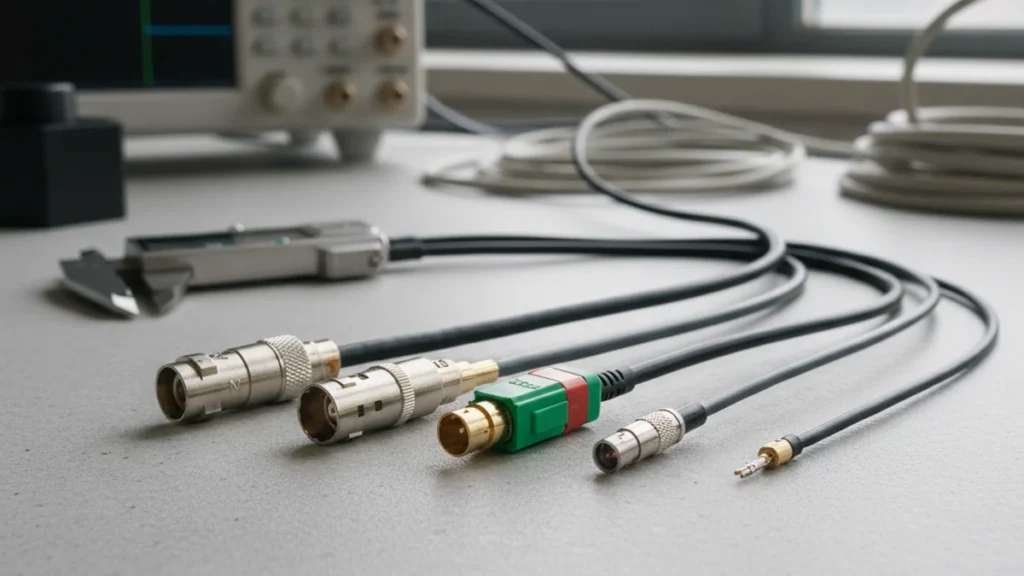
Antenna connector types come down to a handful of families, and picking the wrong one is the fastest way to make a good antenna useless. Three questions settle it: where the antenna mounts, what frequency it has to pass, and what interface is already on the device.
Short answer: embedded on a PCB → IPEX/u.FL (MHF). External on equipment → SMA. Vehicle harness → Fakra with the matching key code. Outdoor or high-vibration → TNC or N-type. Tight or legacy builds → MCX/MMCX. All of it stays 50 Ω.
Below is the working reference for GPS/GNSS, cellular, and embedded antennas: which family belongs to which mount, the frequency and durability limits that come attached, and the three mistakes that force a rebuild.
Quick pick by mount
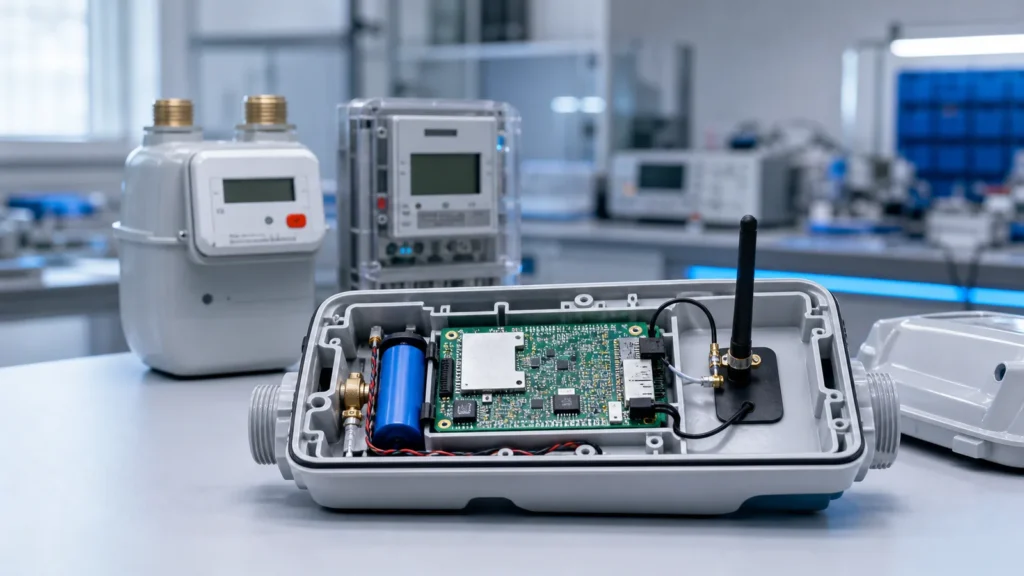
- Embedded, inside a device: IPEX/u.FL and the MHF variants — board-to-cable micro connectors, roughly 1–2 mm tall. Rated for very few unplugs, which matters more than most datasheets suggest.
- External on equipment: SMA. Threaded, standardised to 18 GHz, and the default on most B2B external antennas. Confirm polarity before ordering.
- Automotive / OEM harness: Fakra. Snap-in, colour- and key-coded so the right antenna reaches the right port, specified to 6 GHz.
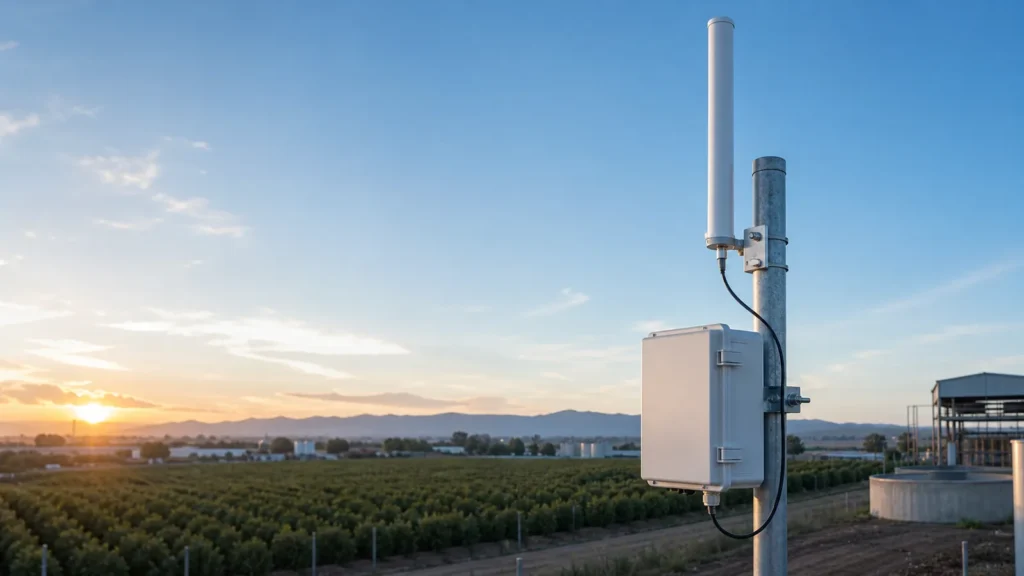
- Outdoor, vibration, marine: TNC (a threaded relative of SMA) or N-type on larger panel and sector antennas.
- Compact or legacy builds: MCX / MMCX snap-on connectors where space is tight or the device already uses them.

The connectors at a glance
| Connector | Coupling | Typical use | Notes |
|---|---|---|---|
| SMA | Threaded | External antennas, equipment | The B2B default; good to ~18 GHz; watch RP-SMA vs SMA polarity |
| Fakra | Snap-in, keyed/colored | Automotive GPS/cellular/V2X | Color + key code prevents mis-mating; pick the right code |
| IPEX / u.FL (MHF) | Snap-on micro | Embedded patch/chip, modules | Tiny, board-level; rated for limited mating cycles |
| TNC | Threaded | Outdoor, vibration, marine | Like SMA but threaded coupling holds under vibration |
| MCX / MMCX | Snap-on | Compact devices, GPS modules | Smaller than SMA; MMCX is the smallest |
| N-type | Threaded, larger | Panel/sector, base-station | Rugged, low loss; used on larger outdoor antennas |
Two of those frequency ceilings come from published standards rather than a supplier brochure. SMA is defined in IEC 61169-15 as a 50 Ω threaded connector with a 4.13 mm outer-conductor bore and an operating frequency up to 18 GHz. Fakra’s interface is defined in ISO 20860-1 (with SAE/USCAR-17 and -18) as a 50 Ω system rated DC to 6 GHz. If a design reaches past 6 GHz — 5G mmWave, for instance — Fakra is out of scope and the connector decision changes before the antenna decision does.

Choose by where the antenna mounts

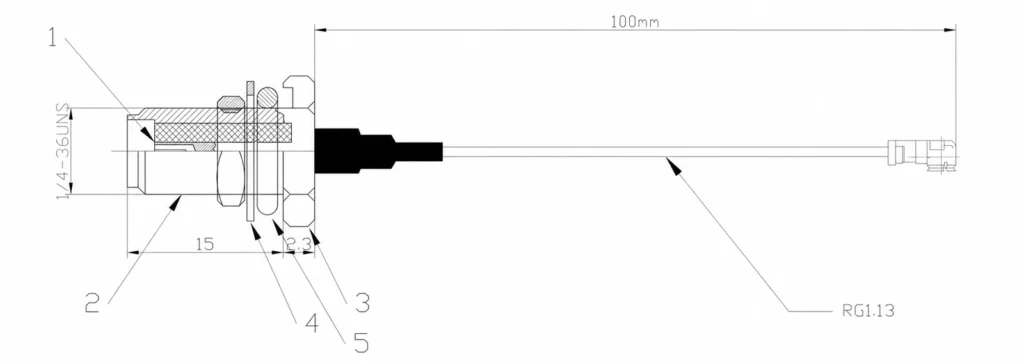
- On the PCB (embedded): use IPEX/u.FL to go from a board-mount antenna or module to a tiny coax. Plan for the limited mating-cycle rating — these aren’t made for repeated unplugging.
- External on equipment: SMA is the safe default. Confirm polarity — RP-SMA (reverse-polarity) is common on Wi-Fi gear and will not mate properly with standard SMA.
- On a vehicle (OEM/aftermarket): Fakra is the standard. Crucially, Fakra is coded by color and key so a GPS antenna mates only with the GPS port. Specify the exact Fakra code that matches the vehicle harness.
- Outdoor / rugged / vibration: TNC (threaded) resists loosening better than snap or even SMA under vibration; N-type for larger panel/sector antennas.
- Compact / legacy: MCX/MMCX where space is tight or the device already uses them.
How many times will it be unplugged?
Durability is where connector families differ by more than two orders of magnitude, and it is the spec that decides whether your product can be serviced.

- u.FL / MHF micro connectors: commonly rated for about 30 mating cycles — the U.FL interface was only ever tested to that figure. It is a factory-assembly interface, not a service interface.
- SMA, SMB, SMC: MIL-STD-348, the US defence interface standard, sets a minimum life of 2,000 cycles for standard test connectors in these series.
- TNC, N-type, C, SC: 10,000 cycles under that same standard, with BNC at 5,000.
What that means on a real product: never put a u.FL at the point a technician has to touch. Mate the micro connector once inside the enclosure and bring the RF out to an SMA or TNC bulkhead. A pigtail costs a few dollars; a board with a torn-off u.FL pad costs a rework line.
GNSS integration
Need help choosing a GNSS or patch antenna?
Tell us your device size, ground plane, constellation, cable and mounting requirements. We can help match active, passive or embedded GNSS antenna options.
Three things that bite people
- RP-SMA vs SMA polarity
RP-SMA keeps the same threads but swaps the centre pin and socket, so the two look nearly identical and will not pass a signal when mated. Check the port before ordering.
Why RP-SMA exists is regulatory, not electrical. 47 CFR 15.203 requires a Part 15 transmitter to be designed so no antenna other than the one supplied can be fitted, and it prohibits a standard antenna jack. Reverse-polarity connectors were the industry’s answer. The part almost no buyer hears: in Public Notice DA 00-1087 the FCC stopped accepting MMCX, MCX and reverse-polarity SMA, BNC and TNC as “unique” couplings, precisely because they had become easy to buy. RP-SMA is still a compatibility trap you have to design around — it just no longer does the compliance job it was invented for.
- Fakra code mismatch
Right family, wrong colour and key code, and it still will not mate — which is the whole point of the system. The coding belongs to the ISO 20860 / USCAR interface, not to a supplier’s catalogue, and it is what keeps a GPS antenna out of an FM or camera port. Specify the code, not just “Fakra.”
- Mixing 50 Ω and 75 Ω parts
RF antenna systems are 50 Ω. What surprises people is how small the electrical penalty of one mismatched junction is — you can work it out without a test lab:
Γ = (75 − 50) / (75 + 50) = 0.2
→ ~4% of power reflected, VSWR ≈ 1.5, mismatch loss ≈ 0.18 dB
That is an engineering estimate from the reflection-coefficient formula, not a measured result, and 0.18 dB is not what ruins installations. The mechanical damage is. The 50 Ω and 75 Ω versions of a family share outer dimensions but use different centre-contact diameters, so forcing them together spreads the female socket and the connector never mates correctly again. Treat 75 Ω parts as incompatible, not merely lossy.


Connector vs cable vs gender
The connector is only part of the interface. Also confirm:
- Gender — male/plug vs female/jack on both the antenna and the device. Gender follows the centre contact, not the threads, which is why threaded connectors confuse people.
- Cable type and length — thin coax adds loss at GHz frequencies. Pair long runs with heavier cable, and use an active antenna where GPS/GNSS needs it.
- Adapters — a last resort. Every adapter adds loss and one more joint that can work loose under vibration.
- Mount mechanics — bulkhead, panel, or board mount changes the part number even when the connector family is identical.
FAQ
What is the most common antenna connector?
SMA is the most common connector for external RF antennas in B2B equipment. Embedded designs use IPEX/u.FL, and automotive designs use Fakra.
What is the difference between SMA and RP-SMA?
RP-SMA (reverse-polarity SMA) swaps the center pin/socket compared to standard SMA. They look similar but do not mate correctly, so check which your device uses.
What connector do automotive antennas use?
Automotive antennas typically use Fakra, which is color- and key-coded so each antenna mates only with the matching port (for example, GPS to the GPS port). Specify the exact Fakra code.
What connector is used for embedded/PCB antennas?
IPEX/u.FL (and MHF variants) — small snap-on connectors that take a board-mount antenna or module to a thin coax. They have a limited mating-cycle rating.
Is antenna impedance always 50 ohms?
RF antenna systems are 50 Ω. One 50/75 Ω junction only costs roughly 0.18 dB by calculation, but the mismatched centre contacts can permanently damage the female connector — so treat 75 Ω parts (common in TV and video) as incompatible rather than lossy.
How do I tell which connector my device uses?
Check the datasheet first, then the port. Threads on the outside of the shell with a centre pin means RP-SMA; threads inside with a centre pin means standard SMA. On a vehicle, read the colour and key code on the harness connector. If nothing is documented, ask for the mating drawing before buying cables.
How many times can a u.FL connector be unplugged?
About 30 mating cycles is the usual rating. Treat it as a one-time factory connection and bring the serviceable interface out to an SMA or TNC bulkhead.
Can I use an adapter instead of the right connector?
You can, but each adapter adds insertion loss and one more mechanical joint. On a short indoor run it is a workable stopgap; on GPS/GNSS or long outdoor runs, order the correct connector, gender, and cable instead.
Choosing with us
Our GPS/GNSS, cellular, and embedded antennas are offered in these connector options — match the connector to your mount and device. Browse the GPS & GNSS antennas, 4G/5G cellular antennas, or patch/embedded antennas, or send your device interface and we’ll specify the connector, gender, and cable.
Ready to specify a product?
Get product suggestions and quotation details for your application.
Tell us your device size, ground plane, constellation, cable and mounting requirements. We can help match active, passive or embedded GNSS antenna options.
Ask our AI antenna assistant. Enter a keyword or question for a free answer based on this article, Global RF Tech content, and general antenna/RF knowledge.
Do not submit confidential or personal information. Privacy Policy


Great content! Keep up the good work!