

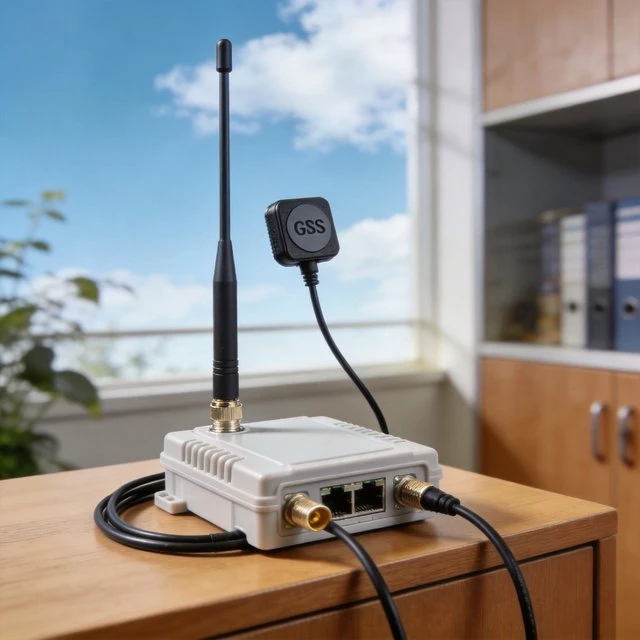
Machine-to-machine (M2M) terminals-asset trackers, payment terminals, industrial telemetry nodes, vending controllers, and smart meters-often combine cellular backhaul with GNSS positioning inside a small enclosure mounted on vehicles, containers, or building infrastructure. This multi-radio pairing creates a distinctive antenna challenge: the cellular transmitter can be a dominant local interferer to GNSS, and the product’s mounting environment (metal, glass, wiring harnesses) can cause persistent detuning unless the antenna system is engineered as part of the mechanical design. A cellular module hardware design guide illustrates the typical terminal architecture: separate 50-ohm main and diversity antenna interfaces, a reserved pi-type matching footprint, controlled-impedance traces (microstrip or coplanar waveguide), and explicit guidance to keep spacing between main and diversity antennas for sensitivity improvement. The same guide shows a GNSS antenna interface and notes practical integration choices: passive GNSS antennas are often recommended by default; if an active antenna is used, the design may require an LDO and optional attenuation/matching network. It also recommends specific micro-coax connector families for antenna attachment in compact products (e.g., U.FL-R-SMT). From the GNSS standpoint, an antenna application note for GNSS receiver integration explains why interference management is so critical: GNSS signals at the antenna are extremely weak relative to thermal noise, and nearby transmitters or digital harmonics can desensitize the receiver.
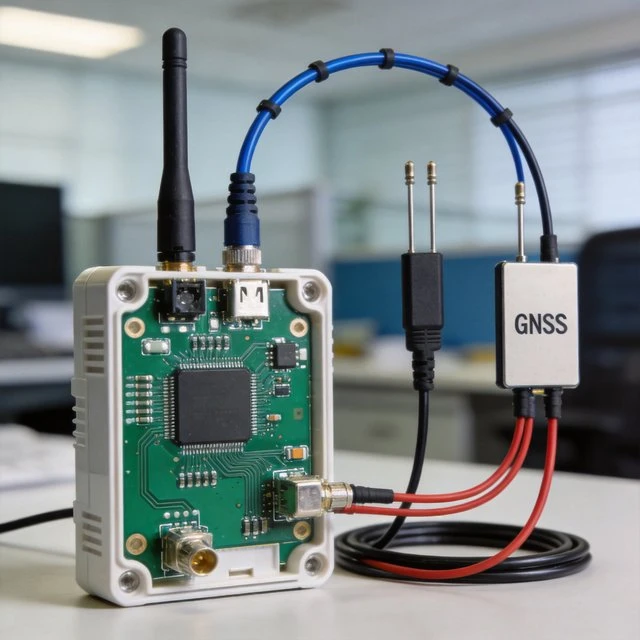
The note explicitly warns that close proximity between a cellular handset transmitter and a GNSS antenna can be a particularly difficult scenario, and it frames filtering, placement, and EMC discipline as essential when integrating GNSS with other RF transmitters and digital systems. This is directly relevant to M2M, where cellular activity (e.g., periodic bursts) and switching regulators often cohabit with the GNSS front end in small plastic housings. Antenna selection at the physical layer typically splits into two layers. For sub-GHz ISM/LPWAN add-ons (or regional variants), compact chip antennas can be used; a sub-GHz chip antenna datasheet provides a concrete example of an 868/915 MHz class component in a 10 x 3.2 x 2 mm SMD package and explicitly lists IoT/LoRaWAN/sensing use cases. For wide regional ISM/LoRa coverage in a single SKU, a flexible PCB antenna example is designed to cover 860-928 MHz for global ISM/LoRa applications. While these are not cellular bands, they are common in M2M products where a secondary sub-GHz radio complements cellular
Target Audience
- M2M device designers
- tracker/meter OEMs
- RF integration engineers
- productization teams managing diverse mounting environments
Key Technical Points
- Separate cellular main/diversity feeds and reserved matching
- controlled-impedance routing
- GNSS vulnerability to nearby RF and digital noise
- connector/cable loss budgeting
- careful antenna spacing and placement
Practical Use Cases
- Fleet/asset tracking
- smart metering with cellular backhaul
- remote telemetry nodes
- payment terminals requiring location + connectivity
Relevant Standards and Protocols
- Cellular UE RF requirements and test frameworks (ETSI/3GPP)
- GNSS L1 constellation bands (as integrated)
- (optional) sub-GHz ISM/LPWAN regional operation (ETSI EN 300 220-2 when relevant)
Typical Hardware Examples
- Quectel EG25-G hardware design guide (ANT_MAIN/ANT_DIV + GNSS interface examples, matching network reservation, connector recommendation). u-blox GNSS antenna integration application note (placement and interference analysis)
- Johanson Technology 0900AT47A0063001E sub-GHz chip antenna datasheet (size and use-case examples)
- Taoglas FXP895 860-928 MHz ISM/LoRa antenna example for global coverage (single SKU design intent)
Deployment Considerations
- Identify mounting surface (metal detuning risk)
- validate GNSS under worst-case cellular transmit
- minimize switch-mode noise coupling
- verify cable insertion loss and connector robustness
- pre-compliance scans before formal certification
Interference environment
Need an antenna matched to a high-interference project?
Tell us the frequency range, installation space and interference scenario. We can suggest suitable anti-jamming or specialty antenna options.
FAQ
What makes integrating cellular and GNSS in one M2M terminal difficult?
The cellular transmitter can be a dominant local interferer to GNSS, and the mounting environment (metal, glass, wiring harnesses) can cause persistent detuning. The antenna system therefore has to be engineered as part of the mechanical design.
How are the cellular antenna interfaces typically arranged?
As separate 50-ohm main and diversity interfaces, with a reserved pi-type matching footprint, controlled-impedance traces (microstrip or coplanar waveguide), and deliberate spacing between the main and diversity antennas to improve sensitivity.
Should an M2M design use a passive or active GNSS antenna?
Passive GNSS antennas are often recommended by default. If an active antenna is used, the design may require an LDO and an optional attenuation or matching network.
Why is GNSS so vulnerable to interference in M2M devices?
GNSS signals at the antenna are extremely weak relative to thermal noise, so nearby transmitters or digital harmonics can desensitize the receiver. Close proximity between a cellular transmitter and the GNSS antenna is a particularly difficult scenario.
Ready to specify a product?
Get product suggestions and quotation details for your application.
Tell us the frequency range, installation space and interference scenario. We can suggest suitable anti-jamming or specialty antenna options.


