

Public safety terminals span two partially overlapping worlds: traditional Land Mobile Radio (LMR) for mission-critical voice and direct-mode operation, and broadband LTE/5G for high-throughput data, mapping, video, and interoperable services. Antenna requirements are correspondingly distinct: LMR terminals prioritize reliability, ruggedness, and predictable coverage in VHF/UHF bands; broadband terminals add MIMO/diversity expectations and may rely on network-managed quality of service. From a regulatory standpoint, U.S. LMR operation is governed under 47 CFR Part 90 (Private Land Mobile Radio Services), which sets the legal framework for permitted public safety and industrial/business radio operations and associated definitions. Public safety handhelds and mobiles must therefore align antenna selection, operating bands, and channelization with Part 90 licensing and equipment rules; a portable radio datasheet explicitly references FCC mandate constraints under Part 90 for certain band operations, illustrating how regulation can directly constrain terminal behavior and configuration.
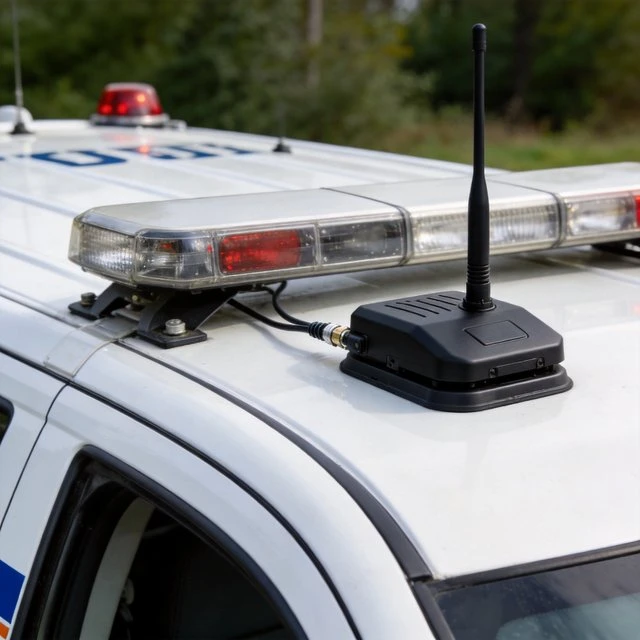
On the standards side, Project 25 (P25) is widely associated with the TIA-102 suite; a publicly available P25 documentation overview lists accepted standards and reinforces that P25 capabilities derive from published standards in this suite. For mission-critical broadband features, 3GPP defines Mission Critical services; a 3GPP overview page enumerates specifications such as MCPTT requirements (TS 22.179) and architecture/flows (TS 23.379), bridging LMR-like operational concepts into LTE/5G systems. The antenna hardware on public safety terminals is usually optimized for durability and handling. A portable two-way radio antenna datasheet provides a representative “duck”/helical construction pattern (e.g., injection molded quarter-wave helical) with frequency variants spanning 806-866 MHz and 902-960 MHz classes and explicit mechanical durability attributes, reflecting typical handheld antenna tradeoffs between size and efficiency. Vehicle-mounted terminals often use roof antennas for better radiation and reduced body-blockage, but handhelds must tolerate detuning from the user’s body and from accessory configurations (shoulder mics, body-worn holsters). In broadband public safety ecosystems such as FirstNet, band-specific features (e.g., Band 14 and high-power user equipment discussions) motivate careful antenna and RF front-end validation to translate power class advantages into real coverage
Target Audience
- Public safety communications engineers
- agency procurement teams
- radio system integrators
- device OEMs supporting LMR + LTE/5G
Key Technical Points
- Part 90 regulatory alignment
- P25/TIA-102 standards basis
- 3GPP MC services for broadband mission-critical
- handheld antenna durability vs efficiency tradeoffs
- vehicle roof mounting benefits
- broadband coverage enhancements tied to band/power class and antenna performance
Practical Use Cases
- Police/fire handheld radios
- EMS devices with push-to-talk
- incident command connectivity
- vehicle radios and repeaters
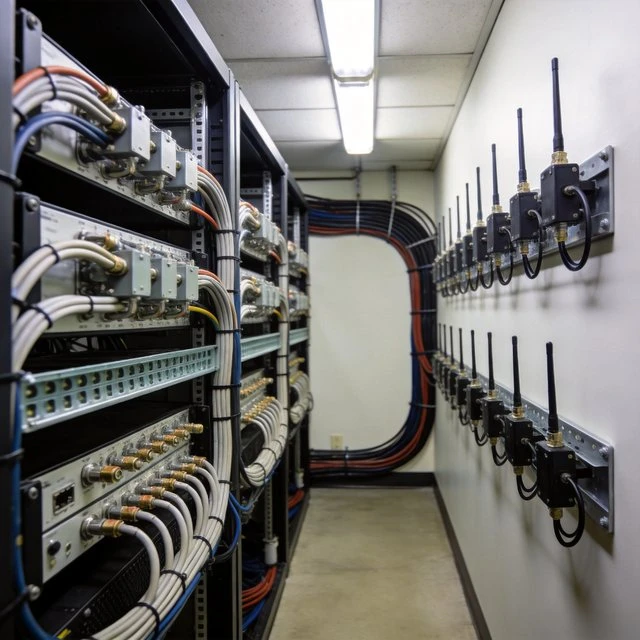
- in-building coverage solutions integrating LMR and LTE
Relevant Standards and Protocols
- 47 CFR Part 90
- P25 standards documentation in the TIA-102 suite
- 3GPP mission critical specifications including TS 22.179 and TS 23.379
Typical Hardware Examples
- Motorola Solutions APX 8000 portable radio datasheet with Part 90-related operating constraints
- Laird Connectivity EXE series two-way radio antennas with quarter-wave helical construction and band-specific variants
- FirstNet Band 14 and HPUE deployment context for public broadband terminals
Deployment Considerations
- Ensure antenna/band alignment to licensed operation
- validate body-worn performance and accessory effects
- manage in-vehicle cable/connector reliability
- coordinate LMR and LTE antennas to prevent inter-system desense
- document compliance with Part 90 and applicable device authorization requirements
Related reading: for the building-wide distribution layer behind in-building emergency coverage, see our distributed antenna system (DAS) guide.
Cellular antenna fit
Need the right cellular antenna for your router, gateway or device?
Share the modem type, frequency bands, MIMO ports, mounting environment and cable length. We can recommend suitable 4G, 5G or MIMO antenna options.
FAQ
How do antenna needs differ between LMR and broadband public safety?
LMR terminals prioritize reliability, ruggedness, and predictable coverage in VHF/UHF bands, while broadband LTE/5G terminals add MIMO and diversity expectations and may rely on network-managed quality of service.
What regulations and standards govern public safety radios?
In the United States, LMR operation is governed under 47 CFR Part 90. Project 25 (P25) is associated with the TIA-102 suite, and 3GPP defines Mission Critical services such as MCPTT requirements (TS 22.179) and architecture (TS 23.379).
Why do public safety handheld antennas trade efficiency for durability?
Handheld antennas often use a rugged duck or quarter-wave helical construction optimized for durability and handling, and they must tolerate detuning from the user's body and from accessories such as shoulder mics and body-worn holsters.
Do vehicle-mounted public safety terminals perform better than handhelds?
Vehicle-mounted terminals often use roof antennas for better radiation and reduced body-blockage, whereas handhelds must tolerate detuning from the user's body and accessory configurations.
Ready to specify a product?
Get product suggestions and quotation details for your application.
Share the modem type, frequency bands, MIMO ports, mounting environment and cable length. We can recommend suitable 4G, 5G or MIMO antenna options.


