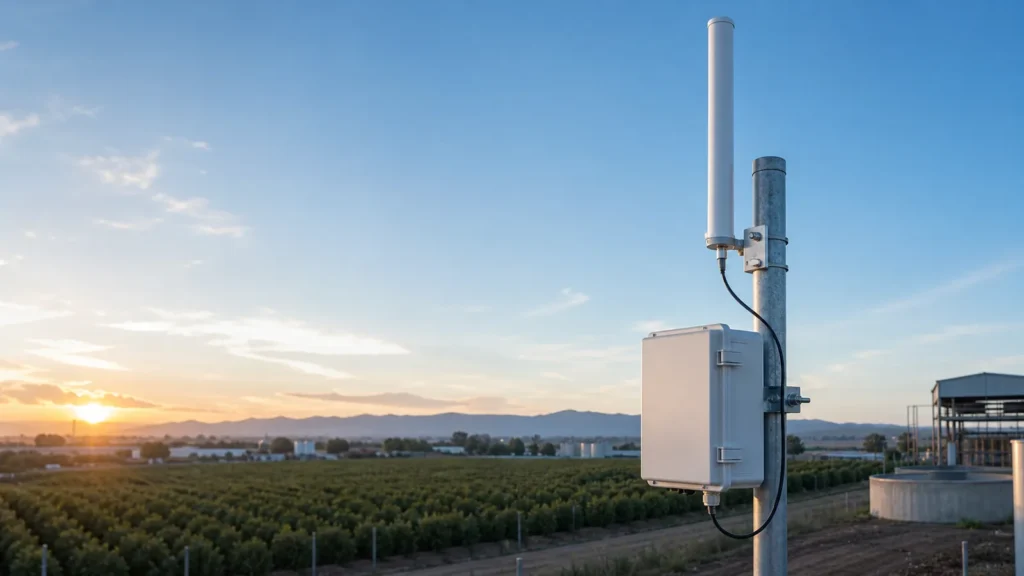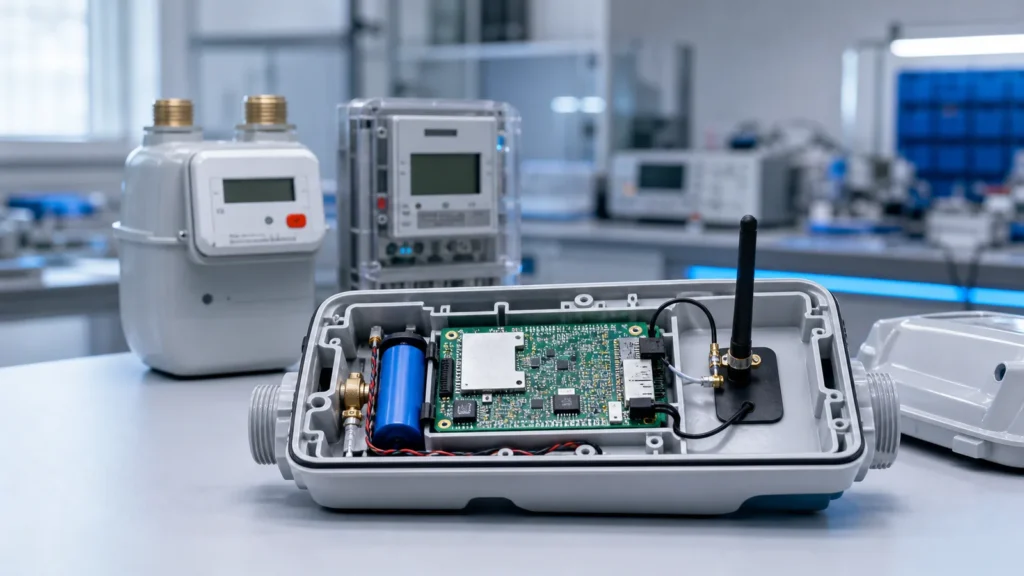

A distributed antenna system (DAS) is an in-building or outdoor RF network that connects one or more signal sources to multiple antennas placed closer to users. The system carries cellular or public-safety radio signals through coax, fiber, remote units, and passive components so coverage reaches areas that a single outdoor site cannot serve reliably.
A DAS can solve a coverage problem, a capacity problem, or both—but those are not the same design. An off-air DAS redistributes the donor signal already available outside and does not create new carrier capacity by itself. Additional capacity requires a suitable signal source, such as a carrier BTS or small cell, plus a sector design that can use it.
This guide explains the two decisions behind every DAS: where the signal comes from and how it is distributed. It also shows how passive, active, and hybrid DAS differ, where antennas fit, and what must be measured before equipment is selected.
Why Buildings Need DAS
Modern buildings are hard on RF. Concrete walls, metal framing, low-E glass, elevators, mechanical rooms, and underground garages all weaken or block signal. In some buildings the issue is basic coverage. In others, especially airports, stadiums, hospitals, and convention venues, signal strength may be acceptable while network capacity is not.
DAS works by moving the antenna closer to the user. That sounds simple, but it changes everything. A cleaner nearby signal is often more useful than a stronger signal trying to travel from far away through multiple layers of structure.
- office towers and campuses
- hospitals and medical buildings
- hotels, airports, and shopping centers
- parking garages, tunnels, and basements
- industrial plants and warehouses
- stadiums and event venues
DAS Is Not the Same as a Signal Booster
People often use the two terms as if they mean the same thing. They do not.
A basic booster amplifies whatever signal it receives. In the right conditions that can help, but weak donor signal, oscillation, interference, and uneven real-world performance can limit the result.
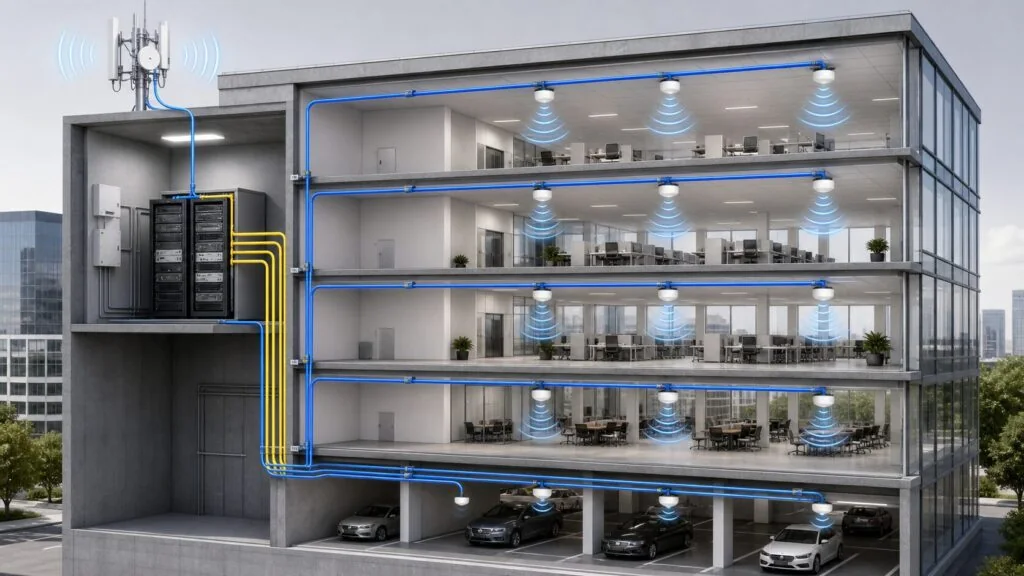
A DAS is a designed distribution system. It takes signal from a defined source, then routes it through cabling, splitters, fiber, remotes, and indoor antennas placed where coverage or capacity is actually needed. The goal is not just louder signal. The goal is controlled signal distribution across the target area.
That distinction matters when performance, reliability, carrier coordination, or public safety compliance is on the line.
How a Distributed Antenna System Works
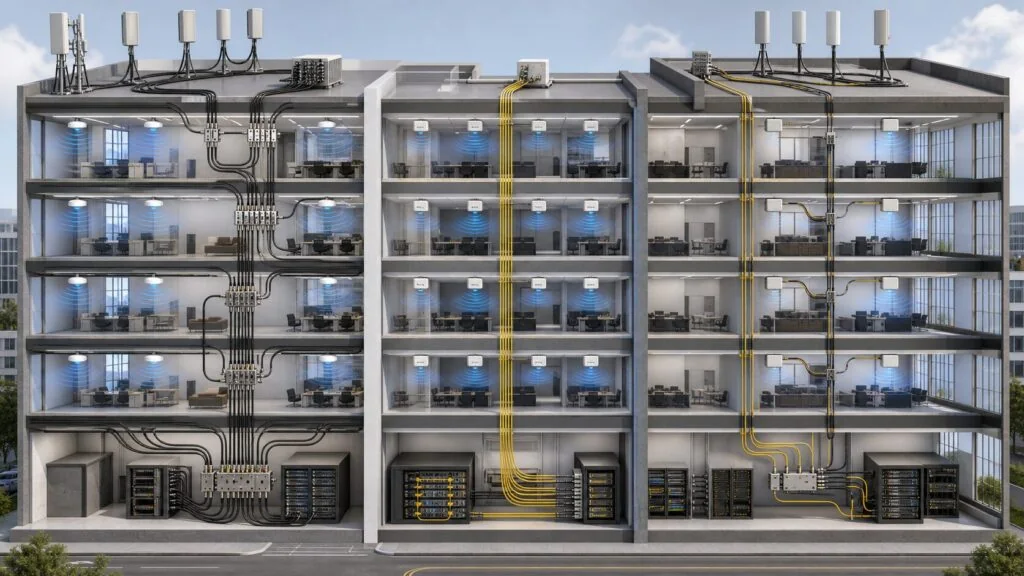
At a high level, every DAS has three parts:
- Signal source. This may be an outdoor donor antenna, a carrier-fed base station, a small cell, or a public safety radio source.
- Distribution network. This is the transport layer that moves signal through the building. Depending on the design, it may include coax, splitters, couplers, amplifiers, fiber, and remote units.
- Indoor antennas. These are installed where people actually need service. Placement is everything. A poor layout can leave dead zones even when the headend equipment is technically working.
The same RF basics that apply to antenna gain also matter here. Indoor system performance is not just about transmit power. Cable loss, antenna placement, isolation, and propagation inside the building all shape the final result.
Signal Source and Distribution Are Separate Decisions
Every DAS needs a signal source and a way to distribute that signal. Treating them as the same decision leads to bad designs.
| Signal source | What it supplies | Best fit | Main limitation |
|---|---|---|---|
| Off-air donor antenna | Existing macro-network signal received from outside | Buildings with a clean, usable donor signal and a coverage problem | Redistributes existing service; it does not add carrier capacity by itself |
| On-site BTS / base station | Carrier-generated cellular signal and dedicated capacity | Stadiums, airports, campuses, and other high-demand venues | Requires carrier coordination, backhaul, space, power, and a longer deployment path |
| Enterprise small cell | A local carrier signal source using IP backhaul | Smaller or mid-sized buildings that need a fresh indoor signal | Carrier support, backhaul, handover, and scale vary by deployment |
The distribution architecture comes next. Passive DAS moves RF through coax and passive components. Active DAS converts the signal for transport over fiber or Ethernet to powered remote units. Hybrid DAS uses an active backbone for long runs and passive coax distribution near the antenna zones.
Active DAS vs Passive DAS vs Hybrid DAS
The three main DAS architectures are passive, active, and hybrid.
| Architecture | Main transport | Powered remote units | Typical fit | Design watch-out |
|---|---|---|---|---|
| Passive DAS | Coaxial cable, splitters, taps, and couplers | No | Smaller footprints and shorter RF runs | Link budget, cable loss, balancing, and PIM |
| Active DAS | Fiber or Ethernet to remote units | Yes | Large or complex buildings with long distribution paths | Power, cooling, equipment cost, monitoring, and vendor architecture |
| Hybrid DAS | Fiber backbone plus local coax | Yes, but fewer than full active | Multi-floor buildings that need long transport and local passive branches | Transition losses, branch balancing, and maintenance access |
Building size alone does not select the architecture; bands, carriers, signal source, cable paths, capacity target, and public-safety requirements all matter.
Cellular DAS and Public Safety DAS Solve Different Problems
This is one of the most common points of confusion.
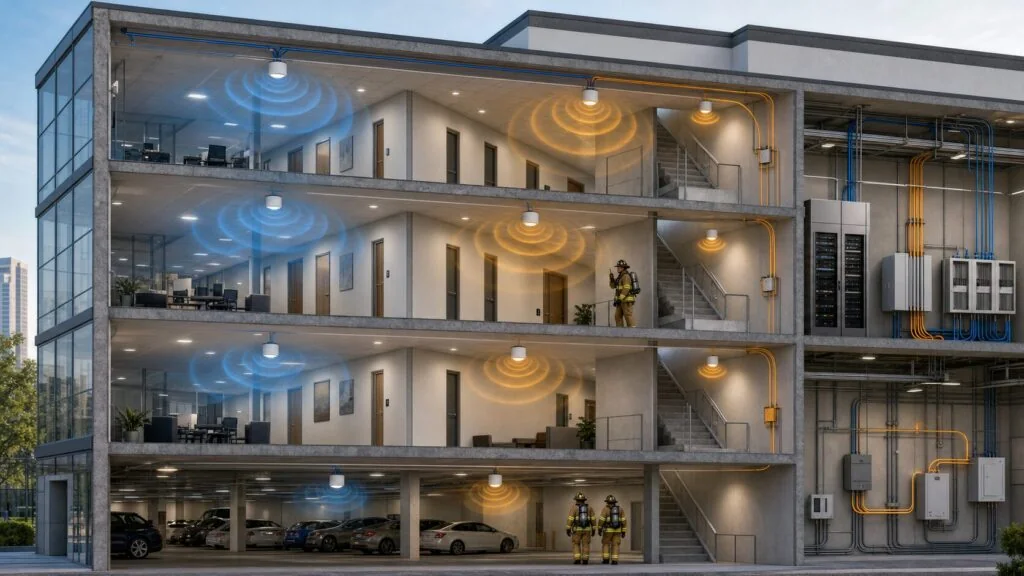
Commercial cellular DAS supports carrier traffic such as voice, text, 4G, and 5G data. Building owners typically install it to improve tenant experience, customer satisfaction, or indoor mobile performance in difficult structures.
Public safety DAS supports emergency responder radio coverage. It is used when fire, police, EMS, or other responder communications do not meet the required in-building signal threshold.
These systems may share planning logic, but they do not serve the same purpose. Frequencies, code requirements, acceptance testing, and approval paths are different. A cellular system that performs well for everyday users can still fail a public safety coverage test.
If you are evaluating the public safety side of the problem, this related article on public safety antennas for LMR and mission-critical broadband is a useful next step.
DAS Is Also About Capacity, Not Just Coverage
Dead zones are only half the story.
In high-density venues, the bigger issue is often congestion. Thousands of users may all be trying to call, stream, upload, or message at the same time. In that environment, one outdoor macro site cannot efficiently serve the entire indoor load.
A DAS distributes RF coverage; it does not automatically create network capacity. Capacity improves only when the signal source and sector design provide additional usable radio resources. A BTS-fed or properly sectorized system can add capacity in a high-density venue, while an off-air DAS mainly extends the capacity already available from the donor macro network.
The same logic appears in connected device infrastructure as well. If you are working on router-side antenna deployment, external MIMO antennas for LTE and 5G FWA routers covers how placement and RF environment affect performance at the equipment edge.
Where DAS Fits Alongside Small Cells and Wi-Fi
Wi-Fi, small cells, and DAS can all improve indoor connectivity, but they are not interchangeable.
Wi-Fi uses unlicensed spectrum for local network access. Small cells are compact carrier radios that serve a limited area. DAS is a distribution layer that is especially useful when coverage has to reach across a broad or complicated footprint, or when multiple carriers or public safety signals must be supported inside the same property.
In industrial settings, RF design constraints can become even harsher because of metal structures, interference sources, and safety requirements. That is why lessons from industrial terminal antennas for private LTE often translate well to indoor DAS planning in plants and utility facilities.
What Building Owners Actually Gain From DAS
When the system is designed correctly, the result is not just better bars on a phone screen.
- fewer dropped calls indoors
- more reliable mobile data
- stronger coverage in basements, stairwells, garages, and elevators
- better user experience in dense venues
- support for code-driven public safety coverage where required
- fewer complaints from tenants, visitors, and operations teams
For many buildings, that directly affects retention, operations, and perceived property quality.
How a DAS Project Is Designed
A useful DAS design starts with measured requirements, not a generic equipment list.
- Define the requirement. Separate commercial cellular, public safety, private radio, or a clearly separated combination.
- Measure the site. Record outdoor donor quality, indoor coverage, interference, building materials, floor plans, and high-priority zones.
- Choose the signal source. Select off-air, BTS, small cell, or a carrier-specific combination.
- Build the RF design. Calculate the link budget, cable and splitter loss, antenna pattern, spacing, isolation, PIM, and handover or sector boundaries.
- Select the architecture and antennas. Choose passive, active, or hybrid distribution; ceiling omni, wall or panel, donor LPDA, bands, ports, connectors, and the PIM target.
- Install and commission. Label paths, test every branch, verify coverage against the agreed acceptance plan, document results, and obtain AHJ or carrier acceptance where required.
The first useful deliverable is therefore a measured design brief—not a generic antenna count or a price per square foot.
When to Consider DAS
- indoor dropped calls are routine
- stairwells, garages, or lower floors are persistent dead zones
- event crowds overwhelm the network
- a public safety radio grid test fails
- tenants or staff keep reporting poor indoor mobile service
The right first step is a site survey, not a guess. Measured conditions should drive the design.
Once DAS is confirmed as the right architecture, use our guide to small cell vs DAS and antenna selection for the next decision: choosing the radiating node, gain, and band coverage.
Common Design Mistakes
The biggest DAS problems usually come from underestimating the RF engineering.
- weak or poorly isolated donor signal
- excessive cable loss
- bad antenna spacing or placement
- inconsistent coverage between floors or zones
- interference fed back into the surrounding network
- skipping commissioning and grid testing
A bad DAS can become an expensive patchwork that still leaves critical areas uncovered.
Testing and Maintenance Matter
DAS is infrastructure, not a one-time install-and-forget purchase.
Buildings change. Tenants add equipment. Carriers add bands. Coverage conditions shift. Public safety requirements can be updated. A system that worked at turnover may not still perform the same way after later construction or occupancy changes.
That is why testing, documentation, and periodic maintenance are part of the real cost of ownership.
Common DAS Questions
How much does a distributed antenna system cost?
There is no reliable generic price for a DAS. Cost depends on building size, signal source, number of carriers and bands, passive, active, or hybrid architecture, cable paths, construction conditions, monitoring, and any public-safety testing and acceptance requirements. A site survey and measured design brief should come before a budget.
What is a real example of a DAS?
One common off-air example starts with a rooftop donor antenna receiving a usable outdoor carrier signal. A headend or amplifier conditions that signal, coax or fiber carries it through the building, floor-level remotes or passive branches divide it into zones, and ceiling antennas radiate it near users. A BTS-fed or small-cell-fed design uses a local carrier source instead of the rooftop donor path.
Does a DAS always increase capacity?
No. An off-air DAS mainly redistributes service and capacity already available from the donor network. Added capacity requires a signal source and sector design that provide additional usable radio resources, such as a carrier BTS, small cell, or properly sectorized system.
What are the main DAS types?
The main distribution architectures are passive, active, and hybrid DAS. Passive systems use coax and passive RF components, active systems use powered remote units with fiber or Ethernet transport, and hybrid systems combine an active backbone with local passive branches. Digital DAS is an implementation of active distribution, not a separate signal source.
Conclusion
A distributed antenna system exists to solve a practical RF problem: outdoor signal does not automatically become usable indoor signal. By bringing controlled signal distribution inside the building, DAS can improve coverage and, when backed by the right signal source and sector design, add capacity where conventional outdoor service falls short.
If the goal is commercial indoor cellular, public safety radio support, or both, start with a survey, define the requirement clearly, and design the system around the actual building rather than a generic template.
For the antenna side of that design, our guide to small cell vs DAS and antenna selection covers radiating nodes, gain, bands, and small-cell options without duplicating this system-level introduction.
To specify the hardware, browse our DAS antennas for in-building coverage — ceiling-mount omni service antennas and log-periodic donor antennas for 4G and 5G distributed antenna systems.
If you are selecting antennas or passive RF components for an in-building coverage project, send the required bands, coverage zones, antenna form factor, connector, PIM target, and quantity through our request a quote form. Global RF Tech can help with antenna and passive-component selection; active DAS headend and carrier integration remain project-specific.
Ask our AI antenna assistant. Enter a keyword or question for a free answer based on this article, Global RF Tech content, and general antenna/RF knowledge.
Do not submit confidential or personal information. Privacy Policy