
A 5G distributed antenna system, or 5G DAS, brings licensed cellular signal into buildings, campuses and venues where the macro network cannot punch through concrete, coated glass, steel or underground levels. The antennas are the last RF step in that system: ceiling omnis, donor antennas, panels and other passive nodes that decide how evenly the signal reaches users. This guide explains where 5G DAS makes sense, when small cells are the better answer, and what antenna details to check before you ask a supplier for a quote.
What Is a DAS Antenna System?
A DAS antenna system is a network of low-power DAS antennas fed by a single headend — a base station, off-air repeater, or signal source — and connected through coaxial cable, fiber, or Ethernet. Instead of one high-power radio fighting through walls and Low-E glass, the distributed antenna system DAS architecture pushes many small radiators close to users, so every floor, basement, and parking level receives uniform signal with consistent uplink performance.
Why Indoor 5G Needs a Distributed Antenna System
Macro base stations are optimized for wide-area outdoor coverage. Their signals attenuate through walls, Low-E glass, and structural materials. In typical commercial construction, outdoor-to-indoor penetration loss ranges from 15 dB to 30 dB. In energy-efficient buildings with metallized glazing, the loss can exceed 35 dB.
For large venues, underground facilities, and high-density indoor environments, operators and enterprises deploy a dedicated indoor coverage layer. The two dominant architectures are:
- Distributed Antenna System (DAS): A centralized base station or repeater feeds a network of remote DAS antennas through coaxial cable, fiber, or Ethernet.
- Small Cell: A compact, low-power base station serves a localized area with integrated or externally connected antennas.
The choice between them is not technical dogma. It is a function of coverage area, multi-operator requirements, deployment timeline, and total cost of ownership.
DAS Antenna Types: Passive, Active, and Hybrid
Modern DAS antenna systems fall into three architectural categories. The right choice determines cable run length, total cost, and how well the system will perform on mid-band 5G.
- Passive DAS: Uses coaxial cable, splitters, taps, and passive DAS antennas. Simple to design but limited by cable attenuation, which rises sharply with frequency.
- Active DAS: Converts RF to digital or optical signals at the headend, transports over fiber or Ethernet, and reconverts at remote radio units near the antennas. Lower loss, longer reach, easier zoning.
- Hybrid DAS: Combines active transport from the headend with passive distribution in local zones. Common in legacy upgrades where existing coaxial infrastructure is retained.
Which DAS Antenna Types Work Best for 5G NR?
For 5G NR, passive DAS faces a structural challenge. Mid-band frequencies such as n77 (3.3–4.2 GHz) and n78 (3.3–3.8 GHz) suffer substantially higher cable loss than legacy LTE bands. A passive DAS feeding 3.5 GHz antennas over 100 meters of standard coaxial cable loses 15 to 25 dB of signal strength, depending on cable type. Active DAS distributed antenna systems are now the default specification for new 5G indoor builds in stadiums, hospitals, and Class A office towers.
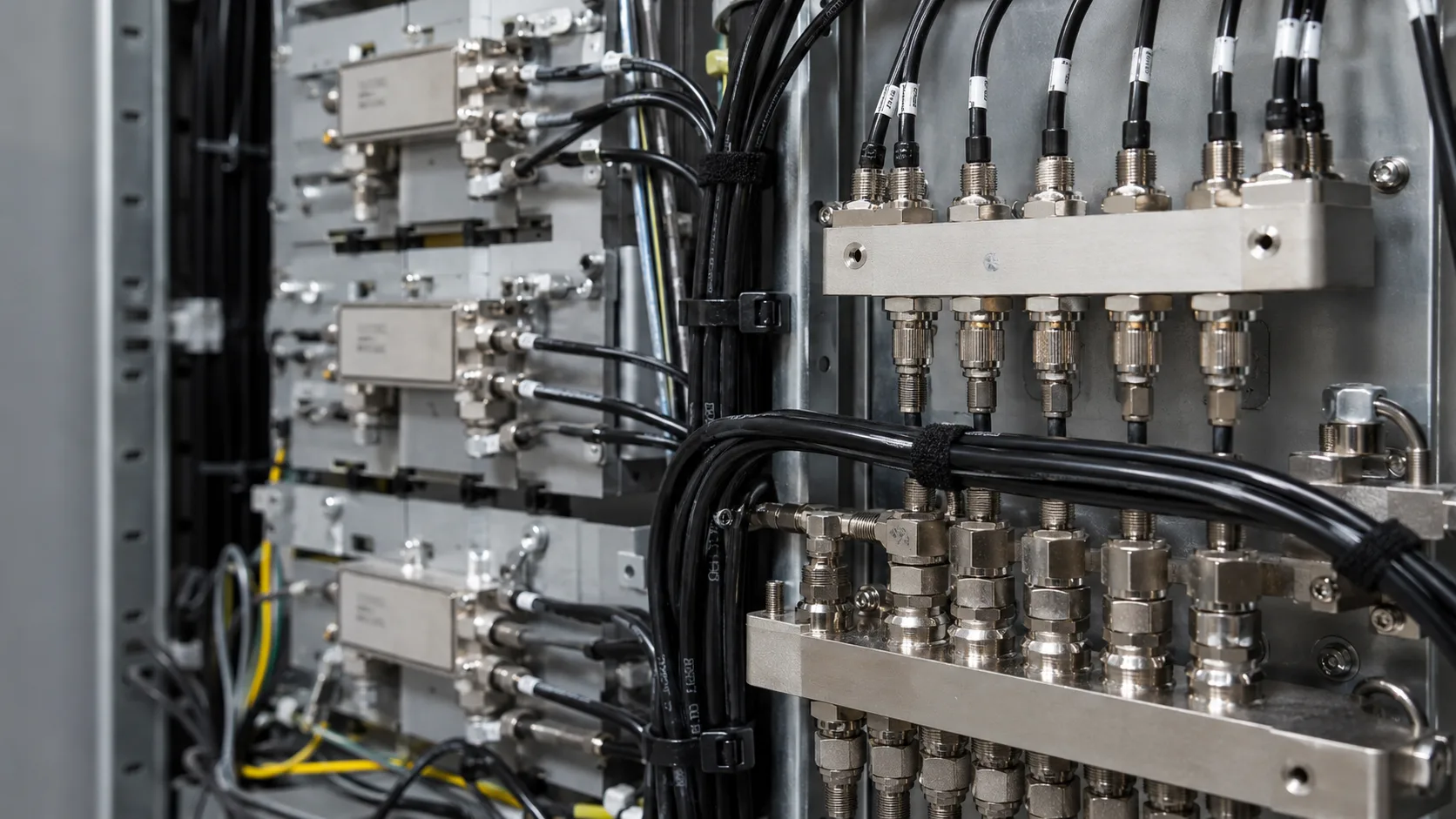
5G DAS Antenna Architecture
A 5G distributed antenna system distributes RF from a central headend to multiple remote antenna nodes throughout a building or campus. Each node terminates in one or more cellular DAS antennas tuned to the operator bands in use — typically a combination of low-band (600–900 MHz), mid-band (1.7–2.6 GHz and 3.3–4.2 GHz), and, in dense capacity hotspots, mmWave (24–40 GHz).
DAS Antenna Selection Criteria
| Parameter | Sub-6 GHz DAS | mmWave DAS |
|---|---|---|
| Antenna type | Low-profile dome, directional panel | Compact phased array, integrated beamforming module |
| Transport medium | Coaxial (passive) or fiber/Ethernet (active) | Fiber only (active DAS) |
| Mounting | Ceiling tile, wall mount, conduit | Ceiling grid, equipment rack, wall enclosure |
| Coverage per node | 15–25 meter radius (omnidirectional) | 10–15 meter radius (beamformed) |
| Zoning | Wide coverage per node | Narrow beams, higher node density required |
| Relative cost per node | Lower | Higher |
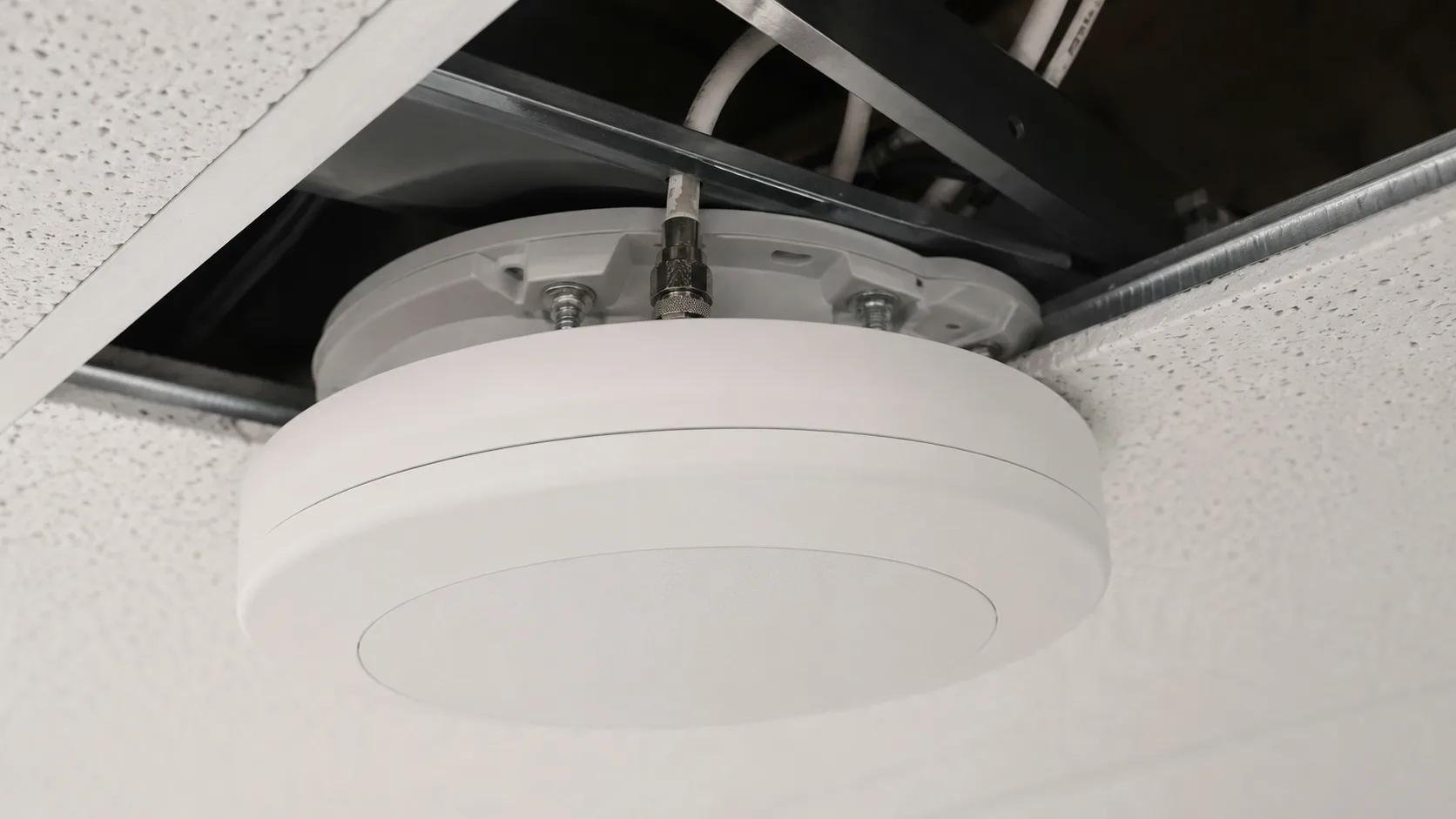
In sub-6 GHz DAS distributed antenna system 5G deployments, omnidirectional dome antennas remain the standard for open-plan offices, retail floors, and conference halls. For broader product-side benchmarking, a fiberglass omni antenna is a useful reference point. Directional panel antennas handle corridor coverage, elevator shafts, parking garages, and loading docks where RF energy must be focused rather than dispersed.
How Do You Choose a Cellular DAS Antenna for Sub-6 GHz vs mmWave?
For sub-6 GHz coverage, choose a wideband cellular DAS antenna covering 698–4000 MHz with a typical gain of 2–5 dBi and PIM ≤ -150 dBc. For mmWave, choose an integrated beamforming module rather than a discrete antenna — the path loss budget at 28 GHz and 39 GHz only closes when the radio and antenna are co-located.
5G Small Cell Antenna Options
Small cells are self-contained base stations that include the baseband processor, RF transceiver, and antenna system in a compact enclosure. For commercial and industrial deployment, the relevant categories are picocells and microcells:
- Picocell: Indoor enterprise unit, 100–250 meter range, often with external antenna ports.
- Microcell: Outdoor or large indoor unit, 500 meter to 2 kilometer range, requires external antennas.
The 5G small cell antenna specification depends on whether the deployment is indoor or outdoor, and whether the device ships with integrated antennas or external RF ports.
Indoor Small Cell Antennas
Enterprise picocells often ship with basic stub or dipole antennas. For professional deployments, external antennas provide better coverage control and let the integrator shape the RF footprint:
- Omnidirectional ceiling antennas: Provide uniform horizontal coverage for open offices, warehouses, and factory floors.
- Directional wall-mount antennas: Focus energy along corridors, into edge zones, or toward specific work areas.
- Temporary magnetic-mount antennas: Used during site surveys and pre-deployment validation to confirm coverage before permanent installation.
Outdoor Small Cell Antennas
Outdoor microcells face weather, wind, thermal cycling, and interference from neighboring macro cells. A 5G outdoor antenna mounted on a small cell must meet the following criteria:
- IP rating: Minimum IP65 for rain and dust ingress. IP67 preferred for flood-prone or coastal environments.
- Wind survival: Rated for regional maximum wind speed with a safety margin. Panel antennas typically survive 200+ km/h when properly mounted.
- Temperature range: Industrial-grade operation from -40°C to +65°C or wider.
- Lightning protection: DC-grounded antenna elements with proper surge arrestors on all feed lines.
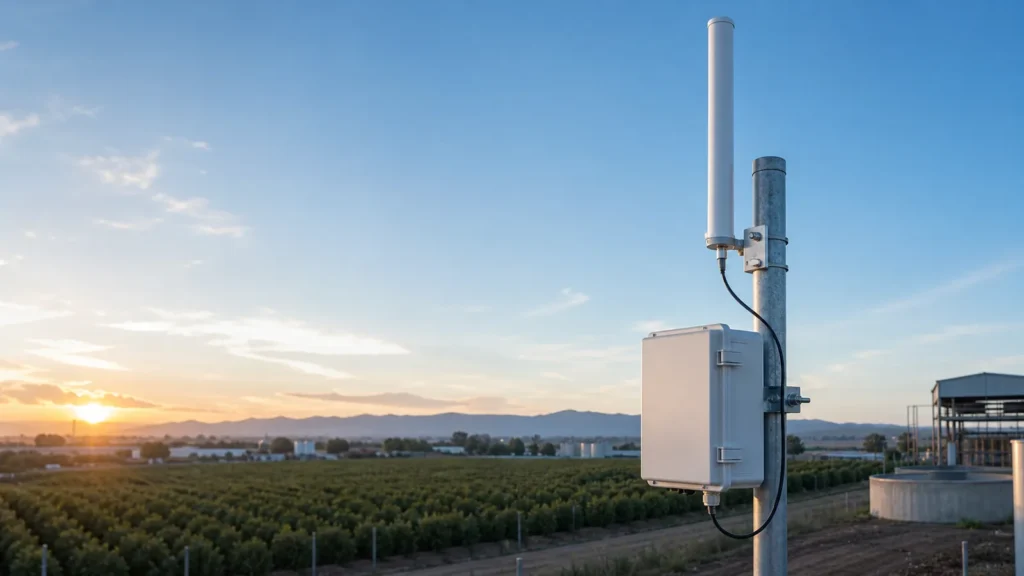
A typical outdoor small cell deployment uses a sectorised 5G antenna or a directional panel antenna aimed at the target coverage zone. In dense urban deployments, a 3-sector configuration (three 120-degree antennas) provides 360-degree coverage around the pole or rooftop mount without the interference footprint of a true omnidirectional radiator.
Small Cell vs DAS: Decision Framework
| Factor | Small Cell | DAS |
|---|---|---|
| Coverage area | Localized hotspot | Large building, campus, or venue |
| Concurrent user capacity | Tens to hundreds | Thousands |
| Spectrum ownership | Operator or private license | Usually operator-provided or neutral-host |
| Deployment speed | Weeks | Months |
| Multi-operator support | Typically single operator | Supports multiple operators via sectorization |
| Cost model | Lower capital per node | Higher upfront, lower per-user cost at scale |
| Antenna flexibility | Limited, often vendor-locked | Higher, open antenna selection |
Choose a small cell when the project covers a single building floor, a parking lot, or an outdoor hotspot; when the operator or enterprise owns the spectrum and wants a standalone network; and when deployment speed is critical.
Choose a DAS when the venue requires coverage across multiple floors, basements, and parking levels; when multi-operator access is mandatory (hospitals, airports, government buildings); or when the building owner wants a neutral-host infrastructure that generates lease revenue.
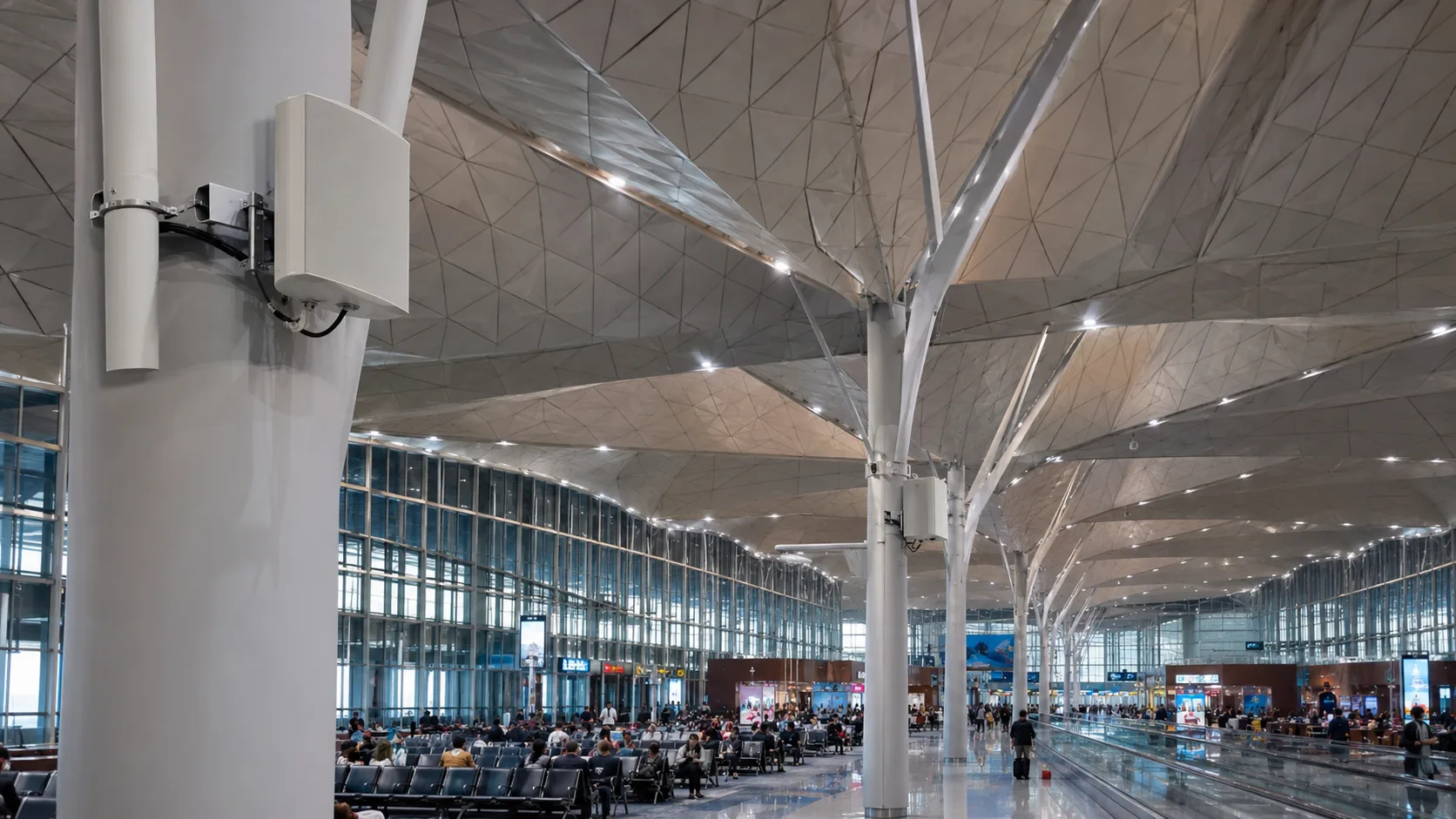
Indoor coverage
Planning antenna coverage inside a building?
Share the building type, coverage area, frequency bands and donor/ceiling antenna requirements. We will help you choose the right components.
Pole and Facade Deployment for Outdoor Small Cells
Urban small cells are commonly mounted on street furniture: light poles, utility poles, building facades, and traffic signal infrastructure. A 5G antenna on utility pole deployment must satisfy constraints that do not exist for macro towers:
- Structural load limits: The combined weight of the small cell enclosure, antenna, mounting bracket, and cable must not exceed the pole’s rated load. Many legacy streetlight poles were not engineered for telecommunications equipment.
- Power availability: Most streetlight circuits provide limited AC power. Microcell installations often require electrical upgrades, dedicated metering, or PoE++ delivery from a nearby transformer.
- Backhaul access: Fiber or millimeter-wave wireless backhaul must reach the pole. In dense urban cores, backhaul availability — not RF planning — is frequently the primary deployment bottleneck.
- Zoning and aesthetic regulations: Many municipalities enforce concealed or low-visual-impact designs. Antennas integrated into shrouds, faux equipment housings, or existing street furniture are standard requirements.
For a 5G antenna on pole installation, panel antennas are preferred over omnidirectional whips because they direct energy toward the street-level pedestrian and vehicle zone and reduce upward radiation that can interfere with macro layers above.
DAS Antenna Installation Best Practices
Good DAS antenna installation is what separates a system that passes a commissioning walk-test from one that quietly underperforms for years. The placement rules below apply to most enterprise and venue distributed antenna systems DAS deployments.
Indoor DAS Antenna Installation
- Ceiling height: Mount dome DAS antennas at 2.5 to 4 meters for optimal floor coverage. Higher mounts increase inter-floor leakage.
- Node spacing: In open-plan offices, space omnidirectional DAS nodes at 15 to 20 meter intervals. In corridors, space directional panels at 25 to 35 meter intervals depending on wall materials.
- Isolation from Wi-Fi: Maintain at least 3 meters of horizontal separation between 5G DAS antennas and 5 GHz Wi-Fi access points to reduce adjacent-channel interference.
Outdoor Small Cell Placement
- Mounting height: 6 to 10 meters for pedestrian and street-level coverage. Higher mounts increase range but reduce signal strength at ground level due to elevation angle spread.
- Downtilt: Use mechanical or electrical downtilt to focus energy on the target zone and avoid overshooting into adjacent small cells. A 5-degree electrical downtilt is a common starting point.
- Azimuth alignment: Align directional antennas to cover the target street segment or plaza. Avoid aiming directly at glass curtain walls, which cause strong multipath reflections and inter-symbol interference.
Common DAS Antenna Installation Mistakes
- Skipping a passive intermodulation (PIM) sweep on connectors and jumpers — the most common cause of degraded uplink on a new DAS distributed antenna network.
- Mixing antenna vendors without verifying VSWR and pattern overlap.
- Using too few high-power nodes instead of more low-power DAS antennas, which overshoots intended zones and creates pilot pollution.
- Forgetting to label every coax run and antenna at install time — a small omission that doubles troubleshooting time for the next ten years.
Working with DAS Antenna Manufacturers
Reputable DAS antenna manufacturers publish full datasheets covering VSWR, gain over frequency, axial ratio, PIM (typically ≤ -150 dBc), and pattern plots in both E- and H-planes. When sourcing for a distributed antenna system DAS project, ask for:
- Independent PIM and third-order intermodulation test reports.
- RoHS / REACH / FCC / CE compliance documents.
- Sample units for chamber validation before bulk orders.
- A clear warranty and field-failure replacement policy.
- Lead times and second-source availability for the same model.
Treat any vendor that cannot supply this paperwork as a material risk to the entire distributed antenna systems DAS investment.
Planning a DAS or small-cell rollout? Send us the bands (for example 698–2700 MHz or specific sub-6 GHz n-bands), the coverage type (ceiling omni, wall-mounted panel, or donor LPDA), the port count and PIM requirement, the connector (4.3-10, N, or SMA), and the quantity per site. We will match a DAS antenna node to your link budget and share chamber and field data for approval.
DAS Antenna FAQ
What is the difference between a DAS antenna and a small cell antenna?
A DAS antenna is a passive or active radiator fed by a remote base station through a shared headend, while a small cell antenna is attached directly to a self-contained, low-power base station. DAS distributes one signal source to many DAS antennas; small cells are many independent sources.
How many DAS antennas does a typical building need?
For a standard office floor, expect one omnidirectional DAS antenna every 200–400 m² for sub-6 GHz coverage, and significantly more for mmWave. A 20-story commercial tower commonly uses 200–400 DAS antennas across the full distributed antenna system DAS deployment.
Can a DAS antenna system support multiple carriers at once?
Yes. A neutral-host DAS antenna system uses a Point of Interface (POI) to combine signals from multiple operators onto the same set of DAS antennas, which is why airports, stadiums, and hospitals overwhelmingly choose DAS over single-operator small cells.
Is a cellular DAS antenna the same as a Wi-Fi antenna?
No. A cellular DAS antenna is engineered for licensed operator bands, tight PIM specs, and high uplink linearity. Wi-Fi antennas are designed for unlicensed ISM bands and do not meet operator acceptance criteria.
How long does a DAS antenna installation usually take?
A mid-sized enterprise DAS antenna installation (50–150 antennas) typically takes 8–14 weeks from design freeze to commissioning, including head-end integration, cable pulling, antenna mounting, walk-testing, and operator acceptance.
What DAS antenna types are used for indoor 5G?
Indoor 5G DAS mostly uses wideband ceiling omni antennas for even sub-6 GHz coverage and wall-mounted panel antennas for directional fill in corridors, atriums, and large halls. Passive DAS feeds these from a shared headend; active and hybrid DAS add remote units where cable loss would otherwise be too high. mmWave floors need many more nodes because of shorter range.
How do I choose between a ceiling omni and a wall-mounted panel DAS antenna?
Use a ceiling omni when you need balanced 360° coverage over an open floor plate, and a wall-mounted panel when you need to push signal down a corridor or across a wide hall from one side. Panels also help control inter-floor bleed and isolate the donor path. Match both to the exact bands and check gain, VSWR, and PIM on the datasheet.
Summary
Small cells and DAS distributed antenna systems are complementary tools. Small cells offer deployment speed, spectrum ownership, and private-network capability. A DAS distributed antenna offers scale, multi-operator neutrality, and deep indoor penetration that no single small cell can replicate.
Antenna selection follows the architecture. A 5G distributed antenna system for sub-6 GHz indoor coverage uses low-profile omnidirectional domes and directional panel DAS antennas — see our DAS antennas for in-building coverage. A 5G small cell antenna for outdoor urban deployment uses sector or panel antennas on street poles with careful attention to wind, power, and backhaul constraints. For donor-side planning and longer outdoor aiming scenarios, teams often also compare an LPDA antenna for donor signal pickup — and if the donor band is fixed and narrow, choosing between a Yagi and an LPDA donor antenna comes down to bandwidth against peak gain. Match the antenna to the deployment model, not the reverse — and choose DAS antenna manufacturers that can back their datasheets with chamber and field data.
Ready to specify a product?
Get product suggestions and quotation details for your application.
Share the building type, coverage area, frequency bands and donor/ceiling antenna requirements. We will help you choose the right components.
Ask our AI antenna assistant. Enter a keyword or question for a free answer based on this article, Global RF Tech content, and general antenna/RF knowledge.
Do not submit confidential or personal information. Privacy Policy