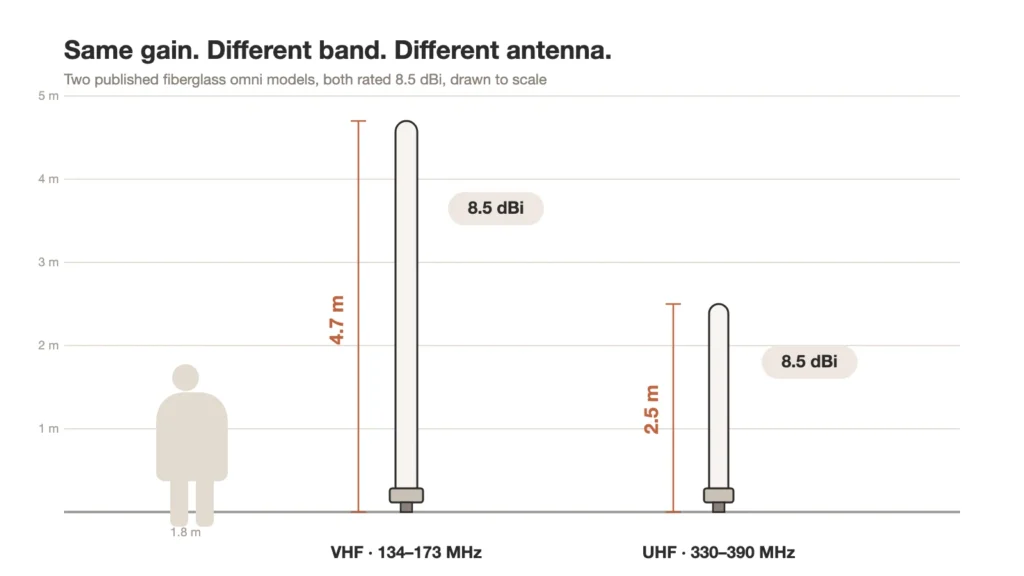
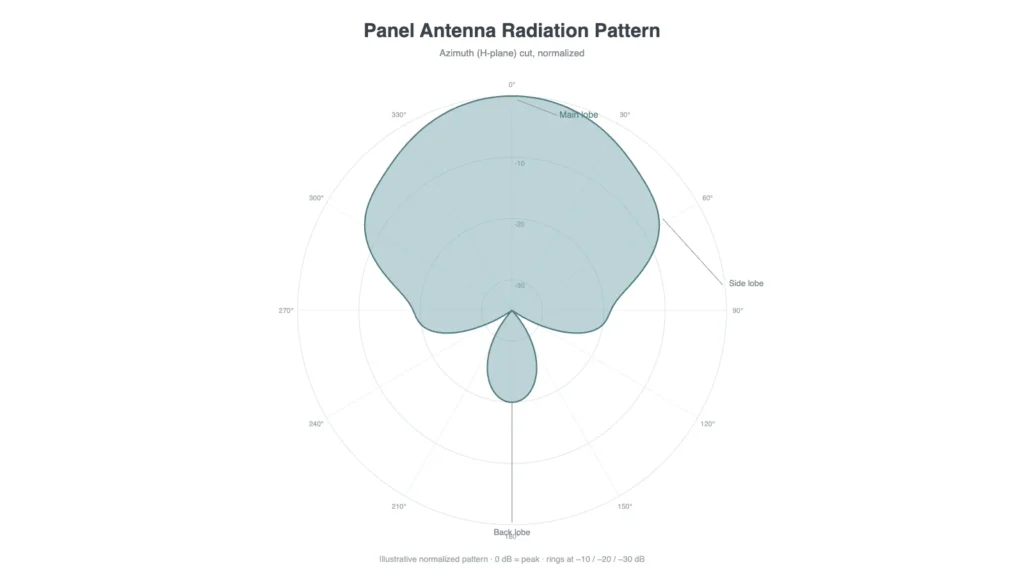
A panel antenna radiation pattern tells you where the antenna actually puts its energy – and that, not the gain figure on the datasheet, decides whether your link works.
Short answer: A panel antenna is directional. Its pattern has a forward main lobe, a suppressed back lobe, and two beamwidths you have to read separately: the azimuth (horizontal) beam, set mainly by the reflector, and the elevation (vertical) beam, set by how many radiating elements are stacked. Match those two angles to the shape of the area you need to cover, then check gain, front-to-back ratio and polarization. When a datasheet’s gain and its beamwidths disagree, trust the beamwidths.
This guide is built around the decision you are actually making: panel, sector or omni, and then which model. It covers how to read the plot, what E-plane and H-plane mean (and when they swap), how to sanity-check gain against beamwidth with a standards-based formula, and how to turn the vertical beam into a real coverage distance on the ground.
What a radiation pattern actually shows
A radiation pattern is a plot of relative signal strength versus direction, usually drawn as a polar graph. The shape tells you where the antenna is “loud” and where it is “quiet.” Three features matter most:
- Main lobe: the direction of maximum radiation. This is where the antenna does its work.
- Side lobes and back lobe: smaller lobes pointing in other directions. They can cause or pick up interference, so smaller is usually better for a directional link.
- Nulls: directions where radiation drops to near zero.
Because an antenna radiates in three dimensions, a single 2D plot is only one slice. That is why datasheets show at least two cuts: the E-plane and the H-plane.
E-plane and H-plane: the two views you need
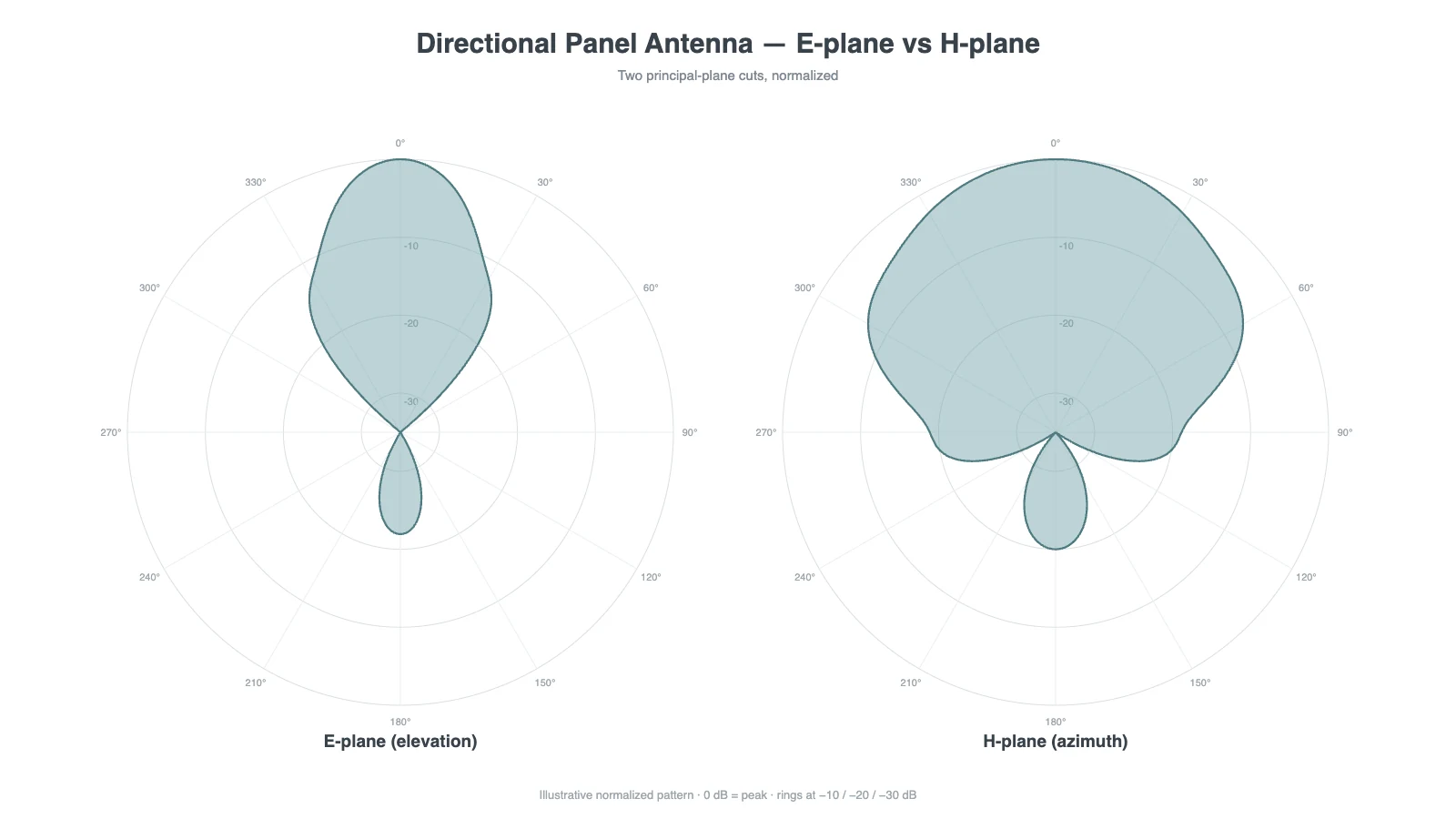
A full pattern is 3D, but engineers describe it with two perpendicular slices:
- E-plane: the plane containing the electric field and the direction of maximum radiation. For a vertically polarized antenna, this is the vertical (elevation) cut.
- H-plane: the plane containing the magnetic field, perpendicular to the E-plane. For the same antenna, this is the horizontal (azimuth) cut.
Together, the E-plane and H-plane plots tell you the beamwidth in both directions, so you know whether the antenna covers a tall-and-narrow slice, a wide flat fan, or a focused pencil beam.
The planes swap with polarization. “E-plane = vertical” only holds for a vertically polarized antenna. As the reference definition of the two planes puts it, the H-plane usually coincides with the horizontal (azimuth) plane for a vertically polarized antenna, and with the vertical (elevation) plane for a horizontally polarized one. Check polarization before you decide which plot is your coverage angle.
Ask for both cuts at several frequencies, not one. Pattern shape depends on the antenna’s size in wavelengths, so it moves with frequency: an NTIA measurement study of array antennas across 8500-10800 MHz found the pattern changing noticeably across the band. For a wideband panel covering something like 698-2700 MHz, the reflector controls the low band far less tightly than the high band, so the azimuth beam is usually widest and the front-to-back ratio worst at the bottom of the range. The useful request to a supplier is therefore specific: E-plane and H-plane plots at the low, middle and high frequency of every band, plus confirmation of whether the radome was fitted during the measurement.
Key terms that read the pattern for you
| Term | What it tells you |
|---|---|
| Beamwidth (HPBW) | The angular width where power is within 3 dB of the peak, i.e. the usable coverage angle |
| First-null beamwidth (FNBW) | The angle between the nulls on either side of the main lobe; commonly approximated as twice the HPBW |
| Gain (dBi) | How much the antenna concentrates energy in the main lobe vs an isotropic radiator |
| Front-to-back ratio | How well the antenna rejects energy from behind; higher is better for directional links |
| Side-lobe level | How strong the unwanted lobes are relative to the main lobe |
| Polarization | The orientation of the radiated field (vertical, horizontal, or dual/slant) |
Gain and beamwidth are linked: for a given antenna type, a narrower beam concentrates energy and raises gain, while a wider beam lowers it. There is no free lunch: higher gain means a tighter beam that must be aimed more carefully. Nulls matter as well – standard antenna course notes approximate the first-null beamwidth as roughly twice the half-power beamwidth, which tells you how far off-axis an interferer has to sit before the antenna stops hearing it.
Check the gain against the beamwidths
You can test whether a datasheet is self-consistent in about 30 seconds. The ITU publishes a semi-empirical relationship between the gain of a sectoral (panel-type) antenna and its two 3 dB beamwidths, valid for azimuth beamwidths up to roughly 120 degrees:
G0 ≈ 10 × log10( 31000 / (φ3 × θ3) ) dBi
Here φ3 is the azimuth 3 dB beamwidth and θ3 the elevation 3 dB beamwidth, both in degrees. It is published on a provisional basis for sharing studies in Recommendation ITU-R F.1336-5.
Two worked examples:
- 65° H × 8° V: 31000 / (65 × 8) ≈ 59.6, so about 17.8 dBi. A datasheet claiming 17-18 dBi is self-consistent.
- 120° H × 12° V: 31000 / (120 × 12) ≈ 21.5, so about 13.3 dBi. A claim of 18 dBi with those beamwidths needs an explanation.

Treat this as an engineering estimate, not a replacement for a measured report. Real antennas give up roughly 0.5-1.5 dB to feed, radome and efficiency losses, so a measured gain slightly below the formula is normal. A measured gain well above it is a red flag.
Where the familiar numbers come from
Two figures appear on panel antenna datasheets so often that they look like marketing: 65 degrees of horizontal beamwidth and 30 dB of front-to-back ratio. Both are standards defaults. The 3GPP channel model defines a single antenna element with a 3 dB beamwidth of 65 degrees and a maximum out-of-beam attenuation of 30 dB in TR 38.901, Table 7.3-1. The ITU-R deployment report M.2292 models macro base station antennas the same way: 65 degrees horizontal, vertical beamwidth derived from it using the F.1336 equations, three sectors, and 3 to 10 degrees of downtilt. Picking 65 degrees puts you where planning tools already assume you are; departing from it should be a deliberate choice.
Directional vs omnidirectional patterns
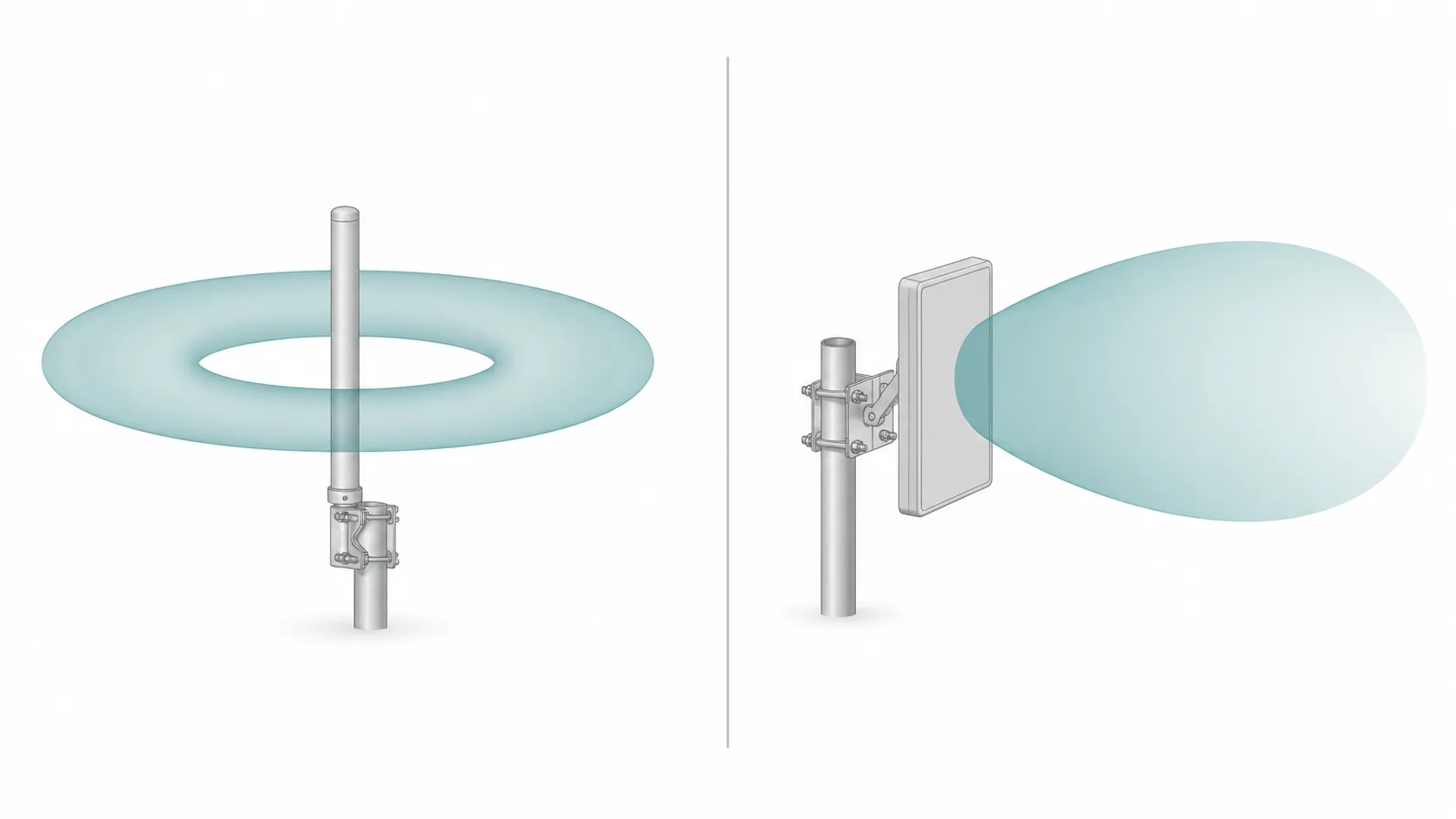
The single biggest split in radiation patterns is directional versus omnidirectional.
- Omnidirectional antenna: radiates roughly 360° in the horizontal plane, like a donut seen from above. It covers all directions at lower gain. Use it when clients surround the site.
- Directional antenna: concentrates energy in one direction with higher gain and a defined beamwidth. Panel, sector, Yagi, and dish antennas are all directional. Use it when you know where the traffic is.
A panel antenna is firmly in the directional camp. Its reflector pushes energy forward and suppresses the back lobe, producing a main lobe aimed at the target area and very little radiation behind it.

If you need the broader choice between full-circle coverage and a focused beam, read the omnidirectional vs directional antenna radiation patterns guide. This page stays focused on panel antenna plots, E-plane/H-plane cuts, beamwidth, side lobes, and other directional pattern terms.
The radiation pattern of a directional panel antenna
A directional panel antenna’s pattern has a clear forward main lobe, a small back lobe, and a beamwidth set by the element layout. Designers shape it for the job:
- A wide-beam panel spreads coverage across a zone or a cluster of clients.
- A narrow-beam panel concentrates energy toward a more distant target for a focused link.
- A sector panel uses a flat-topped azimuth beam and a narrow elevation beam so multiple antennas tile into full cell coverage.
The two beamwidths come from two different parts

The azimuth and elevation beams can be specified almost independently because different structures set them.
- The reflector sets the azimuth beam. A wider backplate with side walls folded further forward squeezes the horizontal beam. The difference between a 65° and a 90° model is often just sheet-metal geometry, with identical radiating elements – which is why the two versions usually cost about the same.
- The vertical stack sets the elevation beam. Adding elements to the vertical column narrows the elevation beam roughly in inverse proportion to the element count, and that is where most of the gain comes from.
That gives you a fast plausibility check: a narrow elevation beam needs a physically tall antenna. If a compact housing claims a narrow beam in both planes, ask how.
This is why “panel antenna” covers many shapes. The same physics governs a microstrip patch antenna radiation pattern, since a panel is often a patch array behind a reflector. To see how the panel pattern stacks up against other directional types, compare the radiation patterns of a panel antenna vs a Yagi antenna and the sector antenna pattern vs a panel antenna.
Interference environment
Need an antenna matched to a high-interference project?
Tell us the frequency range, installation space and interference scenario. We can suggest suitable anti-jamming or specialty antenna options.
How to use the pattern when choosing an antenna
- Start with coverage shape. Decide whether you need a point, an area, one sector, or a full 360° site. For a sectorized antenna layout, sketch the sector split first — for example 3 × 120° or 6 × 65° — then choose the antenna beamwidth.
- Match beamwidth to the target. A target that moves, sways, or spans a wide area needs a wider beam; a fixed distant point can use a narrow one.
- Check front-to-back and side lobes if interference is a concern.
- Confirm polarization matches your radio, especially for MIMO links that need dual polarization.
- Read the pattern across the band, not just at the center frequency, and plan with the worst band edge rather than the best plot.
Turn the vertical beam into a coverage distance

The vertical cut is where most coverage mistakes happen, and it is easy to quantify. With antenna height h, total downtilt t and elevation 3 dB beamwidth θ3, the main lobe reaches the ground between:
- near edge:
d_near = h / tan(t + θ3/2) - far edge:
d_far = h / tan(t − θ3/2)
Take a typical urban macro site – ITU-R M.2292 assumes 25-30 m antenna heights with 3 to 10 degrees of downtilt. At h = 30 m, t = 6° and θ3 = 8°, the main lobe covers roughly 170 m to 860 m from the mast. Increase downtilt to 10° and that shrinks to about 120-310 m. Reduce it to 3° and the upper half of the beam never reaches the ground at all: the classic overshoot that lights up a neighbouring cell instead of your own.
This is geometry, not a propagation prediction. It ignores terrain, clutter, reflections and side-lobe energy, so confirm the real edge by drive test. It does explain three things people find surprising: why a taller mast can cover worse, why one or two extra degrees of downtilt can cut the coverage radius sharply, and why corridors and indoor halls need a wide elevation beam rather than the highest-gain panel in the catalogue.
Common misreadings to avoid
- Treating gain as range. Gain only helps in the direction of the main lobe. Off-axis, a high-gain antenna can be worse than a low-gain one.
- Ignoring the vertical cut. A great azimuth pattern with the wrong elevation beam or downtilt can overshoot or undershoot the target entirely.
- Assuming one plot is the whole story. Always read both E-plane and H-plane.
- Trusting a single frequency point. One mid-band plot flatters a wideband panel; the band edges are where the beam widens and the back lobe grows.
- Accepting a gain figure that its own beamwidths contradict. Run the 31000 check above before you compare prices.
FAQ
Do panel antennas emit RF 360 degrees?
No. A panel antenna is directional. It focuses RF energy in one direction (a forward main lobe) and its reflector suppresses radiation to the rear, so it does not emit 360°. The FCC describes the pattern of a sector (panel) antenna as fan-shaped, “like a wedge cut from a pie”, aimed toward the horizon in a relatively narrow vertical pattern – which is also why power density at ground level under a tower is far lower than directly in front of the antenna. For controlled full-site coverage, use multiple sector panels in a sectorized antenna layout, or choose an omnidirectional antenna when the site is simple and low capacity.
What is the difference between E-plane and H-plane?
The E-plane is the slice of the radiation pattern aligned with the antenna’s electric field and main beam (the elevation cut for a vertically polarized antenna), while the H-plane is the perpendicular slice (the azimuth cut). Reading both tells you the beamwidth in each direction.
What does beamwidth tell me about an antenna?
Beamwidth (half-power beamwidth) is the angle over which the antenna radiates within 3 dB of its peak. It is effectively the usable coverage angle. A narrow beamwidth means high gain and a focused beam that must be aimed precisely; a wide beamwidth covers more area at lower gain.
Is higher antenna gain always better?
No. Higher gain comes from a narrower beam, so it only helps if you can aim the antenna accurately and the target stays inside the beam. For wide-area coverage or moving mounts, a lower-gain, wider-beam antenna often performs better.
Does the radiation pattern change with frequency?
Yes. Pattern shape depends on the antenna’s size in wavelengths, so a wideband panel does not behave the same at 700 MHz and 2.6 GHz. NTIA measurements of array antennas across a wide band show the pattern shifting with frequency, so plan with the worst-case band edge and ask for plots at more than one frequency.
How do I know whether a panel antenna’s stated gain is realistic?
Use the ITU-R F.1336 relationship: gain ≈ 10 × log10(31000 / (azimuth beamwidth × elevation beamwidth)) in dBi. A 65° × 8° panel works out at about 17.8 dBi. A measured value a little below that is normal; a figure well above it needs an explanation from the supplier.
Related guides
- Panel Antenna vs Yagi Antenna: Radiation Patterns and How to Choose
- Sectorized Antennas: 3×120°, 4×90° and 6×65° Layouts
- Panel antenna types and models
Conclusion
A radiation pattern tells you where an antenna’s energy goes, and that, more than any single gain figure, decides whether an antenna fits your link. Learn to read the main lobe, beamwidth, front-to-back ratio, and the E-plane/H-plane cuts, and you can choose between directional and omnidirectional, and between panel, sector, and Yagi designs, with confidence.
Once you know the coverage shape you need, the next step is matching it to a specific antenna. See the panel vs Yagi and panel vs sector comparisons, or browse directional panel antennas to find a model with the pattern your deployment requires.
Ready to specify a product?
Get product suggestions and quotation details for your application.
Tell us the frequency range, installation space and interference scenario. We can suggest suitable anti-jamming or specialty antenna options.
Ask our AI antenna assistant. Enter a keyword or question for a free answer based on this article, Global RF Tech content, and general antenna/RF knowledge.
Do not submit confidential or personal information. Privacy Policy