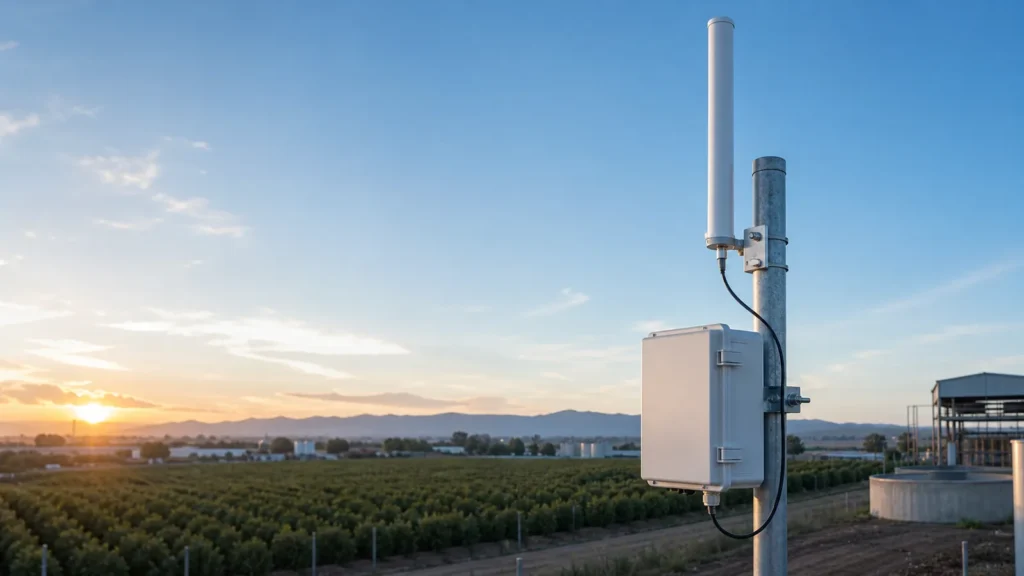

An omnidirectional antenna spreads RF energy around the site in a 360° horizontal pattern. A directional antenna concentrates RF energy into a defined beam, so it reaches farther in one direction and rejects more interference from other directions. Choose omni when users, devices, or towers surround the site; choose directional when the target is known, distant, or interference control matters.
Both antenna types can work well. The mistake is choosing by gain alone. Radiation pattern is the first filter: it tells you where the signal goes, where it does not go, how carefully the antenna must be aimed, and whether the deployment will stay stable when the site changes.
Two antennas from our own catalog make a useful reference pair throughout this article:
- The GL7027V6 fiberglass omni radiates a full 360° in the horizontal plane, covering 698–960 MHz and 1710–2700 MHz.
- The GL-DY7038V11 LPDA focuses its energy into roughly a 90° horizontal / 60° vertical beam at 11 dBi, and reaches up to 3300–3800 MHz.
Same frequency families, completely different coverage jobs. Everything below is about picking the right one.
Omnidirectional vs directional antenna radiation patterns at a glance
The fastest way to compare omnidirectional and directional antennas is to look at the top-view radiation pattern first. An omni pattern is a full circle around the antenna. A directional pattern is a beam, sector, or main lobe aimed toward a target area.
| Factor | Omnidirectional antenna | Directional antenna |
|---|---|---|
| Top-view pattern | 360° horizontal coverage around the antenna | Focused beam, sector, or main lobe in one direction |
| Elevation pattern | Usually gets flatter vertically as gain rises | Depends on the panel, Yagi, LPDA, dish, or sector design |
| Gain behavior | Lower to moderate gain because power is spread around the site | Higher gain in the aimed direction because power is concentrated |
| Alignment | Minimal aiming; easier for moving or unknown target directions | Must be aimed at the tower, AP, client zone, or link endpoint |
| Interference | Receives signal and noise from all directions | Rejects more off-axis noise and unwanted cells |
| Best fit | Moving devices, small sites, temporary coverage, uncertain tower direction | Fixed links, rural CPE, corridors, sectorized coverage, known AP or tower direction |
A simple rule works in most projects: use an omnidirectional pattern when the target direction changes or surrounds the antenna; use a directional pattern when the target is fixed and you need more reach, cleaner signal, or better interference control.
What an omnidirectional antenna actually does
An omni covers a broad ring around the mounting point. Picture it less as a flashlight and more as a bare ceiling bulb: signal goes out in every horizontal direction, which is exactly what you want when the devices it serves are scattered around it rather than lined up one way.
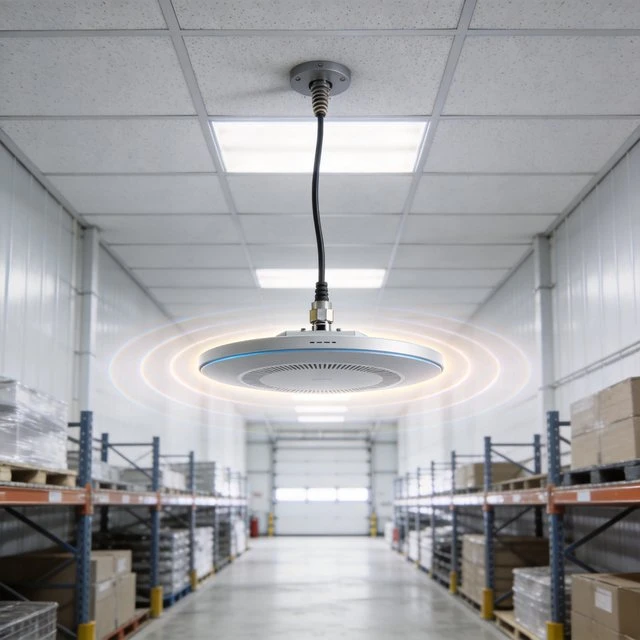
Take the GL7027V6 as a typical broadband cellular omni. Its published specs:
- Bands: 698–960 / 1710–2700 MHz (most 4G/LTE plus sub-1 GHz IoT)
- Pattern: 360° horizontal, vertical polarization
- VSWR ≤ 2.0, 50 Ω, N-female connector
- Ø63 × 600 mm fiberglass radome, about 2 kg, up to 100 W
Where an omni like this earns its place:
- IoT or LPWAN gateways serving sensors spread across a site
- Site perimeters and yards where assets move around the antenna
- A single mast that has to cover a wide campus zone
- Any layout where you genuinely cannot predict where the traffic comes from
The catch is physics: spreading power over 360° means none of it is concentrated. If you need to reach one distant point, or you want to ignore interference coming from behind the antenna, an omni fights you.
What a directional antenna actually does
A directional antenna does the opposite — it throws the energy forward and largely ignores the rest. That is why it shows up in point-to-point links, donor-signal pickup, corridor coverage, and remote yards where you know exactly where the signal has to go. A focused LPDA or panel antenna is a typical directional pick.
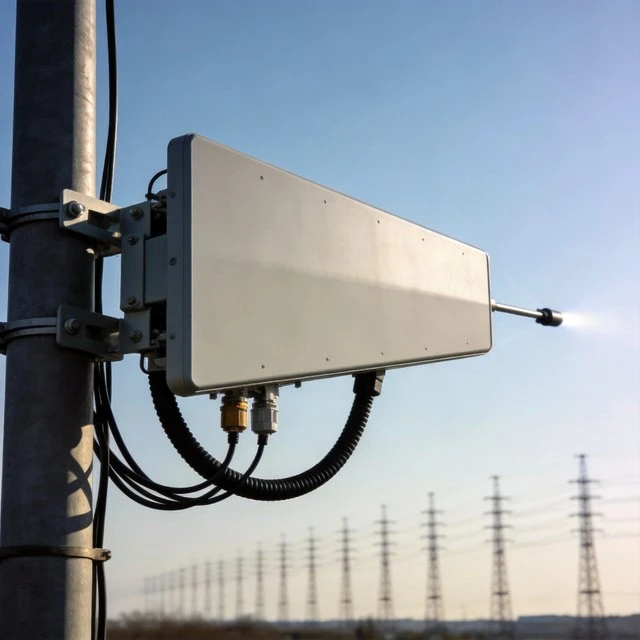
The GL-DY7038V11 LPDA shows what “focused” buys you:
- Bands: 698–960 / 1710–2700 / 3300–3800 MHz (adds the C-band / 5G mid-band)
- Gain: 11 dBi
- Beamwidth: 90° horizontal, 60° vertical
- VSWR < 2.0, N-female (N-K) connector
- 440 × 210 × 65 mm, 50 W, −40 °C to +65 °C, DC-ground lightning protection
That 11 dBi is not free range — it comes from narrowing the beam to about 90°. Aim it correctly and you gain reach and a cleaner signal-to-noise ratio in that direction. Aim it 30° off and most of the advantage is gone. Directional antennas reward careful installation and punish lazy alignment.
How to read the pattern before choosing
Read the azimuth plot first
The azimuth plot is the top-view coverage shape. For an omni antenna, it should look close to a circle around the antenna. For a directional antenna, it should show a forward main lobe with a defined beamwidth. If your users sit all around the site, a narrow beam will miss part of the coverage. If your users sit in one known direction, a 360° omni wastes power where you do not need it.
Check the elevation cut before assuming range
Higher-gain omni antennas often flatten the vertical pattern. That can help along the ground, but it can also overshoot nearby devices or underperform when the antenna is mounted too high or too low. Directional antennas have the same issue: a good azimuth beam with the wrong elevation angle can still miss the target. For a deeper look at E-plane and H-plane plots, read the panel antenna radiation pattern guide.
Compare gain with beamwidth, not by itself
Gain is not raw strength. Gain tells you how tightly the antenna concentrates energy. A high-gain directional antenna can perform worse than a lower-gain omni if the target sits outside the beam. A modest-gain omni can be the better choice when coverage must stay usable in every direction.
Look for front-to-back ratio when interference matters
When noise or unwanted cells come from behind the antenna, front-to-back ratio matters. A directional panel, Yagi, LPDA, or sector antenna can reject more energy from the rear and sides. That is one of the main reasons directional antennas are used for fixed outdoor links, rural routers, and sectorized base-station coverage.
Spec by spec: the two patterns side by side
Here the difference stops being abstract. Real numbers from the two reference models:
| Spec | GL7027V6 (omnidirectional) | GL-DY7038V11 (directional / LPDA) |
|---|---|---|
| Coverage pattern | 360° horizontal | ~90° H / 60° V beam |
| Gain | Broad, low concentration | 11 dBi |
| Bands (MHz) | 698–960 / 1710–2700 | 698–960 / 1710–2700 / 3300–3800 |
| VSWR | ≤ 2.0 | < 2.0 |
| Impedance | 50 Ω | 50 Ω |
| Connector | N-female | N-female |
| Max power | 100 W | 50 W |
| Size | Ø63 × 600 mm | 440 × 210 × 65 mm |
| Alignment effort | Low — point it up | High — must aim at target |
| Best at | Even area coverage | Range and rejection in one direction |
Read the table as a trade, not a ranking. The omni gives you forgiveness and 360° reach at lower concentration. The LPDA gives you 11 dBi and noise rejection, but only along the line you point it, and only if you point it well.
Which radiation pattern should you choose for each deployment?
The right choice depends on site geometry first. Frequency band, gain, connector, and cable length still matter, but they come after the coverage shape is clear.
| Deployment | Better pattern | Why | Useful next step |
|---|---|---|---|
| Vehicle gateway, mobile router, or moving asset | Omnidirectional | The target direction changes, so 360° horizontal coverage is safer than a fixed beam. | Cellular modem and router antennas |
| Fixed rural router or CPE aimed at one tower | Directional panel, Yagi, or LPDA | The tower direction is known, so the antenna can trade coverage angle for reach and noise rejection. | Panel antennas for directional coverage |
| Private 5G or base-station sector | Sector directional | Each sector covers a controlled wedge, which improves capacity and interference control. | Sectorized antenna layouts |
| Warehouse aisle, corridor, road, or long yard | Directional | The coverage area is stretched in one direction, so a focused pattern uses RF energy better. | Panel vs Yagi radiation patterns |
| Small site with users around the antenna | Omnidirectional | The site needs simple full-circle coverage more than long reach in one direction. | Use an omni model such as the existing fiberglass omni examples in this guide. |
A worked example: covering a 150 m equipment yard
Say you have an outdoor yard about 150 m across, with cellular IoT trackers on equipment that gets moved around daily.
Option A — one omni in the middle. Mount a GL7027V6 on a central mast. Every tracker, in any corner, sees roughly the same signal, and assets can move anywhere without re-planning. The limit is reach: if the yard were 400 m long, the edges would start to fade because the power is spread across the whole circle.
Option B — one directional from a corner. Mount a GL-DY7038V11 in one corner, aimed across the yard. The 11 dBi beam pushes much further down that line and ignores a noisy neighbour behind it — great if the assets sit along one axis. But the 90° beam leaves the two near-side corners weak, and every layout change means re-checking coverage.
For scattered, moving assets the omni usually wins on simplicity. For a long, fixed haul down one direction, the directional wins on reach. Notice that the deciding factor was the site geometry, not the gain number.
How gain really works here
Gain is the most misread spec in antenna selection. A higher number does not add power; the antenna cannot create energy it was not fed. It only redistributes what is there. The GL-DY7038V11 reaches 11 dBi because it narrowed the beam to ~90°; the GL7027V6 trades that concentration for full 360° coverage.
So “more gain = better” is only true when a narrower beam actually fits the site. On an omni, extra gain mostly flattens the vertical pattern — more reach along the ground, less straight up. On a directional, extra gain tightens the beam further: better reach, harder aiming. If you want the underlying maths, our companion piece on antenna gain basics walks through dBi, dBd and the beamwidth trade.
Where each one is the wrong choice
Picking by gain number alone
Two antennas, one says 11 dBi, the buyer takes it — without checking that a 90° beam leaves half the site dark. The spec sheet was right; the application was wrong.
Forgetting the environment
Metal racking, vehicles, rooftop clutter and a neighbour’s network all reshape coverage. An antenna that models perfectly can still disappoint if the mounting geometry is off.
A directional beam on moving targets
If assets wander, a fixed beam becomes a maintenance job — you are constantly chasing coverage gaps.
An omni where you needed selectivity
In an RF-noisy site, 360° exposure also means listening to every interferer around you; a directional antenna would have rejected most of it.
A quick decision checklist
Before you compare model numbers, answer these:
- Are the devices spread around the antenna, or lined up in one direction?
- Do you need even area coverage, or range down one path?
- Is interference coming from behind or beside the antenna?
- Will the layout stay put, or change often?
- Would two cheaper omnis beat one struggling directional — or the reverse?
If you are planning outdoor cellular or a private network specifically, 5G outdoor antenna types is the logical next read on how pattern choice ties into network design. For the underlying theory, the overview of an antenna radiation pattern is a neutral reference.
Which pattern to spec
Omni or directional is a coverage-shape decision, not a quality contest. Choose omnidirectional — like the GL7027V6 — when traffic is spread around the antenna and you value even, low-maintenance coverage. Choose directional — like the GL-DY7038V11 LPDA — when you know where the signal has to go and you need range or noise rejection along that line.
If you are choosing between an omnidirectional and directional antenna, send us your frequency band, coverage geometry, target distance, tower or AP direction if known, gain or beamwidth target, connector, cable length, mounting method, outdoor rating, and expected quantity. We can recommend an omni, panel, Yagi, LPDA, or sector antenna for prototype testing or production. If your deployment needs multiple spatial streams, the same pattern logic applies to outdoor MIMO omnidirectional antennas — one 360° antenna carrying two, four or six streams from a single mast. Request a quote with your site details and we will match the antenna pattern to the actual deployment.
For a WiFi-specific workflow that combines coverage pattern, frequency band, gain, beamwidth, cable loss, connector, and outdoor exposure, see our outdoor WiFi antenna selection guide.
Frequently asked questions
Is a directional antenna always higher gain than an omnidirectional one?
Usually yes, but only because it concentrates the same energy into a narrow beam. The GL-DY7038V11 reaches 11 dBi by focusing into about 90°. An omni spreads power across 360°, so its gain reads lower even though the antenna is not weaker. Gain describes beam shape, not raw strength.
Can I just swap an omni for a directional antenna to boost a weak signal?
Only if your devices sit in one direction. A directional antenna strengthens the signal along its beam, but anything outside that ~90° slice gets worse, not better. If coverage is weak everywhere rather than at one far point, more antennas or better placement usually beats a tighter beam.
How much gain do I actually need?
Start from distance and beamwidth, not the highest number. A wide site with scattered devices is better served by a 360° omni with modest gain than by a high-gain beam that misses most of the area. For one long, fixed link, higher directional gain such as 11 dBi or more pays off — provided you can aim and fix the antenna precisely.
Can an omnidirectional antenna be used for a point-to-point link?
It can work over short distances, but it is inefficient: most of the radiated power goes everywhere except toward the far end, and it picks up interference from all sides. For a real point-to-point or building-to-building link, a directional antenna at each end is almost always the better choice.
Which pattern is right for multi-band 4G/5G deployments?
Match the bands first, then the pattern. The GL7027V6 covers 698–960 / 1710–2700 MHz for broad 4G/IoT coverage; the GL-DY7038V11 adds 3300–3800 MHz for 5G mid-band along a focused path. Confirm the antenna covers every band your radio uses before the omni-versus-directional decision even matters.
What is the radiation pattern of an omnidirectional antenna?
An omnidirectional antenna radiates roughly 360° in the horizontal plane. Its 3D pattern is often described as a donut shape: strong around the horizon, weaker above and below the antenna axis. Higher-gain omni antennas usually flatten this vertical pattern, which can improve ground-level reach but reduce coverage above or below the antenna.
What is the radiation pattern of a directional antenna?
A directional antenna concentrates RF energy into a forward main lobe instead of spreading it evenly around the site. Panel, Yagi, LPDA, dish, and sector antennas are all directional types. Their beamwidth, side lobes, and front-to-back ratio decide how much area they cover and how well they reject off-axis interference.
Does an omnidirectional antenna radiate equally in every direction?
Only in the horizontal plane. A real omnidirectional antenna is not a perfect sphere. It usually provides near-360° coverage around the antenna, but the vertical pattern changes with antenna design, gain, mounting height, nearby metal, and ground conditions.
Is a panel antenna directional or omnidirectional?
A panel antenna is directional. It focuses energy forward into a defined beam and suppresses much of the rear radiation with a reflector. Use a panel when the target direction is known; use an omnidirectional antenna when coverage must surround the antenna.
Looking for hardware after choosing a pattern? Browse our omnidirectional antennas for 360° RF coverage.
Ask our AI antenna assistant. Enter a keyword or question for a free answer based on this article, Global RF Tech content, and general antenna/RF knowledge.
Do not submit confidential or personal information. Privacy Policy