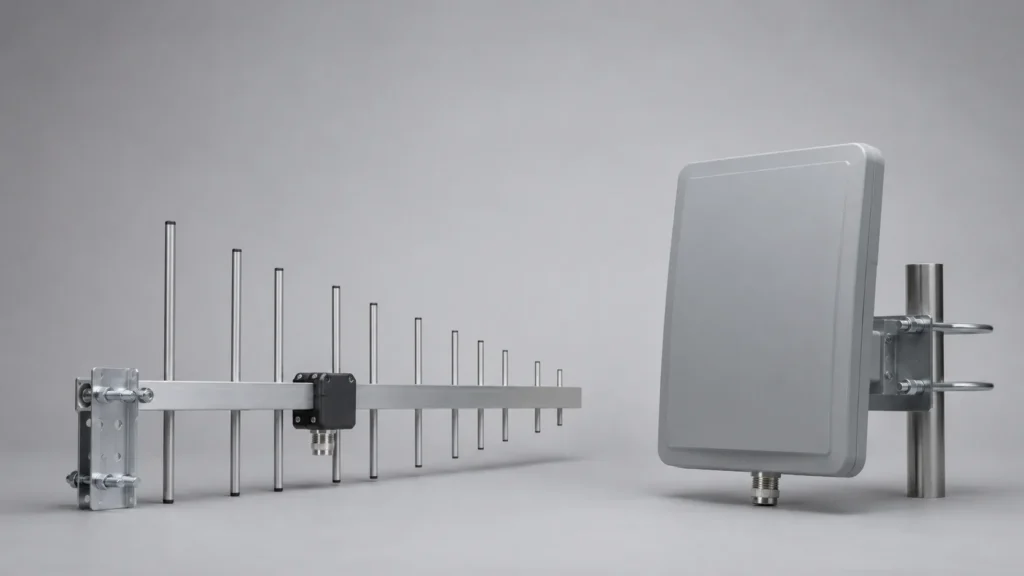
A panel antenna and a Yagi antenna are both directional, but they shape their energy very differently, and that difference decides which one belongs on your link. In short: a panel antenna spreads a wider, flatter beam that covers an area or a sector, while a Yagi antenna concentrates a narrow pencil beam at a single distant point. If you are comparing the radiation patterns of a Yagi antenna vs a panel antenna to pick the right one, start with the coverage shape you actually need, not the gain number on the datasheet.
This guide explains how each antenna radiates, where each one wins, and the practical mistakes that cause weak links and failed site surveys.
Quick verdict
- Choose a panel antenna when you need to cover a wedge, a sector, or a defined area, when you want dual-polarization for MIMO, or when a flat, low-profile housing matters (wall, tower face, building corner).
- Choose a Yagi antenna when you need the most reach toward one fixed point, a narrow beam to reject interference from the sides, and you can accept a longer boom and single linear polarization.
If your application is a point-to-point backhaul over a long, clear path, a Yagi (or its cousin, the log-periodic) is often the simpler answer. If you are sectorizing coverage, feeding multiple clients in a zone, or building a MIMO cellular link, a panel antenna is usually the better fit.
How each antenna radiates
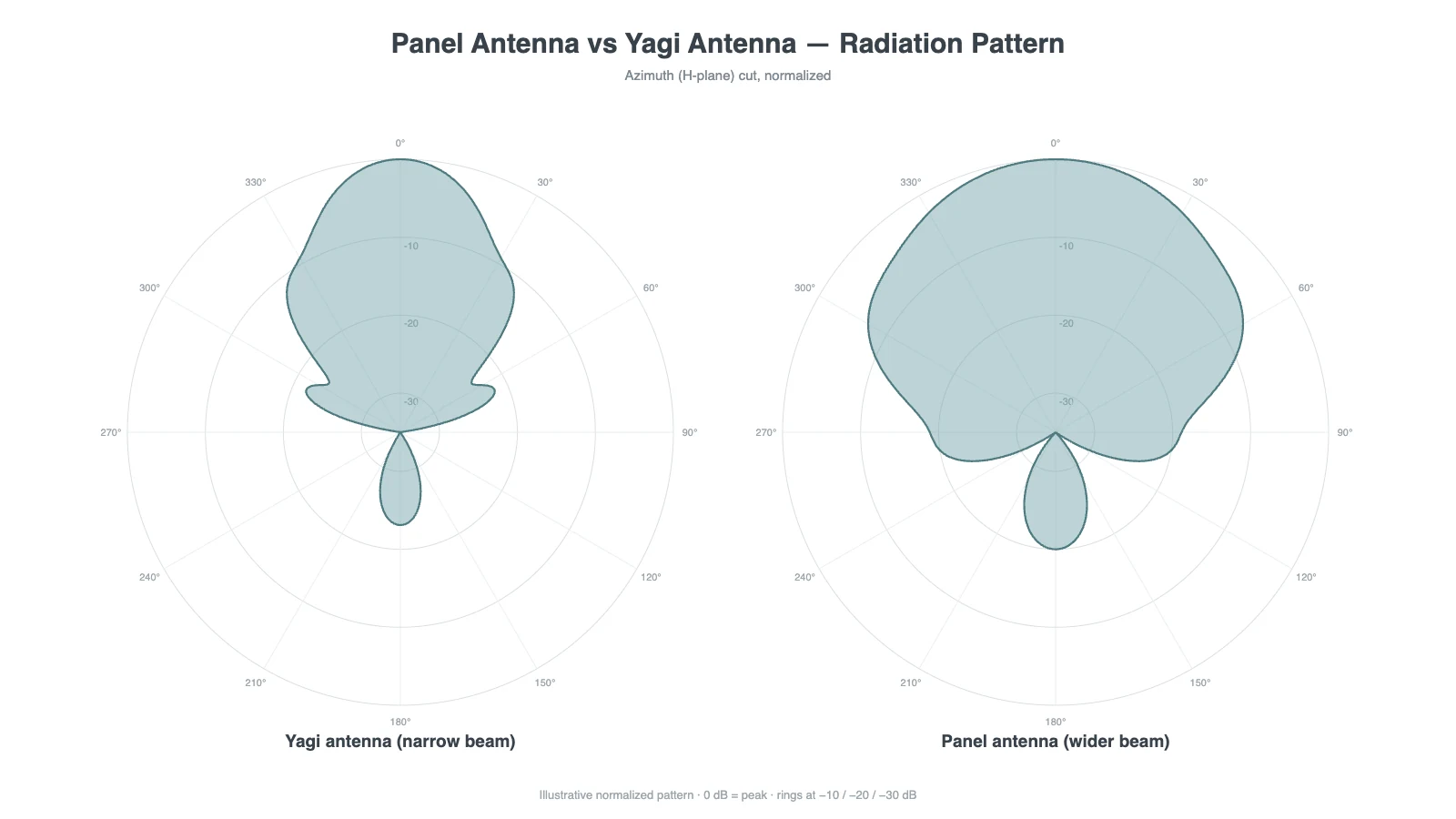
The radiation pattern is the map of where an antenna sends and receives energy. It is the single most useful thing to compare, because it tells you the coverage shape before you ever look at gain.
Yagi antenna (Yagi-Uda). A Yagi is an end-fire array: one driven element, one reflector behind it, and a row of director elements along a boom in front. Energy launches along the boom, so the main lobe is narrow in both the horizontal (E-plane) and vertical (H-plane) directions. Adding directors increases gain and narrows the beam further. The result is a pencil beam with a strong front-to-back ratio, which is excellent for reaching one direction and rejecting signals from behind.
Panel antenna. A panel antenna (also called a flat panel or patch antenna) uses one or more radiating elements mounted over a ground plane or reflector. The reflector pushes energy forward and suppresses the back lobe, giving a directional pattern with a controlled, usually wider beamwidth. Designers tune the azimuth and elevation beamwidth by changing the element layout, so panels are made in many shapes — from a near-square wide-beam patch to a tall, narrow sector panel.
The core takeaway: a Yagi narrows the beam by adding length along one axis; a panel shapes the beam by arranging elements across a flat aperture. That is why a Yagi gets long and thin while a panel stays flat. For a deeper look at how to read these plots, see panel antenna radiation pattern explained.

Radiation pattern comparison
| Pattern characteristic | Yagi antenna | Panel antenna |
|---|---|---|
| Main lobe shape | Narrow pencil beam | Broader, shaped beam (area/sector) |
| Typical horizontal beamwidth | Narrow (often ~20°–50°) | Wider and tunable (often ~30°–120°) |
| Front-to-back ratio | High | High (reflector-backed) |
| Polarization | Usually single linear | Single, or dual/slant for MIMO |
| Bandwidth | Narrower (resonant elements) | Can be broadband |
| Best coverage geometry | One distant point | An area, zone, or sector |
Beamwidth values are typical ranges and depend on the specific design and frequency band — always confirm against the datasheet. Request the measured E-plane and H-plane pattern plots before you commit, not just the peak gain figure.
Form factor, mounting, and durability
The pattern decides electrical fit; the mechanics decide whether it survives in the field.
- Yagi: long boom with exposed elements. It needs clearance and a clear aim down the boom axis. The open structure has relatively low wind load for its gain, but the protruding elements are easier to damage and harder to hide.
- Panel: flat, enclosed housing that mounts cleanly against a wall, mast, or tower face. It is easy to integrate visually and to seal against weather (ask for the ingress rating, for example IP65/IP67). A flat face presents more wind load area than an open Yagi of similar gain, so check the mounting bracket and pole rating.
For tower-face sectorization, building-edge coverage, or any install where a low profile matters, the panel’s form factor is usually the deciding advantage. Global RF Tech supplies both wall-mount panel antennas and sector panels for these mounts.
When to choose each
Choose a Yagi antenna when: 1. You are building a point-to-point link to one fixed, distant location. 2. You need to reject interference arriving from the sides or behind. 3. Single linear polarization is acceptable. 4. You can mount and aim a long boom with clearance.
Choose a panel antenna when: 1. You need to cover an area, a sector, or several clients in a zone. 2. You want dual-polarization for a 2×2 or 4×4 MIMO link. 3. You need a flat, weather-sealed, low-profile enclosure. 4. You want broadband coverage across multiple cellular bands.
A useful rule of thumb: if you can point at the one thing you are talking to, a Yagi is a candidate. If you are covering space rather than a point, choose a panel.
Common mistakes
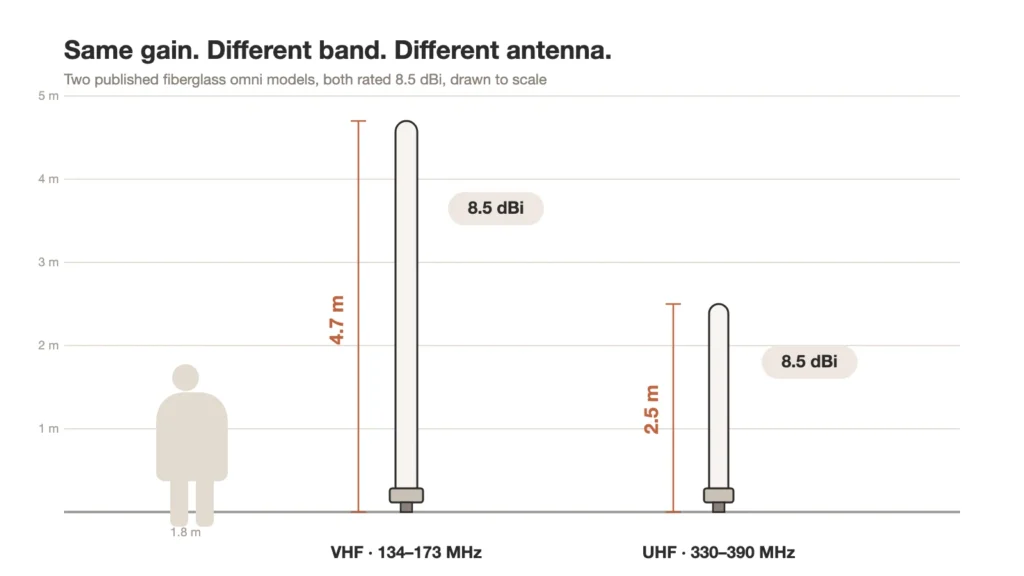
- Comparing peak gain instead of beam shape. Two antennas can share a gain number and cover completely different geometry. Read the pattern, not just the headline dBi.
- Over-narrowing the beam. A high-gain Yagi with a very narrow beam is unforgiving to aim and to tower sway. On a moving or vibrating mount, a slightly wider panel beam holds the link better.
- Ignoring polarization for MIMO. A single-polarization Yagi cannot deliver the dual-polarized streams a 4×4 MIMO modem expects. For MIMO cellular links, a dual-polarized panel is the right tool.
- Forgetting cable loss and connector type. At higher bands, feedline loss can erase the gain advantage you paid for. Confirm the connector (N-type, SMA) and keep the run short.
How to choose: a short selection checklist
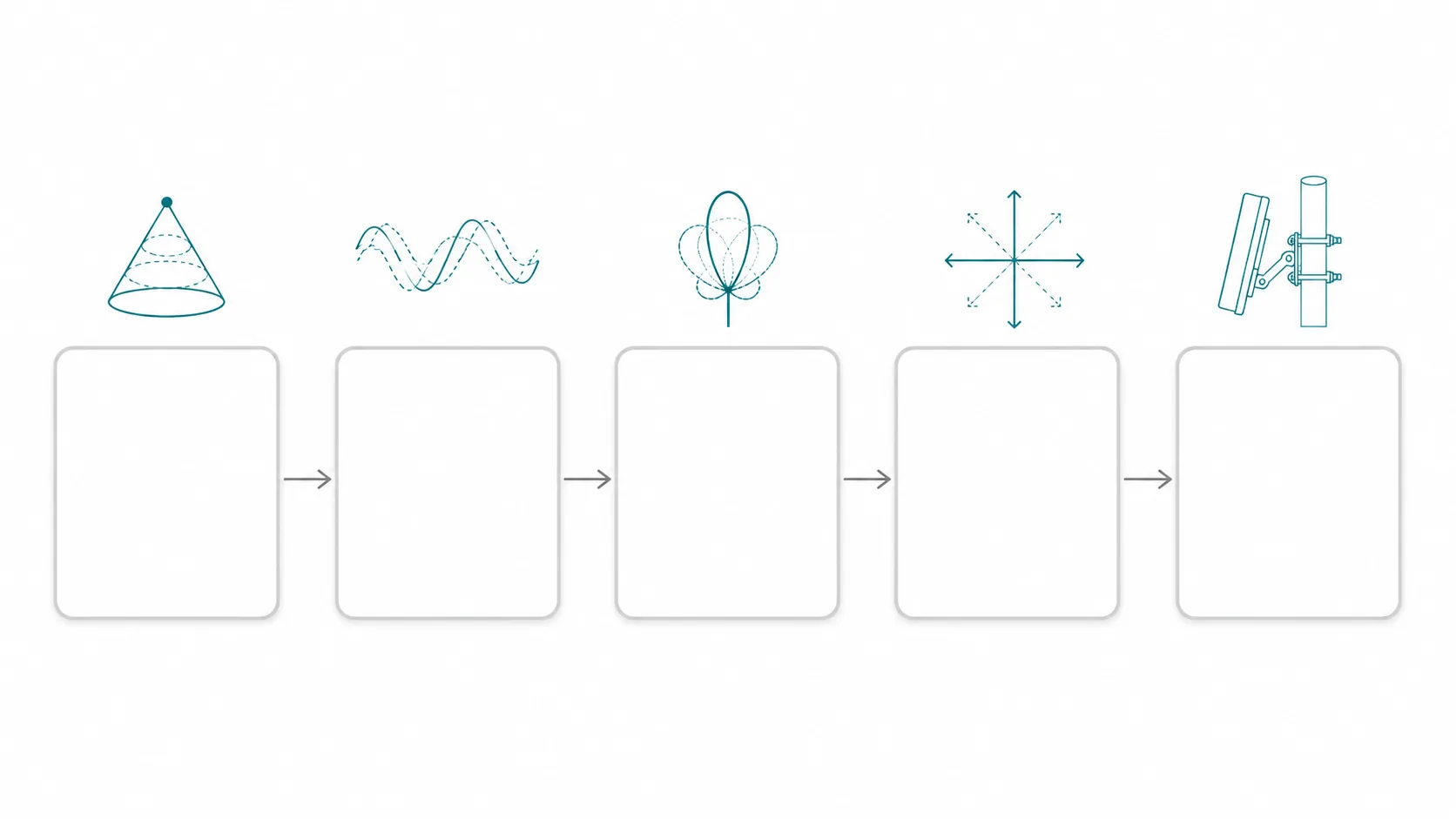
- Define the coverage shape first — one point, or an area/sector?
- Confirm the frequency band(s) the antenna must support.
- Set the required gain and acceptable beamwidth together, not separately.
- Decide polarization — single is fine for simple links; dual is required for MIMO.
- Check mounting and environment — clearance, wind load, ingress rating.
- Ask the supplier for measured pattern plots, VSWR, and gain across the band, plus the connector type and mounting hardware.
Need product options after comparing antenna types? View current Yagi antenna products by frequency, gain and connector.
FAQ
Is a panel antenna or a Yagi antenna better for long range?
It depends on the geometry. For a single fixed point at long range, a high-gain Yagi often reaches farthest because it concentrates energy in a narrow beam. For covering a distant area or running a MIMO link, a panel antenna is usually better, because reach without the right coverage shape and polarization still gives a poor link.
What is the difference between a panel antenna and an omni antenna?
A panel antenna is directional — it focuses energy in one direction and ignores the rest. An omnidirectional (omni) antenna radiates 360° in the horizontal plane to cover all directions at lower gain. Choose a panel when you know where your traffic is; choose an omni when clients are spread all around the site.
Do panel and Yagi antennas use the same connector?
Not always. Both are commonly supplied with N-type or SMA connectors, but it varies by model and band. Confirm the connector gender and type against your radio before ordering, and account for any pigtail loss.
Can I use a Yagi for a MIMO link?
A standard Yagi is single-polarization, so it is not ideal for dual-stream MIMO. For 2×2 or 4×4 MIMO, a dual-polarized panel antenna is the standard choice.
Before choosing between two directional antennas, make sure a directional pattern is the right category. The omni vs directional coverage pattern guide explains when 360° coverage is safer than a focused beam.
Related guides
- Panel Antenna vs Sector Antenna: Differences and When to Use Each
- Panel Antenna Radiation Pattern Explained
- Panel Antennas: Types, Uses & How to Choose
Conclusion
The radiation pattern is the right place to start a panel antenna vs Yagi antenna comparison. A Yagi narrows energy into a pencil beam for maximum reach toward one point; a panel shapes a wider, often dual-polarized beam to cover an area or sector. Match the antenna to the coverage shape and polarization your system needs, then confirm gain, beamwidth, band, and mounting against the datasheet.
If you are not sure which pattern fits your deployment, send us your frequency band, coverage geometry, and MIMO requirement. As an RF antenna manufacturer with in-house design and OEM/ODM support, our engineering team will recommend the right antenna. Browse panel antennas or get a free quote with your project requirements.
Ask our AI antenna assistant. Enter a keyword or question for a free answer based on this article, Global RF Tech content, and general antenna/RF knowledge.
Do not submit confidential or personal information. Privacy Policy