Short answer: choose VHF when you are covering open ground, water or rural terrain and want range from fewer sites. Choose UHF when you are working around buildings, inside structures or in dense industrial environments, or when the antenna has to be physically small. The trade-off is not that one band is better — it is that each band forces a different antenna.
Most comparisons of these two bands are written from the radio side: which handset to buy, how far it will talk. This one covers what happens to the antenna, because that is where band choice shows up as real constraints on length, gain, mounting and cost.
The two bands
VHF spans 30–300 MHz; UHF spans 300 MHz to roughly 1 GHz. In land mobile radio the practical segments are much narrower — most VHF systems sit in 134–174 MHz, and most UHF land mobile work sits in 300–470 MHz.
The number that matters is wavelength. At 150 MHz a full wavelength is about 2 m. At 400 MHz it is about 0.75 m. Everything below follows from that ratio.
Propagation: a trade-off, not a ranking
VHF signals have longer wavelengths, so they diffract more readily around terrain and obstacles and tend to hold up better over open distances. UHF signals have shorter wavelengths, which pass more effectively through the gaps in built structures — doorways, windows, corridors — and reflect around interiors rather than being blocked outright.
This is why the folk rule “UHF penetrates buildings better” is only half right. UHF is not drilling through concrete; it is finding more paths through and around a cluttered environment. In open country that advantage disappears and VHF’s diffraction behaviour wins.
Neither effect can be reduced to a single number that applies to your site. Terrain, building materials and antenna height all move the result.
What actually changes about the antenna
This is the part that gets left out of most comparisons.
1. Element length scales with wavelength
An antenna element is sized against the wavelength it works at, so a VHF antenna is inherently longer than a UHF antenna of the same design.
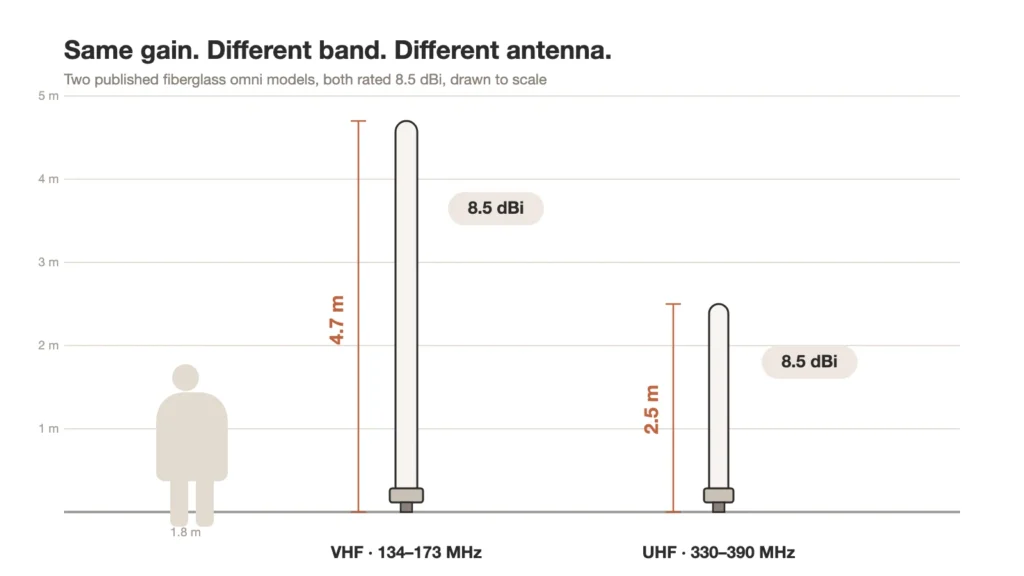
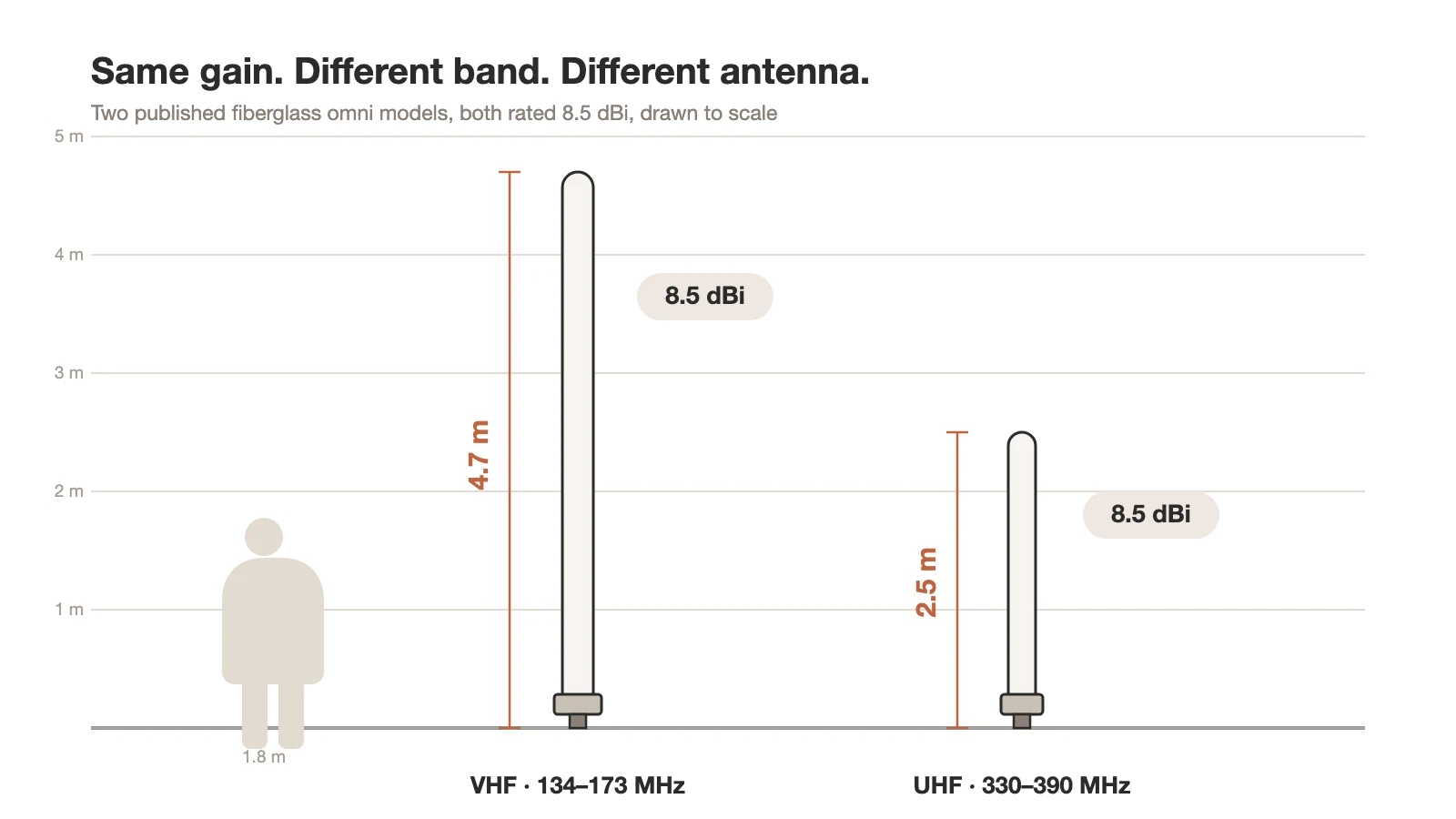
The clearest way to see it is to hold the gain constant. Two of our published fiberglass omni models are both rated 8.5 dBi. The VHF version, covering 134–173 MHz, is 4.7 m long. The UHF version, covering 330–390 MHz, reaches the same 8.5 dBi in 2.5 m — a little over half the length, for identical gain.
That length is not a cosmetic issue. It drives mast loading, wind loading, shipping dimensions and whether the antenna can go where you need it.
2. The gain ceiling is different in each band
Because gain in an omnidirectional antenna is bought by stacking elements vertically, and elements are longer in VHF, high-gain VHF omnis get physically large very quickly.
The pattern shows up clearly across our production range:
| VHF (110–290 MHz) | UHF (300–450 MHz) | |
|---|---|---|
| Fiberglass omni gain | 3.0–8.7 dBi | 3.0–14.2 dBi |
| Yagi gain | 8.0–14.5 dBi | 11.2–15.7 dBi |
| Folded dipole array | up to 12 dBi omni / 15 dBi directional | up to 12 dBi omni / 15 dBi directional |
| Vehicle-mount gain | 2.0–4.7 dBi | — |
| Power handling | 50–500 W | 50–500 W |
The highest-gain VHF omni in the range is 8.7 dBi. The highest-gain UHF omni is 14.2 dBi. Same product family, same construction — the difference is what wavelength allows in a manageable size.
3. In VHF, extra gain usually means going directional
If an 8.7 dBi omni is not enough at VHF, the practical answer is rarely a longer omni. It is a Yagi or a folded dipole array. Our VHF Yagis run 8.0–14.5 dBi and the folded dipole arrays reach 15 dBi in directional configuration.
That is a real design decision, not a catalogue detail: you are trading 360° coverage for gain, which means you now need to know where your traffic is coming from.
4. Ground plane and mounting requirements diverge
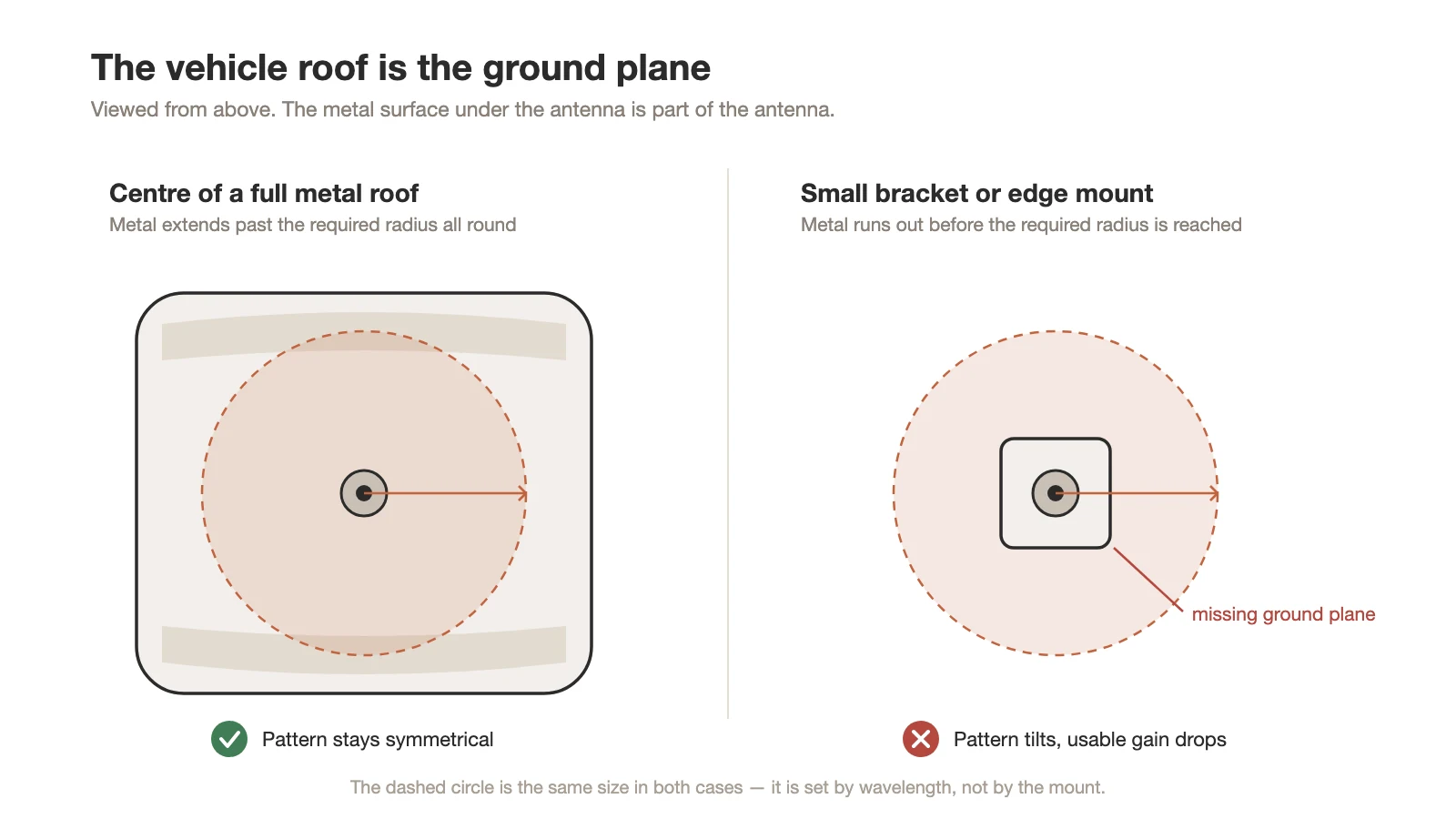
Vehicle-mount VHF antennas depend on the vehicle body acting as a ground plane, and at VHF wavelengths the required ground plane is large — a roof, not a bracket. This is why our vehicle-mount VHF models sit at 2.0–4.7 dBi: the practical gain is limited by what the mounting surface can support.
Interfaces follow the same split. VHF mobile models are supplied with UHF Male (PL-259) or NMO Male bases. Higher-power base station hardware in both bands moves to N Female, and the highest-power folded dipole arrays use 7/16 DIN Female — the interface our 300–500 W models are supplied with.
Advantages and limitations, band by band
VHF
Advantages. Diffracts around terrain and obstacles, so coverage holds up over open ground, water and rural terrain. Fewer sites needed for the same wide-area footprint. Vehicle-mount hardware is simple and widely supported on PL-259 and NMO bases.
Limitations. Antennas are physically long — a 3.2 dBi fiberglass omni is 1.4 m. Omnidirectional gain tops out at 8.7 dBi in our range, so extra gain means going directional. Vehicle-mount gain is capped at 2.0–4.7 dBi by the ground plane the vehicle can provide. High-gain VHF hardware brings real mast and wind loading.
UHF
Advantages. Much higher gain in a manageable size — our highest-gain UHF omni is 14.2 dBi against 8.7 dBi for VHF. Works better around and through built environments. Compact enough for panel, portable and backpack equipment. Yagis reach 15.7 dBi.
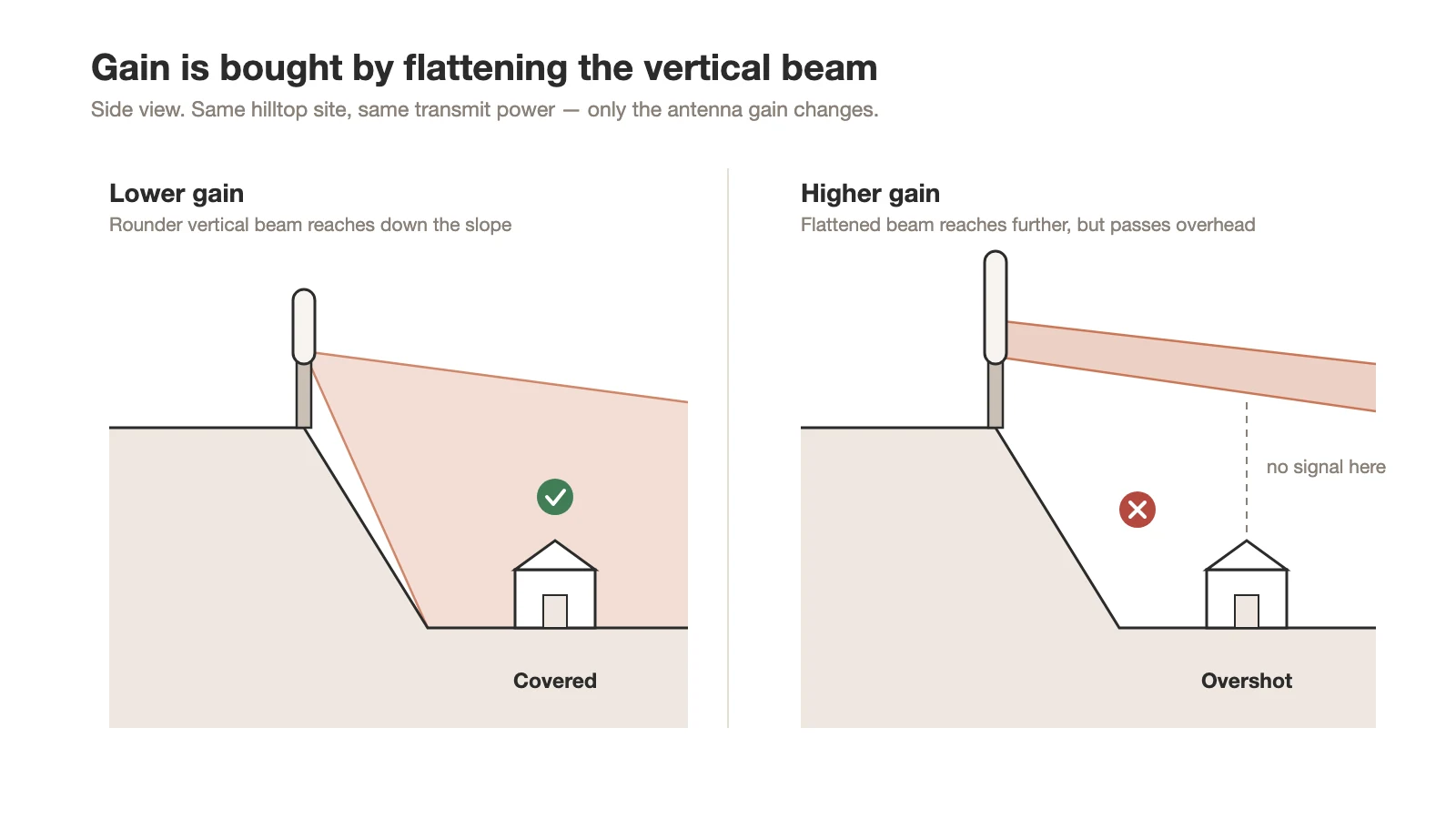
Limitations. Less effective at diffracting around terrain, so open-country range per site is generally shorter. Higher-gain omnis have a flatter vertical pattern, which can overshoot nearby users. In our range UHF stops at 450 MHz, so requirements above that need to be assessed rather than assumed.
Which band for which job
| Situation | Band | Typical antenna |
|---|---|---|
| Wide-area rural or maritime coverage from few sites | VHF | Fiberglass omni, 3–8.7 dBi |
| Vehicle fleet over open territory | VHF | Vehicle-mount, 2.0–4.7 dBi, NMO or PL-259 |
| Fixed link between two known points | Either | Yagi — VHF 8–14.5 dBi, UHF 11.2–15.7 dBi |
| Campus, plant or warehouse with structures in the path | UHF | Fiberglass omni, 3–14.2 dBi |
| Sector coverage in a defined area | UHF | Panel, 5 dBi |
| Portable or backpack equipment | UHF | Terminal antenna, 5 dBi |
| High-power base site | Either | Folded dipole array, up to 500 W |
Three mistakes worth avoiding
Treating “UHF penetrates better” as absolute. It describes behaviour in cluttered environments. Over open terrain the advantage reverses.
Assuming more gain is always better. Omnidirectional gain is achieved by flattening the vertical pattern. A high-gain omni on a hilltop can shoot straight over users in the valley below. Higher gain also means tighter alignment tolerance on directional antennas.
Ignoring size until installation day. A high-gain VHF antenna is a large object with real wind loading. Check the mast, the mounting surface and the access before specifying gain.
Project support
Need an antenna recommendation for your project?
Share your frequency band, device type, installation space and expected range. Our team will help match suitable antenna options and quotation details.
Licensing affects the decision
In most countries both bands are licensed, and which band you can actually get authorised for is often decided before any technical argument. Availability varies by region, by service type and by how congested the local spectrum already is — in some areas VHF land mobile channels are effectively full, which settles the question regardless of what would perform better.
Check with the spectrum regulator in your country, or with the system integrator handling your licence, before committing to a band. We supply the antenna to the frequency you are licensed for; we are not a licensing authority and cannot advise on applications.
Can one antenna cover both bands?
In our production range, VHF and UHF are separate product lines — the models listed above are specified for one band or the other. Wideband coverage across both is a custom question that depends on how much bandwidth you actually need and what VSWR you can accept across it, and it needs to be assessed against a specific requirement rather than assumed.
If you are running both bands, the usual approach is separate antennas rather than one compromise radiator.
Key takeaways
- Band choice is a trade-off between diffraction behaviour and antenna size, not a ranking of one band over the other.
- Wavelength sets element length, so VHF antennas are inherently larger for the same design.
- Omnidirectional gain ceilings differ sharply: 8.7 dBi in VHF against 14.2 dBi in UHF across our range.
- If an omni is not enough in VHF, go directional — Yagi to 14.5 dBi, folded dipole array to 15 dBi — rather than longer.
- Vehicle-mount VHF gain is limited by the ground plane the vehicle provides, which is why those models sit at 2.0–4.7 dBi.
- Licensing availability in your region may decide the band before performance does.
FAQ
Do police use VHF or UHF? Both, depending on the agency and the terrain. Rural agencies covering large open areas often stay on VHF; urban departments working around buildings more commonly use UHF. Many systems now run trunked networks that sit in UHF or 700/800 MHz.
How can I tell if a radio is VHF or UHF? Check the frequency range printed on the label or in the specification, not the model name. Anything in 134–174 MHz is VHF land mobile; 400–470 MHz is UHF. The antenna is also a clue — a noticeably longer whip usually means VHF.
Do walkie talkies use UHF or VHF? Consumer handhelds are mostly UHF, because a UHF antenna can be short enough to be practical on a handheld. Professional and marine handhelds are more often VHF.
Do I need a UHF or VHF antenna for digital TV? That is a different application from the land mobile systems covered here. Broadcast television uses its own VHF and UHF channel allocations and receive-only antennas designed for them; the antennas discussed in this article are for two-way land mobile and industrial radio systems.
Next step
If you know your band, start from the model list: VHF & UHF antennas, 110–450 MHz — 77 models across fiberglass omni, Yagi, vehicle-mount, folded dipole, panel and portable terminal.
Related: omnidirectional antennas · whip antennas
—
Ready to specify a product?
Get product suggestions and quotation details for your application.
Share your frequency band, device type, installation space and expected range. Our team will help match suitable antenna options and quotation details.
Ask our AI antenna assistant. Enter a keyword or question for a free answer based on this article, Global RF Tech content, and general antenna/RF knowledge.
Do not submit confidential or personal information. Privacy Policy