
Private wireless antenna selection
Private LTE and CBRS Antennas for Industrial Networks
Choose the antenna from the actual spectrum plan, radio ports, coverage geometry and installation. “Private LTE” is a network model, not one universal antenna band.
Verified current catalog paths
Start with products whose published range matches the radio
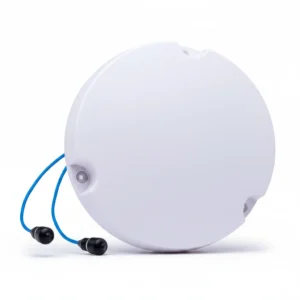
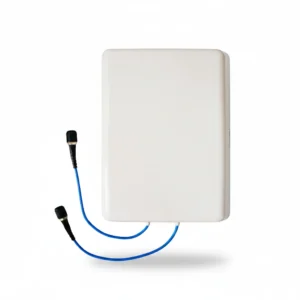
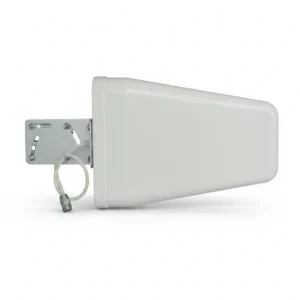
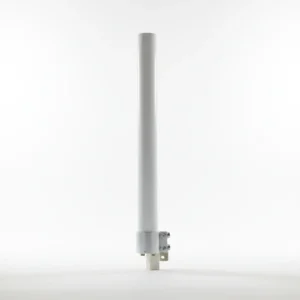
CBRS limit: GL-DY3500V8 overlaps only 3550–3600 MHz of the US 3550–3700 MHz CBRS band. It is not presented as a full-band CBRS antenna.
Start with the spectrum plan
Write down every frequency the radio will transmit and receive. If the network uses carrier aggregation or more than one band, each antenna branch needs suitable coverage across the complete requirement.
The current Global RF Tech 4G LTE antenna family includes terminal, external, panel, MIMO, omnidirectional and LPDA options across published ranges in and around 698–2700 MHz. These products can be a starting point for licensed-band private LTE projects when their individual model ranges match the radio.
CBRS needs a separate check. The verified GL-DY3500V8 fiberglass omni antenna covers 3400–3600 MHz. It overlaps only the 3550–3600 MHz portion of US CBRS, so it is not a full-band 3550–3700 MHz CBRS antenna. Use it only when the project’s operating frequencies stay within its published 3400–3600 MHz range.
| Deployment requirement | Current verified path | Limitation to check |
|---|---|---|
| Licensed LTE bands around 698–2700 MHz | Browse the 4G LTE antenna family and model tables | Confirm every required band on the selected model |
| 3400–3600 MHz private wireless | GL-DY3500V8 is a vertical-polarized fiberglass omni with an N-K connector | It does not cover 3600–3700 MHz |
| Full US CBRS, 3550–3700 MHz | Submit the exact radio and band requirement for feasibility review | No current full-band model was verified in the frozen catalog |
Choose the coverage shape
Omnidirectional outdoor coverage
An outdoor omni distributes energy around the antenna in azimuth. It is a practical starting point for a centrally placed site serving devices in several directions. Height, vertical beamwidth, surrounding structures and terrain still decide where that energy reaches.
Directional links and sector coverage
Use a panel or LPDA direction when the coverage area lies mainly on one side, when the site needs a focused path, or when interference management favors a narrower azimuth. Do not choose a high-gain antenna from the gain number alone; confirm beamwidth and alignment tolerance.
Terminals, gateways and indoor equipment
Compact terminal, screw-mount, low-profile and embedded antennas suit radios or endpoints with limited installation space. Their performance is tied to enclosure, ground reference, cable loss and placement. Review the complete device rather than treating the antenna as an isolated accessory.
For hazardous or industrial terminals, read the private LTE industrial terminal antenna guide and include the site’s mechanical and compliance requirements in the inquiry.
Match MIMO ports and polarization
If the radio has two or four cellular ports, the antenna system needs the corresponding number of branches and a suitable diversity arrangement. A single-port antenna does not create 2×2 or 4×4 MIMO.
Confirm:
- the number and purpose of RF ports on the radio;
- the band coverage of every branch;
- the polarization plan and orientation;
- branch spacing or isolation requirements;
- cable type, length and connector for each path.
MIMO capability is a radio-and-installation property. The antenna must support the plan, but it cannot guarantee throughput without adequate signal quality, isolation and network conditions.
Check the installation before sampling
The same radio can need a different antenna in a rooftop site, a factory enclosure and a mobile machine. Record the mounting position, available clearance, nearby metal, cable route, connector orientation and operating environment.
For outdoor hardware, request the current model drawing and documentation for wind, temperature, sealing and lightning provisions. Do not infer an IP rating or certification from the words “outdoor” or “fiberglass.”
Private LTE antenna project checklist
- country and spectrum authorization;
- exact transmit and receive bands;
- radio make, model and RF port count;
- LTE, CBRS or private 5G mode and MIMO order;
- indoor, outdoor, vehicle or embedded installation;
- target coverage area and preferred omni/directional pattern;
- connector, cable type and cable length;
- mounting, size and clearance limits;
- temperature, weather, vibration and compliance requirements;
- sample quantity and validation schedule.
Request a private LTE antenna review
Prepared by the Rftech Technical Team from current Global RF Tech product data, FCC band information and the stated engineering scope. Product data checked July 15, 2026; confirm the latest datasheet before integration.
