
MIMO antenna category guide
Cellular MIMO Antennas for LTE/5G
These are infrastructure-grade outdoor MIMO antennas for WiFi (2.4/5 GHz) and cellular (LTE / 5G sub-6) networks — 2×2, 4×4 and 6-port models in omnidirectional and panel patterns, N-type and 7/16 DIN. They are built for access points, base stations and DAS, not consumer routers, and we build external MIMO antennas to spec for OEM programs.
Streams
Decide 4×4 or 2×2 first
Match the antenna to the radio’s port count. A 4×4 MIMO antenna feeds four-port APs and radios for maximum spatial multiplexing; a 2×2 MIMO antenna covers two-stream links and tighter budgets.
Pattern & band
Then pattern, band, connector
Omni for area coverage, panel for sector gain. Confirm the band (2.4/5 GHz WiFi or sub-6 cellular), the connector (N-type or 7/16 DIN), and pole mounting.
Product path
Go straight to the models
Skip the catalog search. The model grid below maps each MIMO antenna to its band, stream count, pattern and connector.
Choose the right MIMO antenna
Most MIMO antenna decisions come down to four constraints: stream count, radiation pattern, frequency band and connector. Settle those first, then open the matching products instead of scrolling the whole catalog.
Four streams
4×4 MIMO antennas
Four ports for four-stream APs, sector radios and multi-band cellular. GL-DY2458S46517 (panel) and GL-DY2458V2H2812 (omni) cover 2.4/5 GHz; GL-DY1727S46513 covers 1710–2700 MHz for cellular and DAS.
See 4×4 modelsTwo streams
2×2 MIMO antennas
Two streams where port count or cost is constrained. GL-DY2458V2810 is a 2.4/5 GHz omni; GL-DY2400VH12 handles 2.3–2.4 GHz.
See 2×2 modelsPattern
Omni or panel
An omnidirectional MIMO antenna covers a full area; a directional MIMO antenna or MIMO panel antenna concentrates gain on a sector and rejects off-axis interference.
Compare antenna patternsOEM
OEM and custom
Global RF Tech is a MIMO antenna manufacturer in China supporting B2B OEM projects. Need a different band split, connector or pattern? Send the spec and we build the MIMO antenna to match the deployment.
Start an RFQWhat is a MIMO antenna?
A MIMO (multiple-input, multiple-output) antenna carries several independent RF streams over the same channel through separate, decorrelated radiating elements. More streams mean more throughput and steadier links in multipath, which is why WiFi access points and sub-6 radios run 2×2 and 4×4. For the underlying theory, read What Is a 5G MIMO Antenna? and Understanding MIMO and Beamforming in 5G Antennas.
Indoor coverage
Planning antenna coverage inside a building?
Share the building type, coverage area, frequency bands and donor/ceiling antenna requirements. We will help you choose the right components.
How to choose: streams, pattern, band, connector
| Decision | What it drives | Range on this site |
|---|---|---|
| Stream count | Throughput and match to radio ports | 2×2 and 4×4 |
| Pattern | Coverage shape and interference rejection | Omnidirectional and panel / directional |
| Band | WiFi, cellular or higher-band use | 2.4/5 GHz, 2.3 GHz, 1710–2700 MHz, 6200–8300 MHz |
| Connector | Power handling and integration | N-type (N-K), 7/16 DIN, SMA-K |
| Mounting | Install method on site | Pole-mount across the line |
MIMO antenna applications
WiFi access points & mesh
High-density 2.4/5 GHz AP coverage and mesh backhaul using 2×2 and 4×4 dual-band MIMO.
LTE & 5G sub-6 infrastructure
Base-station and small-cell coverage on cellular bands. See the 1710–2700 MHz 4×4 unit and our external LTE/5G MIMO guide.
DAS & in-building
Distributed antenna systems and in-building coverage on cellular bands with 7/16 DIN. Background in the DAS antenna guide.
Industrial & IoT
A rugged external MIMO antenna on a mast for private LTE, monitoring and IoT gateways. See 5G IoT antenna solutions.
Omnidirectional MIMO antennas (2×2, 4×4 and 6-port)
An omnidirectional MIMO antenna radiates a full 360° horizontal pattern, so one mast position covers an open area — yards, sites, marinas, mesh nodes — without aiming. Most of this category is omni: the 2.4/5 GHz V-series runs from a 2×2 omni (GL-DY2458V2810) through 4×4 units with vertical or dual H+V polarization (GL-DY2458V48, GL-DY2458V2H2812) up to 6-port sleeve arrays for high-density WiFi (GL-DY2458V66, V668, V68, V6811). Where a standard radome will not fit, GL-DY2458V64 packs six ports into a 42 mm low-profile disc.
On cellular bands, the 698–2700 MHz low-profile domes (GL-DY7027HV, GL-DY7060VV3) work as an omni-directional 4G LTE antenna for private LTE, routers and gateways — the same fit if you searched for an omni directional cell antenna. For long reach on a single band, GL-DY2400VH12 is a 15 dBi high-gain omni for 2.3–2.4 GHz links.
Not sure a 360° pattern is right? See Omnidirectional vs Directional Antenna for the pattern trade-offs.
Directional and panel MIMO antennas
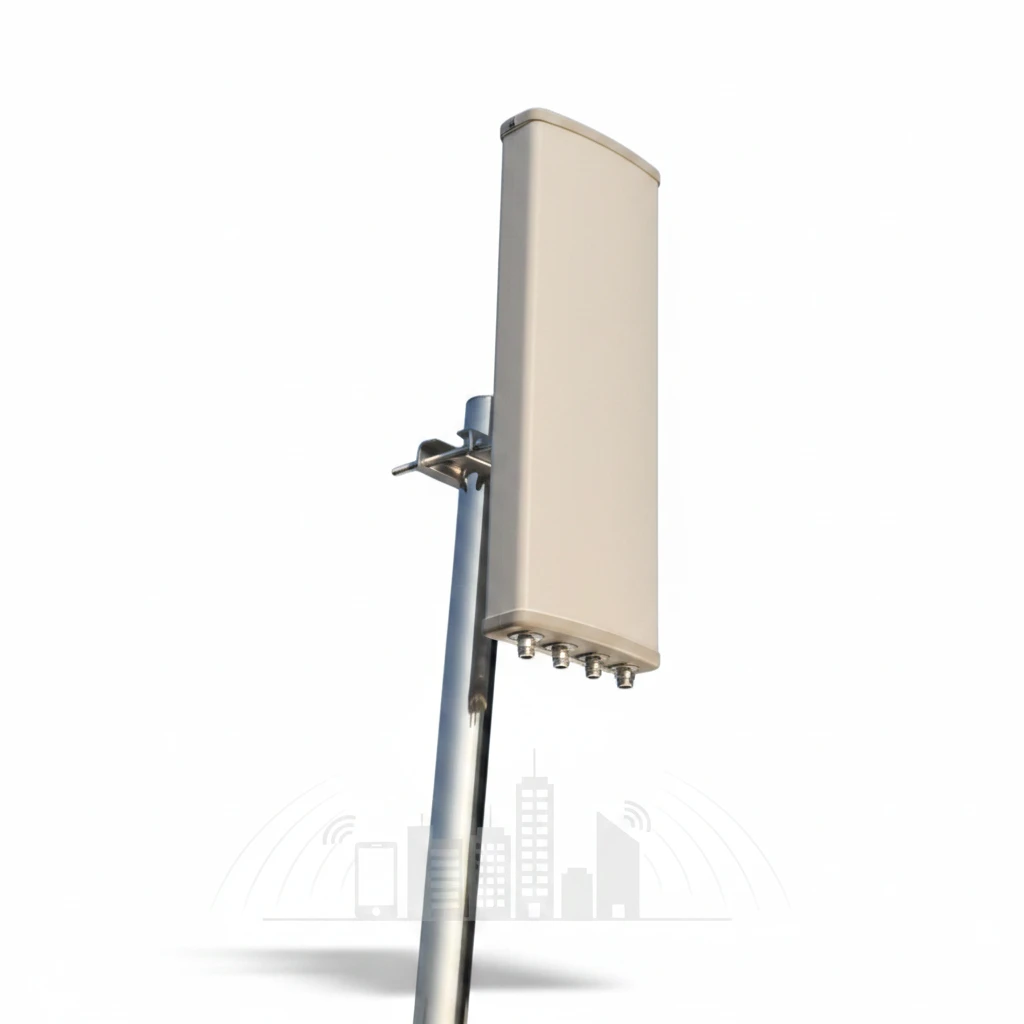
A MIMO directional antenna concentrates gain on one sector and rejects interference from behind — the right call for point-to-multipoint, street-level small cells and stadium sectors. The dual-band MIMO panel antenna GL-DY2458S46517 delivers up to 17 dBi on 2.4/5 GHz; GL-DY1727S46513 is a ±45° slant 4×4 panel for 1710–2700 MHz cellular and DAS feeds; GL-DY7040S4707 covers 698–4000 MHz as a multiband sector panel; and GL-DY7027S handles LTE bands in a compact housing. If the choice between patterns is still open, start from the selector above.
MIMO antenna models
All 16 outdoor MIMO antenna models — omnidirectional, panel and low-profile — across WiFi 2.4/5 GHz and cellular bands. Open any model for full specs.
GL-DY2458V48
2400–2500 / 5150–5850 MHz · 4×4 omnidirectional · 8 dBi · 4×N-K
GL-DY2458V2H2812
2400–2500 / 5150–5850 MHz · 4×4 omni, dual H+V · 8/12 dBi · 4×N-K
GL-DY2458V2810
2400–2500 / 5150–5850 MHz · 2×2 omnidirectional · 8/10 dBi · 2×N-K
GL-DY2400VH12
2300–2400 MHz · 2×2 high-gain omni · 15 dBi · 2×N-K
GL-DY2458V66
2400–2500 / 5150–5850 MHz · 6-port omni · 6 dBi · 6×N-K
GL-DY2458V668
2400–2500 / 5150–5850 MHz · 6-port omni · 6/8 dBi · 6×N-K
GL-DY2458V68
2400–2500 / 5150–5850 MHz · 6-port omni · 8 dBi · 6×N-K
GL-DY2458V6811
2400–2500 / 5150–5850 MHz · 6-port omni · 8/11 dBi · 6×N-K
GL-DY2458V64
2400–2500 / 5150–5850 MHz · 6-port low-profile omni · 6×RP-TNC
GL-DY7027HV
698–960 / 1690–2700 MHz · 2×2 low-profile dome (LTE) · 2×N female
GL-DY7060VV3
698–6000 MHz multiband · 2×2 ultra-low-profile · 2×N-K
GL-DY2458S46517
2400–2500 / 5150–5850 MHz · 4×4 dual-band panel · 14.5/17 dBi · 4×N-K
GL-DY1727S46513
1710–2700 MHz · 4×4 directional panel, ±45° · 13 dBi · 4×7/16 DIN
GL-DY7040S4707
698–4000 MHz · 4×4 multiband sector panel · 6/7/8 dBi · 4×N-K
GL-DY7027S
698–2700 MHz · 2×2 directional panel (LTE) · 6.5–9 dBi · 2×N female
GL-6283H-3
6200–6800 / 7700–8300 MHz · compact module · SMA-K
Related guides and categories
FAQ
4×4 or 2×2 — which do I need?
Match the antenna ports to the radio. Four-port APs and radios want 4×4; two-port links or tighter budgets use 2×2.
Omnidirectional or panel MIMO antenna?
Omni for even area coverage; panel or directional when you need gain on one sector and rejection of interference from other directions.
Do you build 8×8 MIMO antennas?
Stock models run 2×2, 4×4 and 6-port. Outdoor 8×8 MIMO is usually reached by pairing two 4×4 antennas on the mast or by a custom build — send the band plan and stream count and we will quote an 8×8 configuration.
Which models work as a 4G omni directional antenna?
GL-DY7027HV and GL-DY7060VV3 cover 698–2700 MHz in low-profile housings for LTE routers, gateways and private networks; the wideband GL-DY7060VV3 extends to 6 GHz for 5G sub-6.
Are these for home 5G routers?
No. These are outdoor, infrastructure-grade MIMO antennas with N-type or 7/16 DIN and pole mounting, for AP, base-station and DAS builds.
Can you do OEM and custom?
Yes. Send the band plan, stream count, pattern, connector and mounting, and we build the MIMO antenna to spec.
Need a MIMO antenna shortlist?
Send the bands, application, stream count, connector, mounting and quantity. Rftech can return a recommended model or a custom build and an RFQ.
Need single-radiator 360° coverage instead of a MIMO array? See our omnidirectional antennas.
