
An LPDA antenna — short for log-periodic dipole array, and often just called a log periodic antenna — is a directional antenna built to work across a wide frequency range instead of one narrow band. A single RFTECH LPDA such as the GL-DY7038V11 covers 698–960, 1710–2700 and 3300–3800 MHz at up to 11 dBi, which is why these antennas keep showing up wherever a project needs both direction and bandwidth from one part.
For engineers and buyers the appeal is practical: one directional antenna family can cover most of the cellular and sub-6 GHz range, so you do not have to swap hardware every time the band plan shifts. That makes the LPDA a favourite for donor pickup, outdoor directional coverage, and field survey work.
What does “LPDA” mean?

LPDA stands for log-periodic dipole array. The antenna is a row of dipole elements whose lengths and spacing grow in a repeating, scaled pattern along a boom. That geometry — not a tuning trick — is what produces the wideband behaviour.
The same design appears under several names — log periodic antenna, log-periodic array, log periodic dipole antenna, LPDA — and they all describe the same construction. If a datasheet uses any of these terms, it is the same antenna family.
You do not need the maths to use the result. In selection terms, an LPDA is the part you reach for when a project needs all three of these at once:
- Directional coverage, not 360° spread
- Broadband operation across several bands
- More frequency headroom than a narrow directional antenna can give
Why an LPDA counts as wideband

Most directional antennas perform best in a narrow window. An LPDA is designed so that only part of the array is “active” at any given frequency: long elements do the work at the low end, short elements at the high end, and the active region slides along the boom as frequency changes. That is how one antenna stays directional from roughly 700 MHz to nearly 4 GHz.
Wideband does not mean every frequency behaves identically — gain and match still vary across the band, which is why you compare the published numbers per band rather than trusting the headline range. But it does mean one model can serve a much wider planning envelope, which is exactly why LPDAs turn up in outdoor cellular support, donor signal pickup, monitoring and test setups, and broadband directional coverage.
PRODUCT OPTIONS
Compare options for your installation
Check the operating band, connector and installation space before selecting a model.
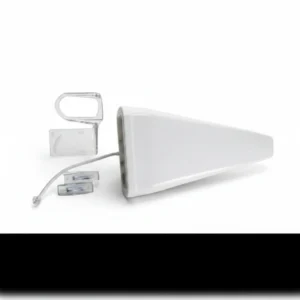
GL-DY7038V11
Directional LPDA antenna with three separate listed operating ranges.
- Bands
- 698–960 / 1710–2700 / 3300–3800 MHz
- Gain
- 11 dBi
- Connector
- N-K (datasheet marking)
Two real LPDA models, side by side
The wideband claim is easiest to see in actual specs. Here are two RFTECH LPDAs that share the same 440 × 210 × 65 mm body but target slightly different jobs:
| Spec | GL-DY7038V11 | GL-DY7040V11 |
|---|---|---|
| Frequency (MHz) | 698–960 / 1710–2700 / 3300–3800 | 698–960 / 1710–2700 / 3400–4000 |
| Gain | 11 dBi | 10 / 10.5 / 11 dBi (by band) |
| VSWR | < 2.0 | ≤ 1.8 |
| Beamwidth | 90° H / 60° V | Not published — request datasheet |
| Impedance | 50 Ω | 50 Ω |
| Connector | N-female | N-female |
| Size | 440 × 210 × 65 mm | 440 × 210 × 65 mm |
| Max power | 50 W | Not published |
| Operating temp | −40 to +65 °C | −40 to +65 °C |
The takeaway: pick the GL-DY7038V11 when you want a published beamwidth, a power rating and DC-ground lightning protection; step up to the GL-DY7040V11 wideband option when you need the top band pushed to 4.0 GHz and a tighter VSWR of ≤ 1.8. Same footprint, different priorities.
LPDA vs Yagi, panel and dish

An LPDA is not the only directional choice; it is usually the most versatile across frequency. A Yagi gives more gain in a narrow band but loses it quickly outside that range. A panel antenna wins when enclosure shape, wind loading or visual integration matter. A parabolic dish wins when you need very high gain and a tight pencil beam. The LPDA sits in the middle: more directional than an omni, far broader in frequency than a Yagi, and mechanically simple enough for survey, donor and broadband coverage work.
Compare on numbers, not category names: operating band, gain, beamwidth, front-to-back ratio, mounting plan and environment. Two “directional” antennas can behave completely differently once they are on a mast, vehicle, rooftop or test fixture.
Types of log-periodic antennas
The log-periodic principle shows up in several product families, and they are not interchangeable:
- Wideband cellular LPDA (roughly 698 MHz–4 GHz). The type this guide covers: outdoor directional antennas for donor pickup, multi-band coverage and survey work. RFTECH’s GL-DY7038V11 and GL-DY7040V11 sit here.
- EMC and test-lab LPDA. Calibrated measurement antennas used for compliance testing, often 200 MHz–3 GHz or wider. They ship with calibration data and are priced as lab instruments, not deployment hardware.
- VHF/HF log-periodic arrays. Long-boom designs for TV reception, monitoring and HF communication — the same geometry with much larger elements.
- Printed / PCB LPDA. Compact log-periodic structures etched onto circuit boards for embedded and research use.
If you are buying for cellular, IoT or in-building infrastructure work, the wideband cellular LPDA is the family that matters — an EMC part covers similar frequencies but solves a different problem at a different price.
LPDA antenna advantages and disadvantages
| Advantages | Disadvantages |
|---|---|
| One antenna covers a very wide, continuous range (698 MHz–4 GHz class) | Lower peak gain than a same-size single-band Yagi (10–11 dBi vs 12+ dBi) |
| Directional beam stays usable across the whole rated band | Gain and VSWR are not identical at every frequency — check per-band numbers |
| One SKU survives band-plan changes; simpler procurement and spares | Physically larger and more wind load than a panel of similar gain |
| Directional control without committing to one band early | Still a directional antenna — it will not do an omni’s job |
The trade-off only hurts when a project genuinely lives inside one narrow band — that is Yagi territory. Everywhere else, the flexibility usually pays for the small loss in peak gain.
Typical LPDA applications
Broadband donor signal capture
When a system must receive from a known direction over a wide span — a repeater donor link, for example — an LPDA is a natural candidate.
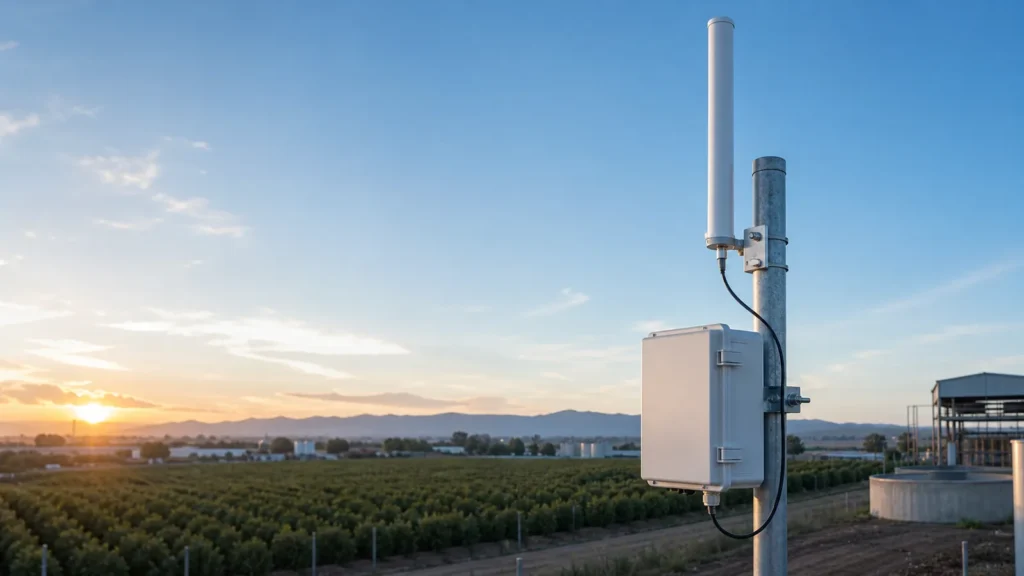
Outdoor directional coverage
Where you need more control than an omni gives but still want multi-band reach, an outdoor LPDA fits.
Testing and survey work
The wide range lets one antenna sweep several bands during RF evaluation and signal survey without swapping hardware between measurements.
Multi-band infrastructure planning
Teams that do not want to lock to one narrow band early often standardise on an LPDA so procurement and field crews manage fewer antenna variants.
Gain, beam shape and installation still decide the result
Wideband does not mean “set and forget.” Gain, beamwidth, front-to-back behaviour, cable loss and mounting geometry still govern what you actually get. For how gain interacts with the rest of the choice, see antenna gain fundamentals — an 11 dBi number only helps when it lines up with the site geometry.
Installation can make or break the theoretical advantage. Aim the antenna along the intended path, keep clearance from metal, and match the cable length and connector to the band — a long, lossy cable erases gain fastest at the high end, exactly where a 3.3–4.0 GHz LPDA is working hardest. The bracket has to hold alignment under wind and vibration, and outdoor units need the connector area weatherproofed.
Common mistakes when choosing an LPDA
Treating wideband as the only requirement
Wide range is useless if the beam shape or mounting plan is wrong for the site.
Ignoring the directionality question
If the site genuinely needs broad area coverage, an LPDA is the wrong starting point — it is a directional tool.
Skipping the application context
Band coverage alone does not pick the antenna. You still need to know whether it is donor pickup, coverage extension, testing or backhaul.
When to choose an LPDA antenna
An LPDA is the right call when:
- You need directional coverage, not 360° spread
- The operating bands span a wide range
- The target signal direction is known
- Future band flexibility is worth more than maximum single-band gain
For broader category context in infrastructure deployments, 5G outdoor antenna types is a useful companion read. Before you buy, confirm four things with the supplier: exact frequency range, expected gain across the band, connector and cable plan, and the mounting environment. Share the target band plan and site geometry rather than only naming an LPDA model — that lets the supplier match the closest standard part or a custom variant, and ask for the datasheet and pattern data so the electrical and mechanical fit is verified, not assumed.
LPDA selection checklist
- Frequency range covers every target band
- Gain and beamwidth match the coverage path
- Connector type matches the radio or cable assembly
- Mounting hardware fits the pole, wall, bracket or test fixture
- Cable loss is acceptable at the highest operating frequency
- Outdoor exposure, vibration and service access are accounted for
- Datasheet and pattern data are available for review
When LPDA belongs on the shortlist
An LPDA (log-periodic dipole array) antenna is a wideband directional antenna that holds a controlled beam across a much broader range than a Yagi or other narrow directional design — in RFTECH’s case, roughly 700 MHz to 4 GHz from one part. Its value is in matching directionality with frequency flexibility, not in the acronym. For a real deployment, request a quote and include your target bands, mounting position and coverage path.
Frequently asked questions
What does LPDA stand for?
Log-periodic dipole array. It describes the construction: a row of dipole elements whose lengths and spacing scale in a repeating pattern along a boom, which is what gives the antenna its wide frequency range.
What frequency range does an LPDA antenna cover?
It depends on the model, but a single wideband LPDA can be very broad. RFTECH’s GL-DY7038V11 covers 698–960 / 1710–2700 / 3300–3800 MHz, and the GL-DY7040V11 extends the top band to 3400–4000 MHz — roughly 700 MHz to 4 GHz from one antenna.
Is an LPDA the same as a Yagi antenna?
No. Both are directional, but a Yagi is tuned for high gain in a narrow band and drops off outside it, while an LPDA trades a little peak gain for usable performance across a much wider range. Choose a Yagi for one fixed band, an LPDA when the band plan is broad or still changing.
How much gain does an LPDA antenna provide?
Commonly around 10–11 dBi for wideband cellular LPDAs — the GL-DY7038V11 is rated 11 dBi and the GL-DY7040V11 is 10/10.5/11 dBi across its three bands. Real gain varies by frequency, so check the per-band figure, not just the headline.
Can one LPDA cover 4G and 5G sub-6 GHz bands?
Yes, within its rated range. A part like the GL-DY7040V11 reaches up to 4.0 GHz, covering most 4G/LTE bands plus 5G mid-band (n77/n78 territory). Always confirm the antenna’s published bands against the exact frequencies your radio uses.
Is a log periodic antenna the same as an LPDA?
Yes. LPDA is the abbreviation of log-periodic dipole array, which is the most common form of log periodic antenna. Datasheets and suppliers use the terms interchangeably — what actually matters is the rated frequency range, gain and beamwidth of the specific model.
What are the disadvantages of an LPDA antenna?
Compared with a single-band Yagi of similar size, an LPDA gives up some peak gain (wideband cellular models are commonly 10–11 dBi), and its gain and VSWR vary across the band — so check the per-band numbers, not just the headline range. It is also a directional antenna, so it is the wrong choice where broad area coverage is the goal.
Need help choosing a model?
Tell us your operating band, connector and installation constraints. Our team can review the options with you.
Discuss selection & pricingAsk our AI antenna assistant. Enter a keyword or question for a free answer based on this article, Global RF Tech content, and general antenna/RF knowledge.
Do not submit confidential or personal information. Privacy Policy