An antenna ground plane is a conductive region that forms part of the RF current and field system. For many monopoles, embedded antennas and patches, it affects impedance, resonance, efficiency and radiation pattern.
Not every antenna needs an external ground plane in the same way. A quarter-wave monopole, a ceramic chip, a GNSS patch, a balanced dipole and an engineered no-ground-plane antenna have different current paths. Follow the antenna design, not a blanket rule.

What does a ground plane do?
At RF, current needs a return path and fields interact with nearby conductors. In a monopole installation, the conductive reference acts as the other part of the radiating system. In a PCB antenna, the board ground can be a major part of the electrical length and current distribution. In a patch antenna, the ground structure sits behind the radiator and helps shape the field and pattern.
The ground plane can therefore change:
- resonant frequency and input impedance;
- radiation efficiency and usable bandwidth;
- pattern shape and direction;
- sensitivity to cables and nearby metal;
- repeatability from one installation to another.
A low VSWR does not prove that the ground plane is correct. Loss or unintended cable radiation can sometimes improve the match reading while reducing useful radiation.
Which antennas need a ground plane?
Quarter-wave monopoles and many vehicle whips
A monopole is designed against a conductive reference. On a vehicle, the roof or body can provide that reference when the mount makes the intended RF connection or coupling. Surface size, shape, continuity and placement all affect the result.
A magnetic base provides mechanical attachment, but the RF behavior depends on the antenna and mount design. Do not assume every magnetic antenna uses the vehicle surface in the same way, and do not add or remove a ground connection without the model guidance.
PCB trace and ceramic chip antennas
Many embedded antennas use the product PCB ground as part of their electrical design. The supplier reference layout normally specifies ground, no-ground and keep-out regions. Moving the antenna, extending copper into the keep-out or changing the board outline can shift performance.
The final enclosure, battery, display, shield and cable arrangement also matter. Prototype tuning on a bare board is not enough if those items change the RF environment.
GPS/GNSS patch antennas
A ceramic GNSS patch is normally integrated above a conductive ground region. Ground-plane size and symmetry, feed location, enclosure and sky-facing orientation affect match and pattern. Use the specific integration guidance and test the finished product; there is no one ground-plane dimension for every patch.
See the GPS/GNSS ceramic patch antenna category for model selection and integration inputs.
Dipoles and balanced antennas
A center-fed dipole has two radiating arms and does not rely on an external ground plane in the same way as a monopole. It still interacts with masts, feedlines, buildings and the earth. A balun or common-mode control may be needed so the feedline does not become an unintended third radiator.
No-ground-plane antennas
Some antennas are deliberately engineered to carry the needed counterpoise or balanced structure inside the product. “No ground plane required” should be a model-specific design statement. It does not mean surrounding metal, cable routing or mounting position no longer matter.
How large should an antenna ground plane be?
There is no universal answer. The useful size depends on frequency, antenna topology, feed, desired pattern and the surrounding product.
For a simple monopole experiment, quarter-wave radials are a familiar reference. A commercial embedded or vehicle antenna may use a different arrangement, and shortening or folding the structure changes the result. For a PCB or GNSS patch, follow the reference layout or current model documentation rather than applying the radial rule.
PRODUCT OPTIONS
Compare options for your installation
Check the operating band, connector and installation space before selecting a model.
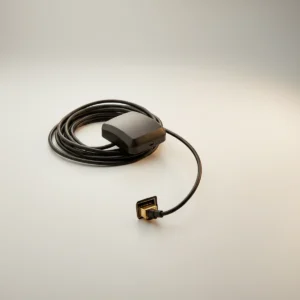
GL-DY008
Active GPS/GLONASS antenna with magnetic mounting and a 3 m RG174 lead.
- Bands
- 1575.42 ±1 / 1601–1610 MHz
- Connector
- SMA male
- LNA
- 28 ±2 dB
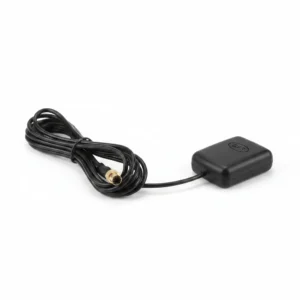
GL-DY006F
GPS antenna for magnetic or adhesive installation.
- Band
- 1575.42 ±1 MHz
- Connector
- FAKRA C blue female
- Mounting
- Magnet or adhesive
Vehicle installation checks
- Confirm the model’s required mount and ground method.
- Choose a location with the intended conductive surface and clearance.
- Check paint, adhesive, corrosion protection and hardware at the RF connection.
- Keep the radiator away from roof edges, racks and large vertical metal where practical.
- Route the coax without sharp bends, crushed sections or large uncontrolled loops.
- Measure the installed antenna across the required band.
For GPS installations, also use the vehicle GPS antenna mounting guide.
Embedded-product checks
- freeze the board outline and layer stack before final tuning;
- preserve antenna keep-out and ground boundaries;
- include matching pads and measurement access;
- test with the production battery, display, shields and enclosure;
- evaluate input match and radiated performance;
- repeat across representative samples and mounting conditions.
Signs the ground or installation needs review
A shifted resonance, narrow tuning window, poor range, pattern null in the service area, strong hand sensitivity or large unit-to-unit variation can point to a ground-reference or placement problem. These symptoms are not proof; cable loss, connector faults, interference and radio settings can look similar.
Measure the feed path first, then compare the installed antenna with the intended reference condition. Change one variable at a time.
Send your antenna and installation details for review
Prepared by the Rftech Technical Team from current antenna-integration references. Sources checked July 15, 2026; use model-specific drawings and final-system measurements for installation decisions.
Related guide: See how these mounting principles affect whip antenna length, loading and selection.
Need help choosing a model?
Tell us your operating band, connector and installation constraints. Our team can review the options with you.
Discuss selection & pricingAsk our AI antenna assistant. Enter a keyword or question for a free answer based on this article, Global RF Tech content, and general antenna/RF knowledge.
Do not submit confidential or personal information. Privacy Policy