
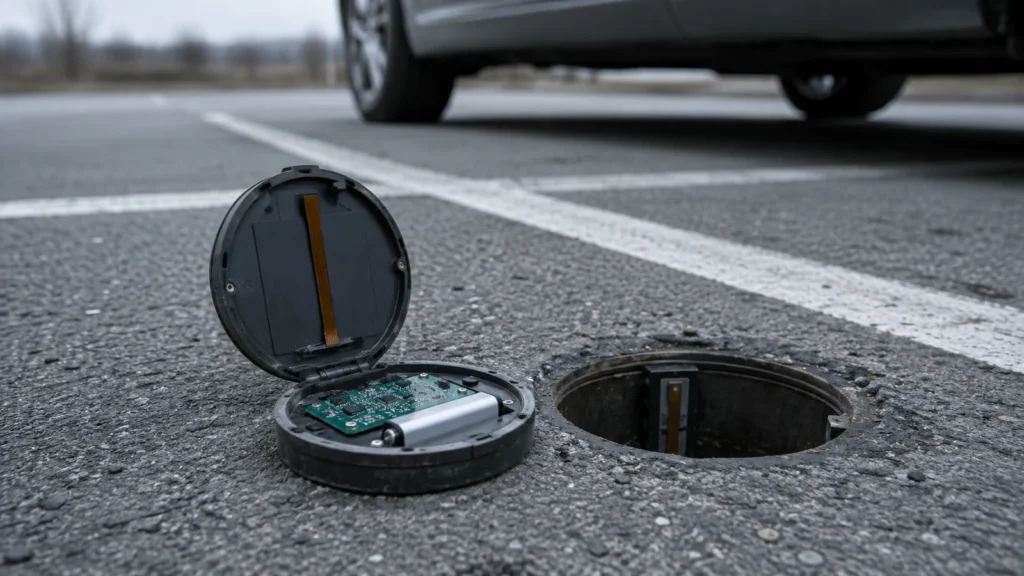
Smart parking application
LoRa Antennas for Smart Parking Sensors
A parking sensor is the most constrained LoRa device we get asked about. It is small, fully potted, mounted at or below road level, and periodically covered by two tonnes of metal. This guide covers antenna selection for in-ground, surface-mount and kerbside units.
Use this guide to
- Choose an antenna that fits a potted puck housing.
- Understand what asphalt and a parked car actually do to the link.
- Plan orientation and keep-out before the mould is cut.
- Prepare the details we need to quote.
Quick answer
For an in-ground or surface puck, use a thin internal antenna: GL8682 (863-928 MHz, 2.15 dBi, UFL, adhesive FPC) covers both EU868 and US915 from one part, and GL-DY107 (868 MHz, 2.5 dBi, UFL, VSWR <1.5) is the compact patch option for EU deployments. Where the housing is very shallow, GL-DYG086-868 is 0.8 mm thick at 37 x 7 mm.
Then spend your effort on orientation and the gateway. In smart parking the antenna model is rarely what makes or breaks the deployment; the mounting depth and the gateway height are.
What the road does to your link
An in-ground sensor transmits upward through a lid, an air gap and often a layer of resin. That is survivable. What is not always planned for is everything above it:
- A parked vehicle. A car body over the sensor is a large sheet of metal a few centimetres above the antenna. Expect a substantial drop while a bay is occupied, which is exactly when the sensor most needs to report.
- Wet road surface. Standing water and wet asphalt absorb at 868 and 915 MHz. Performance after rain is not the same as performance in the sun.
- Depth. Every extra millimetre of material above the antenna costs signal. A flush lid with a thin non-metallic cover is worth more than any gain figure.
- Rebar and metal frames. Reinforced concrete and steel drain covers near the unit change the pattern in ways that are hard to predict and easy to measure.
The practical consequence: design the link with margin for the occupied-bay case, and put the gateway high and close rather than assuming a node antenna upgrade will rescue it. The LoRa gateway range troubleshooting guide covers the gateway side.
Antennas that fit a parking puck
| Model | Frequency | Gain | Format and connector | Size | Temperature |
|---|---|---|---|---|---|
| GL8682 | 863-928 MHz | 2.15 dBi | Flexible FPC/PCB, UFL, 3M adhesive | Thin flexible | -40 to +85 °C |
| GL-DY107 | 868 MHz | 2.5 dBi | Internal patch, UFL, adhesive, VSWR <1.5 | Compact patch | -40 to +85 °C |
| GL-DYG086-868 | 868 MHz | Not published | Thin flexible, UFL, RG1.13 / RG1.37 | 37 x 7 x 0.8 mm | -30 to +60 °C |
| GL868S25 | 868 ±3 MHz | Not published | Ceramic, PCB mount | Module scale | Not published |
| GLG4101 | 868 MHz | 3 dBi | IPEX or other, RG178 / RF1.37 or other cable | Per assembly | -40 to +85 °C |
Two of these have fields their product records leave blank, and we leave them blank here rather than filling them in from a similar part. GL868S25 in particular is a ceramic module-level antenna: its behaviour depends almost entirely on your PCB ground and matching network, so treat the frequency as the only portable number.
None of them publishes an IP rating, and for a parking sensor that is the right way round. The antenna lives inside a potted or gasketed housing that you design and test as a unit. An IP68 figure on an antenna would tell you nothing useful about a puck sitting in a puddle.
In-ground, surface-mount or kerbside?
In-ground, flush
Cored into the bay and capped. Hardest RF case and the most durable mechanically. Keep the antenna as close to the top face as the potting allows, and keep the lid non-metallic.
Surface-mount puck
Bonded to the road surface. A few centimetres of height is a real RF advantage. Vulnerable to snow ploughs and sweepers, so the mechanical case usually decides it, not the antenna.
Kerbside or pole
Sensor beside rather than under the bay. If the design allows it, this removes most of the problem: the antenna is above ground and never under a vehicle. GL-DY403-868 or GLR01 as an external whip becomes viable here.
Get the orientation right before the mould is cut
These antennas are linearly polarised, and so is the gateway antenna, which is almost always vertical. A flat antenna lying horizontally in the bottom of a puck is cross-polarised to the gateway, and polarisation mismatch costs far more than the difference between a 2.15 dBi and a 3 dBi part.
In a housing that must stay flat, this is a genuine constraint rather than something to optimise away, so plan for it: mount the flexible antenna up the inside wall rather than across the floor where the geometry allows, keep the battery and any metal shield out of the keep-out area, and fix the UFL lead so the connector is not stressed during potting. Then measure the assembled unit, in the ground, with a car over it. It is the only number that means anything.
What to send us
- LoRa module and the exact band for the deployment country
- Housing drawing with internal dimensions, wall thickness and potting compound
- In-ground, surface-mount or kerbside
- Available antenna area, and whether it can be vertical
- Battery, PCB and any metal parts near the antenna zone
- Connector on the module, and cable type and length if needed
- Temperature range, and whether the site sees freezing or standing water
- Quantity, and any drawings, samples or test records you need
Related pages
See the full LoRa and LoRaWAN antenna range, the embedded antenna formats, or outdoor LoRa gateway antennas for the gateway end. Need a band, cable or connector we do not carry as standard? Start at custom LoRa antennas.
Ask for a parking sensor antenna review
Send the housing drawing, the band and the mounting method. We will shortlist from the models above and tell you which parts of the link only a real installed test can answer.
