
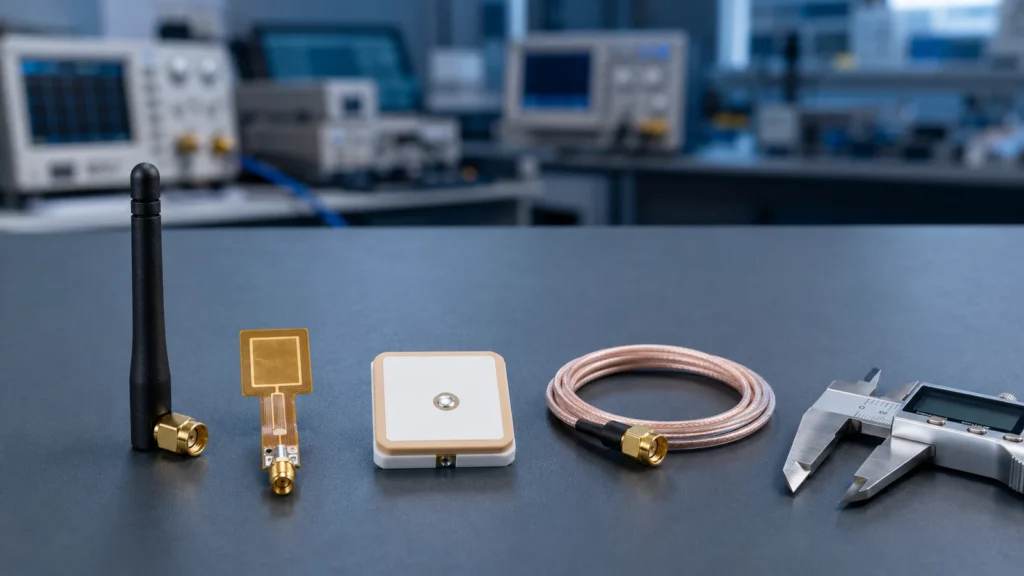
Custom and OEM
Custom LoRa Antennas: Band, Cable, Connector and Mount
Most LoRa antenna requests that reach us are not really custom. They are a standard element with a different cable length, a different connector, or a housing that has to fit somewhere specific. Those we quote from an existing platform. This page explains what we can change, what changes the tooling, and what we need from you to answer quickly.
Commonly asked for
- 868 MHz antenna with a 3 m cable and SMA male
- 915 MHz gateway antenna with a specific connector
- Non-standard cable type, length or exit direction
- A band that spans both EU868 and US915
Start from a platform, not from zero
We keep standard LoRa antennas across the sub-GHz range: adhesive FPC, internal patch, ceramic, rubber stub, screw mount, magnetic mount, fiberglass omni and directional Yagi. A custom build almost always starts by picking the closest of these and changing the parts that are cheap to change.
| Starting platform | Published band | Typical custom request |
|---|---|---|
| GL8682 flexible FPC | 863-928 MHz | Cable type and length, connector, adhesive backing, outline |
| GL-DY107 internal patch | 868 MHz | Cable length, UFL to another series, mounting position |
| GLG4101 cabled internal | 868 MHz | Already specified as IPEX or others, RG178 / RF1.37 or others |
| GL-DY403-868 stub | 868 MHz | Connector gender and type, length, radome colour |
| GL003-868 screw mount | 868 MHz | Cable length, connector, gasket and mounting hardware |
| GL868915 fiberglass omni | 868-915 MHz | Connector type, mounting bracket, radome length |
| GLEM-915-3 US915 terminal | 902-928 MHz | Connector, angle, cable, housing colour |
The 3 m cable question
An 868 MHz antenna with a 3 m cable and an SMA male connector is the single most common request on this page, so it is worth being direct about it. Cable length is not a catalogue field on our standard LoRa parts, it is an order line. We build the assembly to the length you specify rather than stocking one length and calling it standard.
Two things worth deciding before you pick a number:
- Loss. Three metres of thin coax at 868 MHz is not free. If the antenna is going a long way from the radio, a thicker cable or a different antenna position usually beats accepting the loss. Tell us the run and we will tell you what it costs you in dB.
- Exit direction and strain relief. Where the cable leaves the antenna and how it is clamped matters more for field reliability than the length. Put it on the drawing.
What we can change, and what it costs
Cheap and fast
Cable type and length, connector type and gender, cable exit direction, adhesive backing, radome colour, labelling and packaging. These come off an existing platform without new tooling.
Moderate
Retuning within the sub-GHz range, a different mounting bracket, a modified outline on a flexible antenna, or a bracket and gasket set for a specific panel thickness.
Real development
A new radome or housing, a new ceramic or LDS part, or an antenna designed into your PCB. These need tooling, samples and iteration. We will say so up front rather than quoting it as a stock item.
On connectors specifically: our standard sub-GHz internal parts publish UFL and IPEX interfaces, and cabled parts publish RG178, RG1.13, RG1.37 and RG174 class cables. If your module needs a different series, including the smaller MHF variants, that is a cable assembly question we confirm against your module connector rather than something we will assert from a category page.
Band is the one thing to get right first
EU868 and US915 are different allocations, and regulatory approval follows the region, not the part number. Some of our platforms already span both: GL8682 covers 863-928 MHz and GL86803 covers 863-928 MHz, which lets one build serve both markets. Others are cut for one region and should stay there.
If you are shipping the same product into multiple regions, tell us the full list of countries at the start. It is far cheaper to select a wideband platform now than to re-tune and re-certify later.
What to send us
- Target band or bands, and every country the product ships to
- Radio module, its RF connector, and the output power
- Format: internal flexible, patch, ceramic, stub, screw mount, magnetic or outdoor omni
- Cable type, length and exit direction, if the antenna is cabled
- Connector type and gender at the device end
- Enclosure or mounting drawing, with available antenna space and ground plane
- Environment: temperature range, sealing requirement, vibration, UV or chemical exposure
- Expected annual quantity and first-order quantity
- Any drawings, samples, certificates or test records you need with the quotation
With that we can tell you whether it is a platform change or a development project, and what evidence we can supply against it. Our engineers confirm feasibility, tooling, lead time and minimum quantity as part of the quotation rather than in advance of it.
Related pages
Browse the standard LoRa and LoRaWAN antenna range first, or the outdoor LoRa gateway antennas and embedded antenna formats. Application guides: smart metering, smart agriculture, industrial monitoring, asset and cold chain tracking and smart parking.
Get a custom LoRa antenna quoted
Send the band, the cable and connector you need, and the mounting drawing. We will come back with the closest platform, what has to change, and what we can prove on paper before you order samples.
