
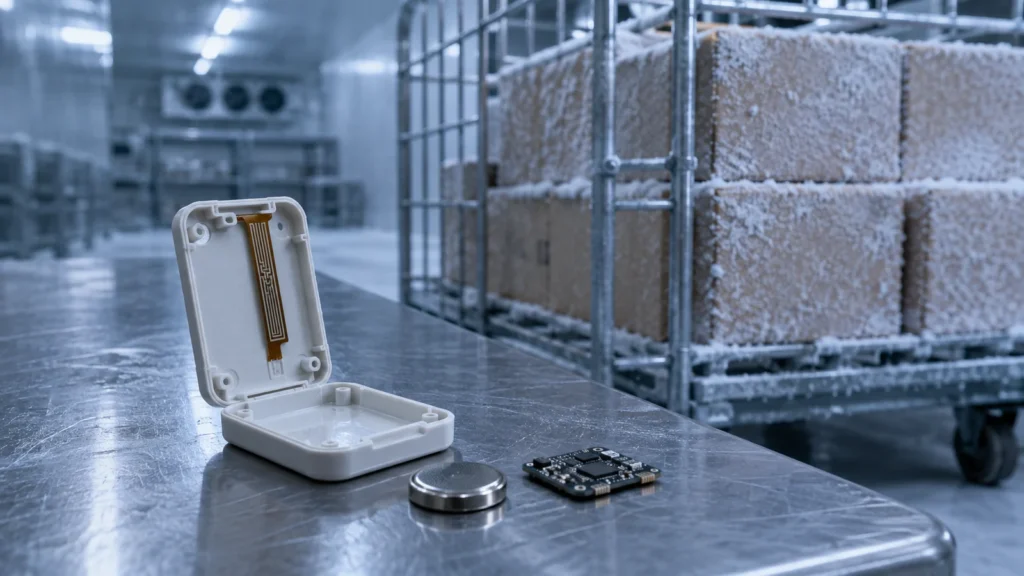
Asset and cold chain application
LoRaWAN Antennas for Asset and Cold Chain Trackers
This page is about the communication antenna, not the positioning one. A LoRaWAN tracker needs an 868 or 915 MHz antenna that fits a sealed enclosure, survives the temperature the cargo is held at, and still works when it is buried in a metal roll cage.
Use this guide to
- Separate the LoRa link from GNSS positioning.
- Choose an internal antenna that survives -40 °C.
- Plan placement inside a small sealed tracker.
- Prepare the enclosure details we need to quote.
Quick answer
For a compact tracker that has to work down to -40 °C, use GL8682 (863-928 MHz, 2.15 dBi, UFL, 3M adhesive FPC, -40 to +85 °C) or GL-DY107 (868 MHz, 2.5 dBi, UFL, adhesive patch, -40 to +85 °C). Both cover the cold end that a frozen or deep-frozen chain actually reaches.
Do not default to GL-DYG086-868 for cold chain. It is a good thin internal antenna at 37 x 7 x 0.8 mm, but its published operating range is -30 to +60 °C. In an ambient or chilled application that is fine. In a -40 °C freezer or a deep-frozen air shipment it is outside its rating, and that is exactly the kind of detail that turns into a field failure three months after launch.
LoRa is the link, GNSS is the position
Asset trackers routinely carry both, and the two antennas have almost nothing in common. The LoRaWAN antenna is a sub-GHz, linearly polarised part that needs to reach a gateway. The GNSS antenna is a 1.5 GHz right-hand circularly polarised part that needs to see the sky. They have different keep-out requirements, different placement rules and different failure modes.
Design them separately, then check the coexistence. Keep the two antennas apart inside the housing, and do not let the LoRa transmission desensitise the GNSS receiver. For the positioning side, use GPS and GNSS antennas for asset and fleet tracking, which covers patch size, ground plane and the IP67 boundary in detail.
Temperature is the specification that bites
Cold chain covers a wide span. Chilled pharmaceutical shipments sit around +2 to +8 °C. Frozen food runs to -18 °C. Deep-frozen and some clinical shipments go to -40 °C or below with dry ice. An antenna that is fine in the first two cases can be out of specification in the third.
| Model | Frequency | Gain | Format and connector | Size | Temperature |
|---|---|---|---|---|---|
| GL8682 | 863-928 MHz | 2.15 dBi | Flexible FPC/PCB, UFL, 3M adhesive | Thin flexible | -40 to +85 °C |
| GL-DY107 | 868 MHz | 2.5 dBi | Internal patch, UFL, 3M adhesive, VSWR <1.5 | Compact patch | -40 to +85 °C |
| GLG4101 | 868 MHz | 3 dBi | IPEX or other, RG178 / RF1.37 or other cable | Per assembly | -40 to +85 °C |
| GL-DYG086-868 | 868 MHz | Not published | Thin flexible, UFL, RG1.13 / RG1.37 | 37 x 7 x 0.8 mm | -30 to +60 °C |
| GL-DY403-868 | 868 MHz | 2.5 dBi | External SMA male stub | Ø8 x 51.5 mm | -40 to +85 °C |
| GLEM-915-3 | 902-928 MHz | 3 dBi | External, right-angle TNC male | 200 mm, ABS | -40 to +60 °C |
The gain column on GL-DYG086-868 is blank on its product record, so we do not quote a figure for it. Cold also affects the adhesive, not just the antenna: a 3M backing applied at room temperature onto a surface that will spend its life at -25 °C needs to be qualified, and that is a bonding question for your assembly process.
The tracker is usually not the hard part. The cargo is.
A LoRaWAN tracker attached to a pallet is rarely in free space. It ends up inside a metal roll cage, under stacked cases, against a refrigeration unit, or in the middle of a container of dense goods. The link that worked on the bench is a different link once the trailer is loaded.
Things that help, and they are mostly mechanical:
- Mount the tracker on the outward-facing surface, high on the pallet or cage rather than in the middle.
- Keep the antenna on the wall of the enclosure that faces away from the load, with the battery and PCB behind it.
- Avoid mounting flat against sheet metal. Even a few millimetres of standoff changes the result.
- Test with the pallet loaded, at temperature, not with an empty demo unit.
Condensation is the other quiet failure. A tracker cycling between a -20 °C store and a +25 °C loading bay will see moisture inside the housing unless the enclosure is properly sealed or vented. That is an enclosure design item; none of the antennas above carries a published ingress rating of its own.
Internal or external?
Internal, adhesive
The normal choice. Nothing protrudes to be snapped off in handling, and the enclosure stays sealed. GL8682 or GL-DY107, placed on the outward wall with a defined keep-out.
Cabled internal
GLG4101 when the radio module cannot sit near the best antenna position. Record the cable type, length and exit direction; there is no single standard length across orders.
External stub
GL-DY403-868 or GLEM-915-3 where a reusable asset tag can carry a short whip and the extra margin is worth the mechanical risk.
What to send us
- LoRa module and the exact band it is certified for, by shipping region
- The real temperature profile, including the coldest sustained condition
- Enclosure drawing, material, wall thickness and available antenna area
- Whether the device also carries GNSS, cellular or BLE, and where those antennas sit
- Connector on the module, plus cable type, length and exit direction
- How the tracker attaches to the asset, and what the asset is made of
- Sealing requirement and any condensation or washdown exposure
- Quantity, and the drawings, samples or test records you need
Related pages
Browse the LoRa and LoRaWAN antenna range or the embedded antenna formats. The gateway side is covered by outdoor LoRa gateway antennas, and link problems by the LoRa gateway range troubleshooting guide. For a band, cable or connector outside the standard range, see custom LoRa antennas.
Ask for a tracker antenna review
Send the enclosure drawing, the band and the coldest temperature the device has to survive. We will shortlist from the models above and say plainly what still needs testing on your hardware.
