
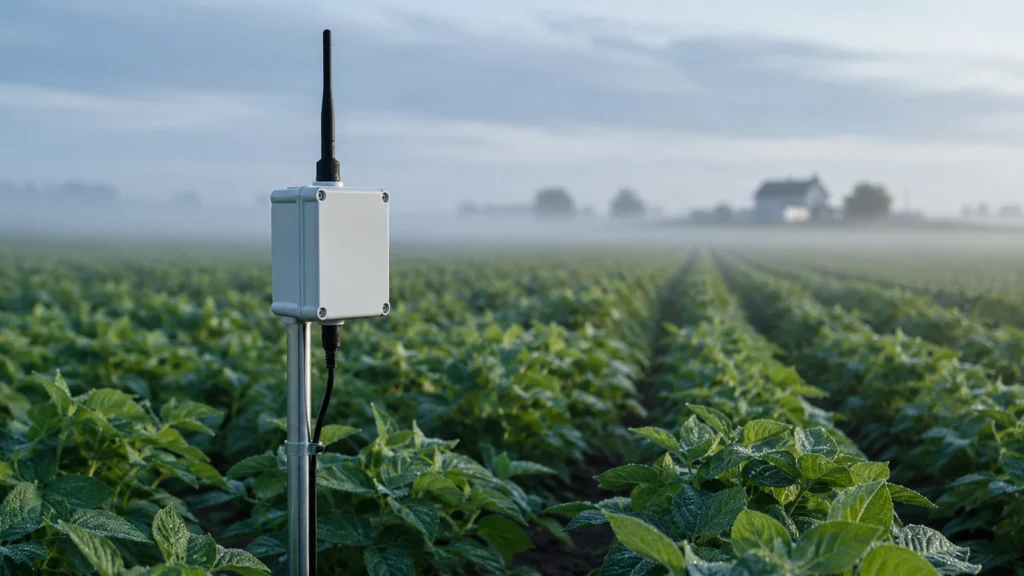
Smart agriculture application
LoRa Antennas for Smart Agriculture and Field Sensors
Farm sensors break the usual LoRa assumptions. The node sits low, wet crops absorb signal, and the gateway is often several fields away. This guide covers 915 MHz and 868 MHz antenna selection for soil moisture probes, weather and irrigation nodes, and livestock trackers.
Use this guide to
- Pick the right regional band before anything else.
- Decide between an external whip and an internal flexible antenna.
- Understand why a low-mounted node loses range and what actually helps.
- Prepare the enclosure and mounting details we need to quote.
Quick answer
For a North American farm deployment on 902-928 MHz, start with an external whip: GLEM-915-3 (3 dBi, right-angle TNC male) or GL491-TNC (3 dBi, screw mount) for a node with a fixed housing, or GL86803 (863-928 MHz, 3 dBi, SMA male) if you want one part number that also works on EU868. For a small on-animal or in-probe device where nothing can stick out, GL8682 is the adhesive FPC option covering 863-928 MHz.
What decides it is not gain. It is the regional band, how high the antenna sits above the crop, and whether the enclosure lets you put the antenna outside at all.
Start with the region, not the sensor
LoRa runs on different unlicensed bands by region, and an antenna cut for one is not a drop-in for the other. North America uses 902-928 MHz. Europe uses 863-870 MHz. If you ship the same sensor to both, you either stock two antennas or you pick one with enough bandwidth to cover both.
| Deployment | Model | Frequency | Gain | Connector and mount | Temperature |
|---|---|---|---|---|---|
| US915 field node | GLEM-915-3 | 902-928 MHz | 3 dBi | Right-angle TNC male, 200 mm, ABS | -40 to +60 °C |
| US915, screw-mounted housing | GL491-TNC | 902-915 MHz | 3 dBi | TNC male, screw mount, Ø15 x 200 mm | -40 to +85 °C |
| US915, wider band | GL490-TNC | 902-928 MHz | 2 dBi | TNC male, 200 mm | -40 to +65 °C |
| One part for US915 and EU868 | GL86803 | 863-928 MHz | 3 dBi | SMA male, 14.5 x 220 mm | -40 to +85 °C |
| EU868 field node | GLR01 | 868 MHz | 3 dBi | SMA male, Ø8 x 170 mm | -40 to +85 °C |
| Inside a small sealed node | GL8682 | 863-928 MHz | 2.15 dBi | UFL, 3M adhesive FPC | -40 to +85 °C |
Note the temperature column. A sensor sitting in an open field in Arizona or Alberta sees more than the air temperature, because a dark enclosure in full sun runs well above ambient. GLEM-915-3 is rated to +60 °C and GL490-TNC to +65 °C, while GL491-TNC and GL86803 go to +85 °C. That difference matters more in agriculture than in most indoor applications.
Soil moisture probes and ground-level nodes
A soil moisture node is the hardest LoRa case on a farm. The antenna ends up a few tens of centimetres above wet ground, and both soil and standing crop absorb energy at 868 and 915 MHz. Vegetation loss is not constant either: the same field is a different RF environment in April and in August, and again after irrigation.
Three things help, roughly in order of how much they buy you:
- Height. Getting the antenna above the canopy is worth more than any gain upgrade. If the node body must stay low, mount the antenna on a short mast and run coax down to it.
- A clear vertical whip. Keep it vertical and away from the metal probe body and any solar panel bracket. GL491-TNC or GLEM-915-3 on a screw or panel mount is the usual answer.
- Gateway placement. Most farm range problems are gateway problems. See the LoRa gateway range troubleshooting guide before you change the node antenna.
We are not going to quote a range figure for your field. Distance depends on terrain, crop stage, gateway height and duty cycle, and any number we gave you would be a guess dressed up as a specification.
Livestock trackers
An on-animal device changes the problem completely. The antenna is small, it sits against a body that is mostly water, and it moves and changes orientation constantly. Water absorbs strongly at these frequencies, so a collar antenna facing inward loses a large part of its budget before it reaches the air.
What we can supply is the antenna: GL8682 as an adhesive FPC inside the collar housing, or GL-DY403-868 (868 MHz, 2.5 dBi, SMA male, Ø8 x 51.5 mm) where a short external stub is acceptable. What we cannot do from a datasheet is tell you how it performs on a cow. That takes a sample on your real housing, worn in the real position, which we would rather schedule than promise.
Practical points for the mechanical design: keep the antenna on the outward-facing wall, keep the battery and any metal buckle out of the keep-out area, and fix the cable so the connector is not taking the strain when the animal moves.
External whip or internal antenna?
Use an external whip when
The enclosure is metal, the node sits low, or range is already marginal. An external antenna on a connector is almost always the better link, and it is easy to replace in the field without opening the housing.
Use an internal FPC when
The device must stay sealed and small, nothing can protrude, or the product is worn or buried. Expect to give up some margin and to validate on the real enclosure.
Watch the sealing boundary
None of the models above publishes an IP rating, so a connector coming through the enclosure wall is a sealing item you design and test. Ask us for the specific datasheet if your tender needs a stated figure.
What to send us
- Target country and the exact LoRa band the radio is certified for
- Sensor type: soil probe, weather node, irrigation controller, livestock tracker, other
- Enclosure drawing, material, and how high the antenna sits above ground or canopy
- Internal or external placement, and the connector on the radio module
- Cable type and length if the antenna moves away from the board
- Real operating temperature range, including sun load on the housing
- Whether the device is fixed, vehicle-mounted or worn
- Quantity, and any drawings, samples or test records you need
Related pages
Browse the full LoRa and LoRaWAN antenna range, or the outdoor LoRa gateway antennas that serve the other end of the link. For a sensor that also needs positioning rather than only LoRa communication, see GPS and GNSS antennas for asset and fleet tracking. Need a band, cable or connector we do not stock as standard? Start at custom LoRa antennas.
Ask for an agricultural LoRa antenna review
Send the band, the enclosure drawing and the mounting height. We will shortlist from the models above and tell you plainly which parts of the link we cannot predict from paper.
